A Year After the Fire: Rebuilding LA County Water Infrastructure
Key Highlights
- The 2025 wildfires destroyed over 16,000 buildings and caused significant damage to LA County's water infrastructure
- Many hydrants and piping systems are obsolete, requiring complete replacement and modernization to meet current fire safety standards
- The Water Demand Calculator helps accurately size piping, reducing costs and increasing efficiency in rebuilding efforts, with California adopting this tool in 2024
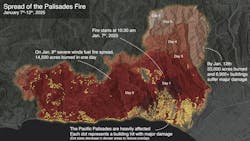
Thirty-two lives lost. More than 180,000 people left their homes. More than 16,000 buildings were destroyed, with about $65 million in damage.
The wildfires that consumed large parts of Los Angeles County in January 2025 destroyed 62 square miles of the county's 4,083 square miles. The Pacific Palisades and Eaton areas were the most affected.
“Despite California experiencing record water reserves in the State Water Project, the city’s aging water delivery system proved inadequate for the extreme demands of the blaze,” reports Archyde.com (bit.ly/3YCzD6Y).
The county’s pump-and-storage system was not designed to handle catastrophic fires, only a few home fires, notes the New York Times.
“The issue [was] … the limitations of a pump-and-storage system designed for a bygone era,” Archyde.com notes. “This system, unable to cope with the scale and rapid intensity of the fire, highlighted the urgent need for modernization. … A staggering 24% of hydrants within the fire perimeter were outdated ‘red-top’ models dating back to the 1940s. These obsolete hydrants, featuring single 2.5-inch outlets, lacked the capacity and connectivity of modern counterparts. The American Water Works Association no longer considers them suitable for standard fire protection.”
Despite Gov. Gavin Newsom signing an executive order suspending “unnecessary permitting and review requirements” to accelerate the rebuilding, the process has been slow and frustrating for everyone.
On the anniversary of these devastating fires, we talk with Christoph Lohr, PE, IAPMO’s vice president of technical services and research, about water systems and fire codes.
CONTRACTOR: The LA wildfires destroyed so much. What was the impact of the fires on the LA County water system?

Christoph Lohr: There was damage to a lot of the piping systems out there, so they are having to start from scratch. For any undamaged pipe, there are flushing protocols, especially if that water's been sitting in piping, as stagnancy can cause issues in water systems for prolonged periods, such as Legionella.
The affected areas need to update their water systems. Much of the piping is no longer usable due to damage; total replacement of those systems is necessary. That includes everything from water mains and water meters to the piping in homes or apartment complexes. Homeowners and business owners who want to rebuild need to right-size some of that piping; using IAPMO’s Water Demand Calculator may help them.
CONTRACTOR: Tell us more about the Water Demand Calculator. How will it help the county reconstruct its water infrastructure?
Lohr: IAPMO developed it in conjunction with the University of Cincinnati and the American Society of Plumbing Engineers in 2017, along with the release of the water efficiency and sanitation standard, WE•Stand.
In many cases, it leads to much smaller piping, but that piping is much more accurately sized. Instead of a safety factor of up to 27 times, you might have a safety factor of more like two times the peak flow rate. We're sizing the piping much more accurately, but we still add a bit of a safety factor.
Let's say an apartment building with 100 units needs a 4-inch pipe. Using the calculator, you might be able to get away with 2-inch or maybe even 1 -1/2-inch pipe, depending on the available water pressure. So, it helps to make everything much more affordable.
In 2024, California adopted the Water Demand Calculator. These kinds of savings are now available to places like LA County and others that have been impacted by wildfires.
CONTRACTOR: What about the codes?
Lohr: I believe California is starting to adopt the latest version of the California plumbing code, but the National Fire Protection Association (NFPA) has codes specifically for fire protection, such as NFPA 13, the standard for sprinkler system installation, and NFPA 17, for dry chemical extinguishing systems.
In the Uniform Plumbing Code, in addition to Chapter 6, which addresses residential fire sprinkler systems, there's also Appendix F, which addresses firefighter breathing air replenishment systems (FBAS).
In Phoenix, there's a local ordinance that requires FBAS on any building over 75 feet tall. The idea behind it stems from the 9/11 Twin Towers attack. When these firefighters have to go up into high-rise buildings, they can run out of air on the scuba systems. The FBAS systems are hard-piped with stainless steel into the stairwells. A fire truck with an air compressor pulls up next to it and pumps fresh air into the piping. Firefighters can go to a safe place and replenish their air without having to go down multiple flights of stairs.
There aren’t many high-rise occupant systems installed, but especially in some of these wild areas, an FBA system can become part of the code or an ordinance. However, it doesn't have to be a high-rise. If a home is up a steep embankment or you have a larger building with some inaccessible areas, it's a great way to build in some safety for people fighting the fires.
We must ensure that places prone to wildfires have the latest code versions, which give them the best tools to address these challenges as they come up.
About the Author
 Kelly L. Faloon
Kelly L. Faloon
Freelance Writer/Editor
Kelly L. Faloon is a contributing editor and writer to CONTRACTOR, Contracting Business magazine and HPAC Engineering and principal of Faloon Editorial Services. The former editor of Plumbing & Mechanical magazine, Faloon has more than 26 years of experience in the plumbing and heating industry and more than 35 years in B2B publishing. She started a freelance writing and editing business in 2017, where she has a varied clientele.
Faloon spent 3 1/2 years at Supply House Times before joining the Plumbing & Mechanical staff in 2001. Previously, she spent nearly 10 years at CCH/Wolters Kluwer, a publishing firm specializing in business and tax law, where she wore many hats — proofreader, writer/editor for a daily tax publication, and Internal Revenue Code editor.
A native of Michigan’s northern Lower Peninsula, Faloon is a journalism graduate of Michigan State University. You can reach her at [email protected].