Key Highlights
- Construction growth in 2025 is slowing overall, but data center, healthcare, and energy projects are experiencing significant expansion
- Residential construction is declining, with single-family starts down 7%, though multifamily units saw a modest rebound, indicating shifting housing preferences.
- Infrastructure spending remains strong in areas like sewage and waste disposal, despite a slowdown in other nonresidential sectors, driven by aging systems and technological upgrades
- Rising material costs and tariffs are increasing construction expenses, while interest rate cuts are helping to improve mortgage affordability and stimulate housing activity.

Let’s be clear about one thing: there’s no such thing as a crystal ball. Any forecast is only looking at the best available current data and extrapolating where things might probably be heading.
The US economy in 2025 was a mixed bag of good news and bad, with 2026 looking to be more of the same. Our best guess for the coming year: continued growth at a slower pace for the overall construction industry, but with higher growth potential for those working in data center construction, energy production & distribution, healthcare and remodeling.
Let’s take a deeper look at the numbers.
Construction
According to Deloitte’s Engineering and Construction Industry Outlook (published this November—www.deloitte.com), real value added in construction and engineering climbed to US $890 billion in the second quarter—a 1% increase year-over-year—while real gross output reached US $1.732 trillion, reflecting a 0.6% fall. By July, total construction spending declined almost 3% year-over-year, primarily driven by downturns in commercial (–8.2%) and manufacturing (–7%) construction.
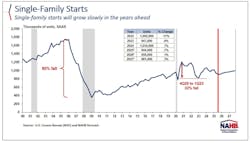
On the residential construction side, the National Association of Home Builders now projects 944,000 single family starts in 2025. That’s down 7% from 2024. Looking ahead, NAHB anticipates slow growth over the next two years, with a 1% increase in starts in 2026 followed by a 3% increase in starts 2027.
After two slow years in 2023 and 2024, the multifamily sector saw a modest rebound in 2025 with 410,000 units built, a 16% increase over 2024. But that was still 136,000 fewer units than were built in the boom of 2022. NAHB predicts mild declines in multifamily of 3% in 2026 and 2% in 2025.
From August 2024 to August 2025, nonresidential construction saw a 1.5% decline. Adjusted for inflation, that represents an almost 5% decline. However, infrastructure projects are still paying some dividends: sewage and waste disposal projects, for example, were up 8.2%. “We are seeing the final stages of the post pandemic infrastructure spending boom,” said Anirban Basu, Chief Economist for ABC, in a recent webinar.
The bright spot on the nonresidential side is, of course, data center construction. ConstructConnect reported that total data center construction starts reached $14.0 billion in July 2025, representing a substantial year-over-year increase from July 2024’s total of $682.0 million. This record-breaking figure nearly doubled the previous high of $7.4 billion set in August 2024.
On a not seasonally adjusted basis, construction unemployment stood at 3.8% in September, up 0.1 percentage points from September 2024, according to the most recent report from the Bureau of Labor Statistics. All states posted construction unemployment rates below 10%, and just over half of states (26) recorded lower rates compared to a year earlier. This compares to a 4.4% unemployment rate for the US population as a whole.
One key leading indicator for construction projects is the Architectural Billings Index (ABI), the gauge of how much work architects are seeing. The ABI score for November (the most recent available) remained well below the 50 level at 45.3 (a score over 50 indicates billings growth). This marked the 13th consecutive month of declining billings at architecture firms, and the 35th month of a score below 50 out of the last 38.

However, billings were seen to vary by region. “The Midwest remained a bright spot in November,” according to the American Institute of Architecture website. “Billings increased at firms located in that region for the third consecutive month, and more firms reported growth this month than last month.”
Yet another key indicator is the Associated Builders and Contractors Construction Backlog Indicator. In November, backlog declined to 8.1 months, based on an ABC member survey conducted from Nov. 20 to Dec. 8. That November reading reflects a 0.3-month decrease compared to both October 2025 and November 2024, signaling a modest pullback in work under contract. (See our story on pg. 1.)
Despite mixed movement, all three components of ABC’s Construction Confidence Index (sales, profit margins and staffing) remained above 50, the threshold that signals expectations for growth over the next six months.
Interest Rates and Inflation
The push-pull of the US economy, interest rates affect the price of money—so, borrowing and credit—while inflation affects the price of everything (with some prices rising more rapidly and others, such as labor, following more slowly).
Inflation proved stubbornly high in 2025, hovering at around 3% for the core Consumer Price Index and Personal Consumption Expenditures. Over the last five years, construction materials prices are up 43.3%. Iron and steel are up 52.0%, with plumbing fixtures and fittings up 26.6%.
Given the Federal Reserve’s mandate to keep inflation at 2%, one would think rate cuts would be off the table. Instead, the Fed has been cutting interest rates in the face of rising—although still historically low—unemployment. The Federal Fund Reserve Board cut rates ¼ of a basis point in September, October, and once more in December. The federal fund rate now stands between 3.50% and 3.75%.
Those rate cuts are having an impact on mortgage rates. The average mortgage rate in November continued to trend down to its lowest level in over a year. According to Freddie Mac, the 30-year fixed-rate mortgage averaged 6.24% in November, two basis points lower than in October, and is 57 basis points lower year-over-year. Mortgage application activity continues to strengthen, with existing home sales rising to an eight-month high in October.
Back on the construction side, construction input prices rose 0.2% in September 2025, according to the most recent Producer Price Index data from the US Bureau of Labor Statistics. Prices for nonresidential construction inputs also increased 0.2% for the month. Total construction input prices were 3.5% higher than a year ago, while nonresidential inputs were up 3.8% compared to September 2024.
Administration Policy
The Trump Administration has made tariffs a central part of its trade policy. On April 2, President Trump unveiled an array of new tariffs, including a 10 percent minimum tariff on all imported goods and higher "reciprocal" tariff rates for over 80 countries. On April 9, he paused the implementation of many of these levies. On July 31, the administration finalized adjustments to reciprocal rates for over 100 trading partners.
These and other policies have brought the average tariff rate to 17.0 percent. If all announced policies take effect, the average tariff rate on all imported goods will be 21.0 percent.
There are currently legal challenges to the emergency powers the administration is using to justify these tariffs, and it is very possible the Supreme Court may rule them illegal. However, the administration has other legal justifications it could turn to, meaning tariffs in some form are likely here to stay.
The aim of the tariffs is twofold: to bolster American-based manufacturing, and to generate revenue for the federal government.
As to that first aim, free trade policies in place for decades have allowed US-based manufacturers to shop the globe for the lowest-priced labor. Reversing that trend is probably more than any one administration could hope to achieve—and the latest manufacturing construction numbers do not show much momentum in that direction.
As to that second aim, generating revenue, as of mid-December 2025, the United States Customs and Border Protection (CBP) has collected over $200 billion in tariffs resulting from new duties imposed since the beginning of 2025. It should be noted that tariffs are paid by American companies, and it remains to be seen what use those revenues will be put to.
Another hallmark of the Trump Administration has been immigration enforcement. According a workforce survey conducted in August of 2025 by the Associated General Contractors of America (AGC) and the National Center for Construction Education and Research (NCCER), construction workforce shortages are the leading cause of project delays, and new immigration enforcement efforts have impacted nearly one-third of construction firms.
Putting aside the underlying reasons behind these policies, economists agree they are both inflationary, with tariffs raising the price of materials, and immigration policy raising the price of labor.
Unknowns
Again, the recent economy has been a mixed bag.
On the residential side, despite an affordable housing shortage, new home construction has been flat. Possible bright spots are in multifamily (as families priced out of homeownership opt for apartment living), high-end homes (as wealthier families, bolstered by a rising stock market feel free to spend) and in remodeling (as families staying put look to rehab their existing homes).
On the nonresidential side, huge amounts of money are already committed to data center projects. Those data centers will in turn demand energy from new power facilities.
On the municipal side, even as federal infrastructure investment begins to decline, more states and cities will be forced to invest in their water and wastewater systems as those systems age, and as new monitoring and metering technology demonstrates huge potential savings in water and energy.
Lastly, healthcare construction has been booming in 2025 with no end in sight, driven by an aging population and a shift to outpatient, ambulatory care.
As always, there are potential problems we have no way of predicting. A new political or military conflict in the Middle East, Eastern Europe or Aisa could rattle markets or impact supply chains. A new pandemic could easily do the same. Artificial intelligence is rapidly reshaping entire industries—there is simply no way to predict what its long-term effect on the American economy will be.
One thing is certain: people will always need clean running water, meaning the people who build and maintain the systems that deliver it will always have work to do.
About the Author
Steve Spaulding
Editor-in-Chief - CONTRACTOR
Steve Spaulding is Editor-in-Chief for CONTRACTOR Magazine. He has been with the magazine since 1996, and has contributed to Radiant Living, NATE Magazine, and other Endeavor Media properties. You can find him on LinkedIn at www.linkedin.com/in/stevespaulding.