Construction Unemployment Holds Below 4% Nationwide as Hiring Gains Continue to Slow
Key Highlights
-
Construction unemployment remained below 4% nationally and under 10% in every state, reinforcing ongoing labor shortages
-
Employment levels remain strong, but year-over-year hiring gains are clearly slowing after years of rapid growth
-
Contractors continue to face pressure from labor availability, material costs and insurance, even as interest rates show signs of easing.

WASHINGTON, DC — The national construction unemployment rate remained historically low in September 2025, underscoring ongoing workforce tightness across the industry, according to a state-by-state analysis of US Bureau of Labor Statistics data released by Associated Builders and Contractors.
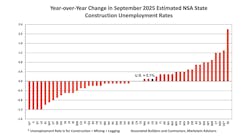
On a not seasonally adjusted basis, construction unemployment stood at 3.8% in September, up 0.1 percentage points from September 2024. All states posted construction unemployment rates below 10%, and just over half of states (26) recorded lower rates compared to a year earlier. Twenty-one states saw higher rates, while Alaska, California and Texas were unchanged.
Following the conclusion of the 43-day government shutdown—the longest on record—federal agencies have resumed releasing economic data. However, no October labor data will be available, as the shutdown prevented the BLS from collecting the necessary information.
Employment Levels Remain Elevated, but Hiring Momentum Is Slowing
National not seasonally adjusted payroll construction employment increased by 33,000 jobs compared to September 2024. On a seasonally adjusted basis, construction employment reached 8.3 million, marking a level 9.1% above the industry’s pre-pandemic peak of 7.6 million.
Despite these gains, year-over-year employment growth is decelerating. September marked the third consecutive month in which annual job growth came in below 100,000, following more than four years of six-digit increases.
States With the Lowest Construction Unemployment
The six states with the lowest estimated not seasonally adjusted construction unemployment rates in September were:
-
Oklahoma: 1.4%
-
Hawaii: 1.7%
-
New Hampshire: 2.0%
-
Georgia: 2.2%
-
Indiana: 2.2%
-
Tennessee: 2.2%
Oklahoma, Hawaii and Indiana each posted their lowest September construction unemployment rates on record. Hawaii also recorded one of the largest year-over-year declines, down 1.2 percentage points, along with Illinois, Kentucky and Louisiana. Tennessee posted its second-lowest September rate on record, trailing only the 2.1% levels seen in 2021 and 2022.
Note: Hawaii’s rate includes construction plus mining and logging.
States With the Highest Construction Unemployment
The five states with the highest estimated construction unemployment rates in September were:
-
Minnesota: 5.9%
-
Montana: 5.9%
-
Connecticut: 6.7%
-
Rhode Island: 7.5%
-
New Jersey: 9.4%
Rhode Island recorded its lowest September rate since 2021.
Comparison to Pre-Pandemic Labor Conditions
Construction unemployment rates were lower than pre-pandemic levels in just over 40% of states. As of September 2025, 21 states reported lower construction unemployment compared to September 2019, while 27 states were higher and two—Arkansas and Washington—were unchanged.
“Higher building materials costs due to tariffs, higher insurance costs and rising labor costs along with a shortage of skilled construction workers are weighing upon the construction industry,” said Bernard Markstein, President and Chief Economist of Markstein Advisors, who conducted the analysis for ABC. “On the positive side, a somewhat easier policy stance by the Federal Reserve has resulted in lower interest rates. Further declines in interest rates are likely in 2026.”
Month-to-Month Changes Signal Seasonal Pressure
From August to September, the national not seasonally adjusted construction unemployment rate rose by 0.6 percentage points. Only Iowa and Utah recorded lower rates month over month, while 46 states posted increases. Hawaii and Ohio reported no change.
To better understand the basis for calculating unemployment rates and what they measure, check out the Background on State Construction Unemployment Rates at www.abc.org/News-Media/News-Releases.