Construction Jobs Dip in December as Nonresidential Sectors Lose Ground
Key Highlights
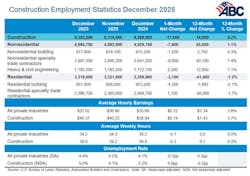
- Construction employment fell by 11,000 jobs in December, with nonresidential sectors most affected
- Heavy and civil engineering sectors added 2,300 jobs, offsetting some losses in other areas
- The industry’s unemployment rate remained steady at 5.0%, despite job declines, due to workforce dynamics
- 2025 saw the worst construction job growth since 2011, with only 14,000 net new jobs added

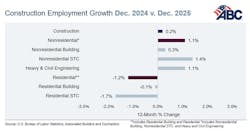
WASHINGTON, DC — Construction employment declined modestly in December, shedding 11,000 jobs on net, according to an Associated Builders and Contractors analysis of newly released data from the US Bureau of Labor Statistics. Despite the monthly pullback, industry employment remains slightly higher than a year ago, up 14,000 jobs, or 0.2%.
Nonresidential construction accounted for most of the losses, with employment down 7,800 positions. Heavy and civil engineering was the lone bright spot, adding 2,300 jobs, while nonresidential specialty trade contractors and nonresidential building construction shed 8,900 and 1,200 jobs, respectively.
The construction unemployment rate held at 5.0% in December. Across all industries, unemployment declined to 4.4%, though it remains 0.3 percentage points higher than this time last year.
Tough Start to the Year
“The construction industry added just 14,000 net new jobs in 2025,” said ABC Chief Economist Anirban Basu. “Excluding the first year of the COVID-19 pandemic, that’s the worst 12-month performance since 2011, when the construction industry was still spiraling from the Great Recession. While the nonresidential side of the industry performed significantly better over the past year, even that segment’s momentum has started to wane. Nonresidential specialty trade contractors, demand for which led the industry in 2025, posted its worst month in nearly four years, losing 8,900 jobs in December.
“Despite this dismal performance, the industry’s unemployment rate remains relatively low, down 0.2 percentage points from the same time last year,” said Basu. “This unusual dynamic—decreasing employment but a steady unemployment rate—likely reflects the effects of immigration policy on the industry’s workforce. As a result, average hourly earnings for production and nonsupervisory construction workers were up 4.5% on a year-over-year basis in both November and December, a sharp increase from the 3.9% increase observed in October.
'While contractors remain optimistic about hiring over the next six months, according to ABC’s Construction Confidence Index, recent declines in backlog, ongoing declines in construction spending and December’s job losses suggest it could be a difficult start to 2026 for the industry.”
Visit abc.org/economics for the Construction Backlog Indicator and Construction Confidence Index, plus analysis of spending, employment, job openings and the Producer Price Index.