Skilled Trades Shortage Puts $325 Billion a Year in Economic Output at Risk
Key Highlights
-
Contractor relevance: Quantifies how labor shortages directly threaten project timelines, system installs and service capacity
-
Local angle: Includes state-by-state and regional breakdowns editors can localize
-
Economic stakes: Ties workforce gaps to GDP, tax revenue and infrastructure reliability, not just hiring challenges

PORTSMOUTH, NH — Bring Back the Trades Inc., in collaboration with F.W. Webb Company, has released a comprehensive economic impact report detailing the growing skilled trades shortage across every state in the US—and the escalating cost of inaction for contractors, building owners and the broader economy.
Workforce Gap Puts Billions in Output at Risk
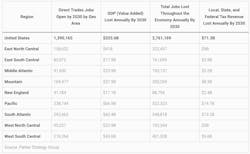
According to the analysis, the skilled trades workforce gap could leave an estimated 1.4 million positions unfilled across just seven core trades by 2030. Those trades—electricians, mechanics, plumbers, welders, construction workers, HVAC technicians and carpenters—are foundational to building, maintaining and operating US infrastructure.
The projected shortfall carries a steep economic price tag. Nationally, the workforce gap equates to an estimated $325.6 billion in lost gross domestic product each year, along with approximately $71.3 billion in lost federal, state and local tax revenue.
Core Trades Drive $1.3 Trillion in Annual Impact
Today, the seven trades analyzed account for roughly 5.6 million jobs nationwide. Combined, they generate an estimated $1.3 trillion in annual economic impact, underscoring how deeply skilled labor availability affects project delivery, system reliability and long-term economic growth.
The report provides both national findings and a detailed state-by-state and regional analysis, highlighting how workforce challenges vary across the country. While shortages affect every market, certain regions face sharper pressure due to an aging workforce, increased construction demand and a limited pipeline of new skilled workers entering the trades.
“This isn’t just a report—it’s a call to action,” said Steve Turner, Founder and CEO of Bring Back the Trades. “The shortage in the skilled trades impacts every sector of our economy. We must act now to fill the current need, and share solutions on how to empower the next generation of skilled workers.”

Industry-Backed Research Anchored in Real Data
The research was sponsored by F.W. Webb Company, a third-generation, family-owned distributor founded in 1866 with a long history of supporting plumbing, HVAC and mechanical trades professionals.
“F.W. Webb is proud to support this work because solving the skilled trades shortage requires real data and real collaboration,” said Sean Davis, Vice President of Marketing at F.W. Webb Company. “By quantifying the economic impact of the gap, this report gives leaders, educators, and employers the insight they need to take meaningful action. The stakes are high, and together we can ensure America has the skilled workforce it needs to thrive.”
Bring Back the Trades engaged Parker Strategy Group, a national consulting firm, to quantify the economic impact of the projected job deficit. The analysis incorporates jobs data compiled by the University of New Hampshire using Department of Labor sources and examines how workforce shortages create ripple effects across multiple industries.
Urgency Extends Beyond Hiring Needs
“Closing the skilled trades gap is not just about filling jobs—it’s about sustaining industries, strengthening communities, and creating opportunities for the next generation,” said Shana Brunye, Chief Operating Officer and Research Director at Bring Back the Trades. “Our national and regional analysis shows just how urgent this challenge is, and how much is at stake if we don’t act.”
“Across the United States, the shortage of electricians, welders, plumbers, and other skilled workers is more than a workforce issue—it’s an economic imperative,” said Nichole Parker, Managing Principal of Parker Strategy Group. “By analyzing the baseline and gap impact of these seven core trades, we’re equipping leaders with the evidence they need to start to reverse the trend and build a stronger future.”
Call to Action for the Trades Pipeline
Bring Back the Trades emphasized that addressing the workforce gap will require coordinated investment in training, education and career pathways.
“The time to act to address the issue is now,” said Turner. “We challenge students, families, educators, employers, and policymakers to recognize this economic imperative. We must mobilize now to invest in expanded training pathways and inspire the next generation to pursue these essential careers that keep America’s economy strong.”
Ongoing research supported by F.W. Webb Company will continue through 2027 to evaluate projected impacts across additional trade occupations.
“This foundational report, made possible by the generous support of F.W. Webb Company, is just the beginning of Bring Back the Trades’ commitment to data-driven advocacy,” said Brunye. “We are already beginning another round of comprehensive research to tackle additional trade roles to help increase visibility on the opportunities in the skilled workforce across the country today and into the future.”