Construction Adds 33,000 Jobs in January as Nonresidential Hiring Leads Gains
Key Highlights
-
Specialty trade contractors accounted for the vast majority of January’s hiring gains
-
Heavy and civil engineering posted a slight decline, contrasting with broader nonresidential strength
-
Construction unemployment remains notably higher than the overall US jobless rate, reinforcing workforce pressures

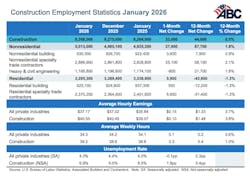
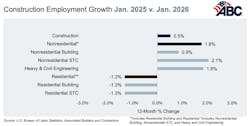
WASHINGTON, DC — The construction industry added 33,000 net new jobs in January, according to an Associated Builders and Contractors analysis of data released by the US Bureau of Labor Statistics. On a year-over-year basis, construction employment has increased by 44,000 positions, a 0.5% gain.
Nonresidential Hiring Drives January Gains
Nonresidential construction employment accounted for the bulk of January’s growth, expanding by 27,900 jobs across the sector’s major categories.
Specialty trade contractors led the way, adding 25,100 positions during the month. Nonresidential building contractors added another 3,600 jobs. Heavy and civil engineering was the lone soft spot, shedding 800 positions.
For mechanical, electrical and other specialty contractors, the data signals continued demand for skilled labor in active nonresidential project segments, even as infrastructure-related hiring showed signs of cooling.
Construction Unemployment Remains Elevated Compared to Economy-Wide Rate
The construction unemployment rate registered 6.9% in January.
Across all industries, unemployment declined to 4.3%, though that figure remains 0.3 percentage points higher than one year ago.
The gap between construction and overall unemployment rates underscores ongoing workforce challenges for contractors navigating hiring, retention and project backlogs in a competitive labor market.
Contractors Remain Confident
“The construction industry, much like the broader labor market, rebounded in January,” said ABC Chief Economist Anirban Basu. “While that’s a welcome development, the industry lost 1,000 jobs in 2025, the first calendar year decline since 2020 and 2010 before that. Much of the industry’s weakness is concentrated in the residential segment, where employment has declined by 43,600 jobs over the past year.
“Despite the lack of job growth in 2025, the industry’s unemployment rate is only modestly higher than one-year ago,” said Basu. “That dynamic at least partially stems from immigration enforcement and the downward pressure it has put on the industry’s labor supply. Neither last year’s weak employment growth nor current labor force dynamics have weighed on contractor confidence, with ABC members still upbeat about both their sales and staffing levels over the next six months, according to ABC’s Construction Confidence Index.”
Visit abc.org/economics for the Construction Backlog Indicator and Construction Confidence Index, plus analysis of spending, employment, job openings and the Producer Price Index.