Construction Labor Market Remains Under Pressure Despite Employment Growth
Key Highlights
- Construction unemployment increased in 44 states year over year
- National construction employment remains above pre-pandemic levels despite slower hiring growth
- Rising costs, labor shortages and project delays continue reshaping contractor hiring decisions
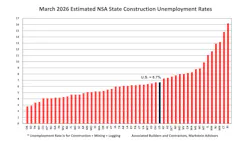
WASHINGTON, DC — Associated Builders and Contractors (ABC) released new state-by-state construction employment data showing the national non-seasonally adjusted construction unemployment rate reached 6.7% in March 2026, up 1.3 percentage points compared to March 2025. The analysis, based on data from the US Bureau of Labor Statistics, found that only two states posted lower construction unemployment rates year over year, while 44 states recorded increases.
Construction Hiring Continues, But Growth Is Slowing
National payroll construction employment remained higher than a year ago, adding 58,000 jobs compared to March 2025. However, the latest increase marked the 12th consecutive month of year-over-year gains below 100,000 jobs, suggesting hiring momentum may be moderating.
Seasonally adjusted payroll construction employment reached 8.3 million workers, remaining significantly above pre-pandemic levels and approximately 9.3% higher than the February 2020 peak of 7.6 million workers.
While employment remains elevated overall, state-level data points to a mixed labor environment. Estimated construction unemployment rates were below pre-pandemic levels in 20 states, while 31 states reported higher rates than March 2019.
Contractors Continue To Face Multiple Cost Pressures
“The Iran war and resulting hike in energy prices are negatively affecting the construction industry, which was already struggling with insurance premium increases, escalating labor costs, shortages of skilled labor and elevated interest rates,” said Bernard Markstein, President and Chief Economist of Markstein Advisors, who conducted the analysis for ABC. “Consequently, some projects have been scaled back, put on hold or abandoned altogether. With slower construction activity, demand for construction workers is growing more slowly.”
Contractors continue navigating multiple challenges simultaneously, including labor availability, financing costs and project affordability concerns. Slower project pipelines can affect hiring decisions and reduce labor demand even when broader employment levels remain historically strong.
Monthly Trends Show Mixed Results Across States
On a month-to-month basis, the national non-seasonally adjusted construction unemployment rate improved slightly, declining 0.2 percentage points from February.
State trends varied:
- 28 states posted lower unemployment rates
- 20 states recorded increases
- Kansas and Maine remained unchanged
Rhode Island recorded the largest monthly improvement, with its rate falling 3.4 percentage points from February, while Connecticut posted the third-largest decline at 2.7 percentage points.
States With The Lowest Construction Unemployment Rates
The lowest estimated March construction unemployment rates were reported in:
- Oklahoma: 2.8%
- South Dakota: 2.9%
- Tennessee: 3.4%
- New Hampshire: 3.5%
- Colorado, Hawaii and North Carolina: 4.1%
South Dakota posted its second-lowest March construction unemployment rate on record.
States Facing The Highest Construction Unemployment Rates
The highest estimated March construction unemployment rates were reported in:
- New Mexico: 11.7%
- New Jersey: 12.9%
- Minnesota: 13.2%
- Connecticut: 14.8%
- Rhode Island: 16.2%
The latest data illustrates how labor conditions continue to vary significantly across regional construction markets, with some states maintaining tight labor conditions while others are experiencing slower activity and softer workforce demand.
To learn more visit abc.org/economics.