Data Center Investments Boost Nonresidential Construction Despite Private Sector Decline
Key Highlights
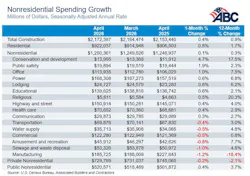
- Nonresidential construction spending reached $1.250 trillion on a seasonally adjusted annual basis in April
- Data centers, included in the office category, saw a 1.9% increase, contributing to a 28.1% rise over the past year
- Private nonresidential spending decreased by 0.2%, marking the seventh consecutive monthly decline

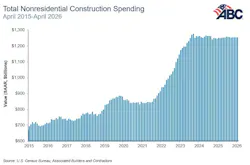
WASHINGTON, DC — Data published June 1 by the US Census Bureau shows National nonresidential construction spending increased 0.1% in April. On a seasonally adjusted annualized basis, nonresidential spending totaled $1.250 trillion.
Spending on data centers—which is included in the office category—increased another 1.9% in April, rising to a seasonally adjusted annual rate of $50.7 billion, and is up 28.1% over the past year.
Spending was up on a monthly basis in 10 of the 16 nonresidential subcategories. Private nonresidential spending was down 0.2%, while public nonresidential construction spending was up 0.4% in April.
“Nonresidential construction spending inched higher in April, but that growth was entirely due to a sizable increase in public sector activity,” said ABC Chief Economist Anirban Basu. “Private nonresidential construction spending fell for the seventh consecutive month and is down nearly 8% from December 2023’s all-time high.
"While much of the segment’s recent weakness is attributable to the rapid decline in CHIPS Act-incentivized manufacturing megaprojects, private sector construction momentum has been difficult to find outside of the still-ascendant data center segment.
“Those data center projects have buoyed the ABC Construction Backlog Indicator and kept ABC members confident about their outlooks, at least on the whole,” said Basu. “While that particular tailwind will persist for some time, rising materials prices and a lack of momentum in many commercial segments may eventually weigh on contractor sentiment.”
Visit abc.org/economics for the Construction Backlog Indicator and Construction Confidence Index, plus analysis of spending, employment, job openings and the Producer Price Index.