US Nonresidential Construction Spending Declines Amid Broader Market Challenges
Key Highlights
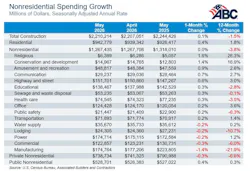
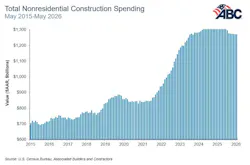
- Nonresidential construction spending fell 1.5% in May, totaling $1.267 trillion on an annualized basis
- Private nonresidential spending has declined for seven consecutive months, down 6.6% year-over-year, mainly due to manufacturing sector weakness
- Overall market momentum remains uneven, with some sectors showing growth while others face persistent declines.

WASHINGTON, DC — Construction spending data released July 1st by the US Census Bureau indicates nonresidential construction spending slid 1.5% in May, continuing a downward slide.
On a seasonally adjusted annualized basis, nonresidential spending totaled $1.267 trillion.
Private nonresidential spending was down 0.3%, while public nonresidential construction spending was up 0.4% in May. Spending was up on a monthly basis in 11 of the 16 nonresidential subcategories.
Numbers Tied the Decline in Manufacturing Construction
“Private nonresidential construction spending shrank for the seventh consecutive month in May and is now down 6.6% on a year-over-year basis,” said ABC Chief Economist Anirban Basu. “This weakness is largely due to the ongoing decline in manufacturing-related construction spending as CHIPS Act-supported projects wind down, yet overall there are few sources of momentum in the segment.
“Yes, the amusement and recreation category continues to grow at a healthy pace, and the religious category has rebounded meaningfully over the past year,” said Basu. “But those modestly sized segments are far too small to carry the broader nonresidential market, especially given the weakness in larger categories.
"For instance, warehouse construction spending, which appeared to stabilize at the start of 2026, has now fallen for three consecutive months and is down 8.5% year over year, while the general office category remains in a state of freefall, down 11.9% since May 2025.
“For now, momentum remains largely concentrated in the data center segment,” said Basu. “As seen in ABC’s most recent Construction Backlog Indicator release, those fortunate enough to have data center work have significantly longer backlogs (11.6 months) than those that do not (8.6 months).”
Visit abc.org/economics for the Construction Backlog Indicator and Construction Confidence Index, plus analysis of spending, employment, job openings and the Producer Price Index.