Construction Industry Gains Jobs Amid Softening US Labor Market
Key Highlights
- Construction industry added 22,000 jobs in July, with nonresidential sectors leading growth
- Overall employment decreased in July, marking the first decline since February, indicating emerging labor market weakness
- The construction unemployment rate remained low at 3.7%, reflecting strong sector demand despite broader economic softness

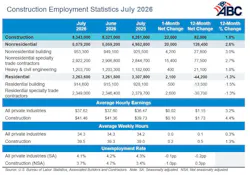
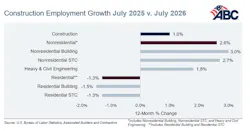
WASHINGTON, DC — The US Bureau of Labor Statistics released employment figures for the construction industry on August 7. Year-over-year, industry employment has increased by 82,000 jobs, or roughly 1.0%. The construction sector added 22,000 jobs on net in July.
The construction unemployment rate was 3.7% in July. Unemployment across all industries decreased to 4.1% and is 0.2 percentage points lower than one year ago. At the same time, the US labor force participation rate fell to 61.4% in July—the lowest level since early 2021.
Other key employment data from the release:
- Nonresidential construction employment grew by 20,000 positions, with gains in all three subcategories.
- Nonresidential specialty trade added the most jobs, increasing by 15,400 positions.
- Nonresidential building and heavy and civil engineering added 4,200 and 400 jobs, respectively, in July.
A Softening Labor Market and Lower Borrowing Costs
“Nonresidential construction employment continued to expand at a healthy pace in July as the data center investment boom fuels ongoing demand for specialty trade contractors,” said ABC Chief Economist Anirban Basu. “Given recent construction spending data and upbeat contractor sentiment, as measured by ABC’s Construction Confidence Index, this is not particularly surprising.
“Construction industry employment, however, is far from the most salient aspect of July’s jobs report,” said Basu. “Rather, the unexpected loss of economywide jobs in July—the first since February—and massive downward revisions to the prior two months of growth signal emerging labor market weakness. If this soft labor market persists, it will benefit the construction industry in the form of lower borrowing costs. Indeed, treasury yields fell sharply following the release of the July jobs numbers.”
Visit abc.org/economics for the Construction Backlog Indicator and Construction Confidence Index, plus analysis of spending, employment, job openings and the Producer Price Index.