PPI Addresses Long-Term Design Life of Plastic Geothermal Piping
Key Highlights
- 50-Plus-Year Projection: PPI conservatively projects more than 50 years of design life for properly specified and installed GHX plastic piping
- Material Selection: The statement examines HDPE, PEX and PE-RT and the properties that make them suitable for geothermal applications
- System-Specific Variables: Installation conditions, temperature swings and pressure cycling can influence the actual service life of GHX piping

IRVING, TX — The Plastics Pipe Institute, Inc. (PPI) has published a new technical document addressing the projected design life of plastic piping used in geothermal ground heat exchangers (GHX). PPI Statement AF, Projected Design Life of Plastic Piping used in Geothermal Ground Heat Exchangers, examines the materials approved for ground source heat pump (GSHP) applications and the operating conditions that can affect their long-term performance.
The document is available through PPI’s Building & Construction Division at www.plasticpipe.org/bcd.
PPI Examines Plastic Piping Used in Geothermal Systems
GHX piping is a critical component of GSHP systems and must withstand the demands of long-term operation. PPI identifies corrosion resistance, flexibility, chemical resistance, slow crack growth resistance, impact resistance, long-term hydrostatic strength, pressure capability and temperature resistance among the properties required for geothermal applications.
GSHP pioneers began experimenting with different piping materials during the 1970s and 1980s before high-density polyethylene (HDPE) emerged as a material well-suited for the majority of GHX applications. Crosslinked polyethylene (PEX) was approved for geothermal systems in 2008, followed more recently by polyethylene of raised temperature resistance (PE-RT).
PEX and PE-RT are based on HDPE materials and can operate continuously at temperatures up to 180°F when that capability is required. PPI Statement AF also details the approved piping materials and the test methods used to predict their long-term hydrostatic strength.
Operating Conditions Can Affect GHX Piping Life
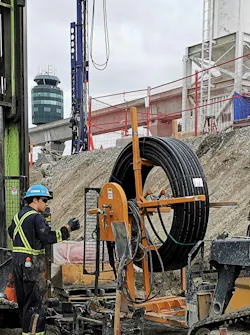
PPI notes that manufacturing of HDPE, PEX and PE-RT piping and their associated fittings is controlled through standards, third-party certification programs and code enforcement. However, the conditions encountered by GHX piping can differ substantially from those in other piping applications.
Some HDPE PE4710 piping materials, for example, have a projected design life of 100 years or more in certain applications where internal water pressures, loads and temperatures remain relatively constant, such as municipal water systems. GHX applications introduce additional variables that can affect service life.
Installation and Pressure Cycling Add Variables
According to PPI Statement AF, factors that can affect GHX piping service life include:
- Potential damage to piping during installation in boreholes
- Wide ranges of fluid temperatures
- Changes in internal hydrostatic pressure caused by fluid temperature and elevation
- Cyclic pressure changes as system pumps are activated and deactivated
These variables make it difficult to establish a single extended design-life value for all GHX applications. Each system has its own operating conditions, installation characteristics and pressure and temperature cycles.
PPI Projects More Than 50 Years Of Design Life
Taking those variables into account, PPI conservatively projects that GHX plastic piping materials, when correctly specified and installed according to industry and manufacturer guidelines, will typically have a design life in excess of 50 years.
The actual service life of GHX piping in some GSHP systems may extend well beyond that value, according to PPI.
The statement provides contractors, designers and other industry professionals with information for evaluating plastic piping materials used in geothermal ground heat exchangers, while distinguishing between projected design life and the actual service life of piping once installed and operating.
To learn more visit plasticpipe.org.