USGBC California Competition Highlights New Approaches to Water-Efficient Home Design
Key Highlights
- Winning designs put plumbing, hot water and water reuse systems at the center of residential conservation
- Competition concepts show how existing homes can dramatically reduce water consumption through retrofit-friendly upgrades
- Global participants proposed practical solutions for building more resilient and water-efficient communities
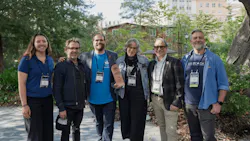
LOS ANGELES, CA — USGBC California has announced the winners of its inaugural global design competition, “Shaping the Future of Water Use at Home,” highlighting innovative residential plumbing, water conservation and hot water strategies designed to help address growing water scarcity challenges.
The competition invited architects, engineers, designers and students from around the world to develop practical, near-term solutions that reduce residential water consumption while supporting long-term sustainability goals. Top honors were awarded to Red Dot Studio in the Professional division and Flow in the Student division.
The challenge was developed to encourage new thinking around residential water use as California and other regions face ongoing drought conditions, stricter water regulations and increasing pressure on aging infrastructure.
Residential Water Efficiency Requires a New Design Approach
Competition organizers identified three common themes across the strongest submissions:
- Making water-efficient choices easier, more attractive and more convenient for homeowners
- Addressing hot water consumption as a way to reduce both water use and residential energy demand
- Prioritizing retrofit-friendly solutions that can be implemented in existing homes as well as new construction
“Water scarcity is no longer a future challenge for California—it is a design challenge for today,” said Ben Stapleton, CEO of USGBC California. “What inspired us most about this competition was seeing teams from around the world rethink the home not just as a place that consumes water, but as a system that can conserve, reuse, generate, and steward it more intelligently. The strongest submissions proved that lower-water living does not have to feel restrictive—it can be healthier, more resilient, more beautiful, and ultimately more desirable. That is the future we hope to help accelerate across California and beyond.”
Lessons From Real-World Water Reduction Projects Guided the Challenge
The competition builds on USGBC California’s experience implementing the 50L Home Los Angeles Pilot, which sought to reduce household water use from roughly 300 liters per person per day to 50 liters.
The pilot retrofitted 31 homes and reduced average consumption to 87 liters per person per day while cutting hot water use by 23%. Participants reported improvements in quality of life despite using significantly less water.
Drawing on those results, the competition challenged participants to design homes that could achieve dramatic water savings using solutions that could realistically be implemented within one to three years.
Winning Design Focuses on Decentralized Water and Plumbing Systems
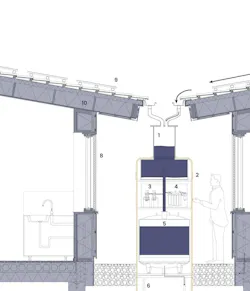
The Professional division winner, Bio-Regional Shelter by California-based Red Dot Studio, combines advanced water harvesting, wastewater treatment and energy-efficient plumbing technologies into a flexible design that can function as a home, accessory dwelling unit (ADU) or post-disaster housing solution.
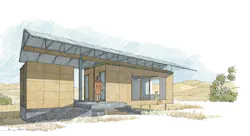
The concept incorporates atmospheric water generation, graywater reuse, onsite treatment systems, rainwater management and heat pump water heating technologies designed to operate with minimal dependence on centralized infrastructure.
The design targets water consumption between 55 and 103 liters per person per day, aligning with United Nations benchmarks for basic water access.
“With over 1,000 at risk or failing water systems in CA, water insecurity is closer to home than we think,” said Karen Curtiss, Principal at the Studio and Ranch. “Our water infrastructure is aging and we need approaches that rethink water conveyance and work at the watershed level. We need to help water find its way home. We appreciate USGBC California holding the Future of Water at Home contest and look forward to learning from the results.”
Student Team Highlights Community-Scale Water Management
The Student division winner, CoFlow, was developed by a team of students from Delft, Netherlands.
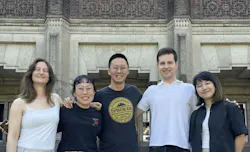
Rather than focusing solely on individual fixtures, the design examines water use at multiple scales, from individual residences to neighborhood-wide systems. The concept includes shared water infrastructure, graywater reuse, rainwater storage, UV treatment, smart monitoring and landscape-based stormwater management strategies.
The team’s design targets approximately 66 liters of water use per person per day, representing an 84% reduction compared to the Los Angeles baseline referenced in the competition.
Representing the Flow team, Yoonji Kim said, “With CoFLOW, we set out to make water visible again. Rather than accepting infrastructure as something hidden and managed elsewhere, we embedded these principles, reduce, reuse, recharge within the spaces people actually inhabit. What emerged was not just a water strategy, but a new kind of civic relationship between people and the environment they share.”
Plumbing Innovation Plays a Central Role in Award-Winning Concepts
Several recognized projects focused heavily on plumbing system design, leak detection, alternative water sources and water reuse.
Among the Professional division award winners, concepts included circular water economy models featuring leak intelligence systems, graywater-ready plumbing infrastructure and dedicated nonpotable water distribution lines. Other designs explored atmospheric water generation integrated into mechanical, electrical and plumbing (MEP) systems.
Student award recipients proposed behavioral tools to reduce shower water consumption and household water monitoring systems designed to make daily water use more visible and actionable for homeowners.
Competition Highlights Growing Focus on Water Infrastructure Resilience
The competition attracted 112 participants representing six states and nine countries, reflecting growing global interest in residential water conservation and resilient plumbing infrastructure.
USGBC California presented the awards during its 25th Annual California Green Building Conference at the University of California, Berkeley.
Organizers also announced their next international design challenge, Beyond the Box: Reimagining the Future of Data Centers, which will focus on integrating data center development more effectively into surrounding communities. To learn more, visit usgbc-ca.org/data-center-adc.