Blow Down Your Boilers and Save Your Controls
Key Highlights
- Regular maintenance and inspection of boiler controls are essential to prevent malfunctions and ensure safety
- Debris buildup in the float chamber can hinder the low water cutoff switch from functioning properly
- Proper blow down procedures involve quick, controlled releases of water to clear out impurities without introducing excess fresh water, which can harm the boiler
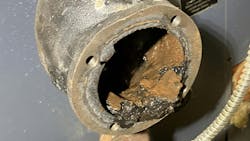
A troubled system leads to a malfunctioning float-type low water cutoff, and illustrates the imporance of basic system maintenance.
One of the old timers of the industry in our area asked me to help him with a steam boiler. It was a competitor’s boiler, and I had no dog in the hunt, but I said yes to help out a fellow old timer. I also get the satisfaction of knowing that the competitor doesn’t have anybody to go out and help customers in the field, the original purpose of the “heating guy” at the wholesaler.
This supply house has morphed into more of an on-line presence than a local presence (fair enough and to each their own). But this is now the second time that I’m going to look at a boiler I’m not that familiar with. The first time I didn’t have enough time to get the boiler running right and we agreed that I would come back. The house can heat with a furnace on every floor, so no real priority.
It sits right on the Ohio River on the Kentucky side across from downtown Cincinnati with a million dollar view next to the suspension bridge that you see whenever the big TV networks are in town for a Bengals football game. It is also so close to the river that it occasionally floods; the waterlines are easy to see on the basement columns. The old timer thought that problem started after the last flood. The electric feeder won’t work, and he thinks it’s a wiring issue.
Maybe the Wiring?
Since I’m not an electrical genius I decided to ask a favor of the guy that wires up this brand boiler all the time. So, the second time there, it was the old timer and his sidekick, me and the expert. We go right to re-wiring the whole limit/safety portion because the expert didn’t like what was there.
The old timer doesn’t have a problem with that and says to just leave everything hanging out until the boiler works fine, then he and his sidekick will make it all look neat and tidy. Of course, there isn’t any paperwork for the boiler or feeder. These are the times I like the internet, since both wiring diagrams were available on the company’s websites—just in a tiny format—on my phone.
Not to complain, it beats making a third trip after going back to the office to find the diagrams in the product literature file cabinets like we had to do 30 years ago. One of my first responsibilities in the industry was keeping those file cabinets up to date with printed literature. Now current technical info just a click and/or swipe away.
Maybe the Low Water Cut-Off?
The process took a bit longer than expected, but sometimes it is harder to re-work something than to start at the beginning. Once we were satisfied, we tried to fire it up only to be disappointed. Thinking it might be the low water cut-off, the expert said that he had a new one in his truck. This didn’t surprise me since he works with them a lot. The old timer sent the sidekick to fetch it.
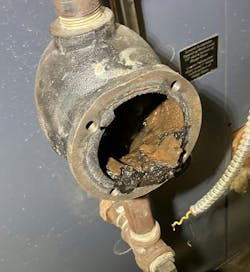
We took the switch off the new control to put on the old control since the problem seemed to be a “fried” contact on the old control. At that point the expert and I both had the light bulb go off in our head. Let’s not switch the switches. Let’s open up the control to make sure the float inside can move freely. The photo of the float chamber reveals the cause of the problem.
The control is a float-type low water cutoff, which means a float mounted outside the boiler heat exchanger senses how much water is in the boiler, while a switch attached to the end makes and breaks contacts as the water level changes. Modern residential boilers now use a probe inserted directly into the heat exchanger to sense water level changes.
The switch on the old school float-type control can be used to act as a safety in case of a low water condition in the boiler, opening the circuit to the burner to prevent a dry fire. The switch can also be used to activate an electrical feeder to refill the boiler before it gets to a low water condition. That was the problem we were having. The switch wasn’t making to energize the feeder as we opened the boiler drain to lower the water level.
Blow Down the Right Way
It wasn’t the switch’s fault, it was the junk you see in the float chamber. It was just enough and in just the right place to keep the float in the control from dropping. Without that movement, the switches don’t switch. The control that is supposed to be shutting the burner off and/or activating a feeder is keeping the burner on during the call for heat.
This is why it is so important to “blow down” a steam boiler with float-type controls. It is also important to teach the homeowner/super the proper way to do this. Recently I was told of a job with a steel tube boiler where the property owner would open the “blow down” valve for fifteen minutes, every day during the heating season. If you aren’t familiar with this, that is ridiculous.
A “blow down” should be done with the valve on the bottom of the control while the burner is activated and only last until the burner cuts off when the water level in the heat exchanger drops. On a residential boiler, that might be seconds. On a commercial boiler, it might be up to a minute. The quick opening of the blow down valve clears the junk out of the float chamber. This doesn’t have to be done every day. I recommend once every two weeks for a well-maintained system.
More often might seem safer, but every time you blow down the boiler, you add fresh water. Fresh water is the enemy of cast iron steam boilers. Fresh water adds things like chlorine and sediment that ruins a cast iron boiler over time. The more fresh water, the less years the boiler will survive.
About the Author
Patrick Linhardt
Patrick Linhardt is a forty-one-year veteran of the wholesale side of the hydronic industry who has been designing and troubleshooting steam and hot water heating systems, pumps and controls on an almost daily basis. An educator and author, he is currently Hydronic Manager at the Corken Steel Products Co.