PA Contractor Slams a Hydronic Home Run
Key Highlights
- Rich Romea replaced an old cast iron boiler with a high-efficiency NTI TFTN wall-mounted unit, freeing up basement space and reducing energy costs
- The project included reconfiguring piping to establish three zones, ensuring consistent heating and thermal comfort across all floors
- Built-in zone controls in the new boiler simplify setup and operation, eliminating the need for external zone boards and enhancing system efficiency
- Additional Taco components, such as dirt and hydraulic separators, help maintain system performance, prevent corrosion, and improve water flow stability
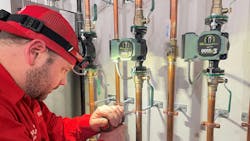
Many plumbing and heating contractors spend “busman holidays” working on projects for family, friends and even their own homes. Rich Romea’s work on his house was more like an extended vacation, requiring nearly a month to replace a boiler, add zones and retrofit piping throughout the three-story structure.
“The first floor of the house was the only one that was comfortable with the old system,’’ says Romea, the proprietor of Romea & Son Heating & Air Conditioning in Pittsburgh, along with his father, Richard Sr. “That’s where the only thermostat was with the old system. The basement was always chilly, and the second floor was always hot.”

The Cape Cod style house, built in the 1950s, includes 1,600 square feet and three bedrooms. The 30-year-old cast iron gas boiler was inefficient, resulting in high energy bills, and infringed dramatically on basement space.
Romea replaced the unit with a wall hung unit from NTI’s flagship line of TFTN boilers. He also installed a Taco magnetic dirt separator to help preserve cast iron radiators and a Taco hydraulic separator, which helps maintain proper water flow. Both components also improve operational efficiency.
“I think for Rich the primary advantages from this project will be independent zone control with three zones,’’ explains Mike Mazzarese, who assisted Romea with the project. “I think it was mostly a comfort factor. He’ll also get some energy savings, clear up some space in the basement and he likes the features of the boiler.”
Home Sweet Home
Romea wrestled with the inefficient cast iron boiler since he purchased the home in 2018. The aging unit pushed energy costs higher, and thermal comfort differed from floor to floor.
“It also took up a lot of space,’’ Romea says. “The basement is a decent size, but it’s not huge. Having a wall mounted boiler gave us a lot more room. If we want to renovate at some point, we’ll have some more space.”
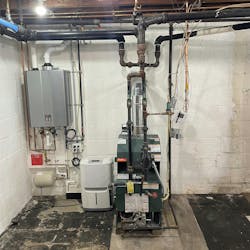
The most challenging part of Romea’s project involved reconfiguring the piping throughout the house—and finding the time to do it. The window for HVAC contractors to work on side projects is frustratingly short. Heating problems in the Northeast can arise any time between October and May, at which point air conditioning systems require attention. With a small team, there is rarely time to devote attention to projects that don’t boost the bottom line.
“There was a little bit of a lull in between seasons around September,’’ Romea says. “We worked on it for four days in a row, which is rare in this business. Then we spent time in additional time getting it done whenever we found we had a little extra time.”
Romea explains that re-piping the house required the most time and helped establish zone heat for each floor. “I had to get water flow to the basement level for that thermostat,’’ Romea explains. “The same with the second floor. The house was never set up to be zoned. I had to take out all the pipes and make sure that we got hot water to the second floor. That required a lot of time.”
Boiler Selection
Contractors find a wide range of boilers to choose from for their projects, and Romea and Mazzarese collaborated before deciding on the NTI TFTN unit.
“We went through all of the different options,’’ Mazzarese says. “I think what we both liked about this unit is the technology to do the zoning and set-up, which was quite easy. We were able to set it up in a few minutes.”
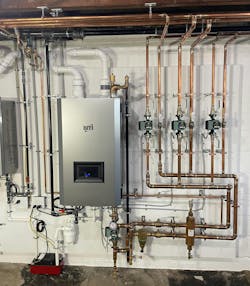
One of the main features of the TFTN is built-in zone control for up to three heating zones plus domestic hot water. Built-in zone control optimizes boiler performance by synchronizing multiple areas and allowing the boiler to run more efficiently while managing and distributing heat. Zone controls also offer system protection and enhance longevity.
“This unit has zone controls and the electronics built into it,’’ Romea says. “The boiler is saying when it’s time for the first-floor zone to kick on, and when it’s time for the second floor to kick on. That’s a nice time saver.”
Romea explains that without zone controls on a boiler, the remedy is to purchase and install an external zone board. “It’s nice that we have all of that control directly on the unit,’’ he says.
The TFTN model operates at 95 percent thermal efficiency rating and remote monitoring and diagnostics, which allows contractors remote access for programming and troubleshooting. Contractors also appreciate easy-to-read full color graphics. It also includes an EZ Setup Wizard, which guides users through initial setup, making it easy to configure backup settings and allows for setting up automatic, scheduled backups for consistent data security.
Additional Efficiency
Romea also installed products from Taco to maximize system efficiency. A dirt separator and a hydraulic separator will help ensure the system maintains peak performance.
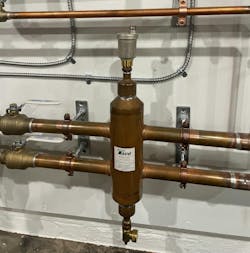
The dirt separator increases system life and efficiency by removing ferrous material and other harmful particles from closed loop hydronic systems. Removing contaminants prevents premature failure of pumps, valves and heat exchangers, and also protects against corrosion, which is the primary enemy of a hydronic system.
The hydraulic separator manages flow rates within the system, improving stability and efficiency. Systems with multiple zones can create issues with hydraulic balance, water quality and air removal, and can lead to noise, component wear and inefficiency. The separator allows primary and secondary circuits to operate independently.
“There’s a lot going on with three zones,’’ Romea said. “It’s important to keep proper water flow, and this is the most convenient way to keep the system operating at peak efficiency.”
Comforts of Home
Since purchasing the home eight years ago, maintaining thermal comfort throughout the weather extremes challenged Romea and his family. With a new system and comfort throughout the house, Romea made a major upgrade that should solve heating challenges for the next few decades and save substantially on heating costs.
“I’ve been considering it for a long time, but I’m happy I did it,’’ Romea noted. “Now, you can set it so that whatever floor of the house we’re at, we can set it to the temperature we want. It’s a big improvement and we’ll be comfortable all year-round.”