Passing the Torch: A Veteran's Reflection on Steam System Service
Key Highlights
- Proper maintenance of dirt legs and traps is crucial to prevent debris buildup and system blockages
- Incorrect piping, such as concentric reducers instead of eccentric ones, can cause water hammer and uneven heating
- Experienced technicians play a vital role in mentoring and passing on knowledge to the next generation
It has been a recurring phenomenon in my career with boilers (more often steam than hot water). This job was a classic case. I guess I should have seen it coming, even though it happened after the problem was resolved.
The photos were sent to me by a tech I talk and text with when he’s on a steam or hot water job for service. Let’s call him JJ, since that’s what he calls himself. I haven’t mentioned anyone’s specific name in the six years I’ve been writing this column. However, I’m going to break my routine now that it’s my last column.
Passing the Torch
I decided that it is time to pass the torch to someone that can focus on it. The cancer is back and treatable, so I’m going to concentrate on getting it out of my body and my life. That and my golf game, which if I may say so, is improving, despite or maybe because of the chemotherapy.
But enough about me, let’s get back to JJ. He was going to a residential steam job that has float and thermostatic (FT) steam traps at the ends of the two steam mains, to keep the steam in the main but pass the air and water. FT traps aren’t used very often around here on residential systems. The preferred method is using the water level in the wet return to keep the steam on the right side.
Step One
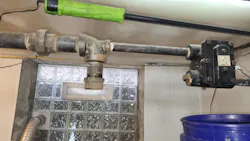
We had discussed the situation weeks before. I had suggested that as a first step, he check for a stainer or dirt leg before the FT trap. If present, he would inspect, since these are used to protect the trap from the stuff that floats around in steam systems. Photo 1 shows that the installer used a dirt leg instead of a stainer.
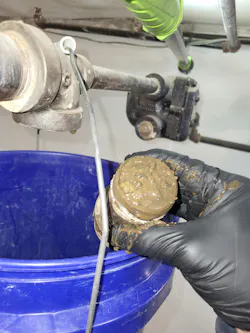
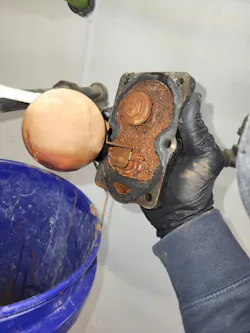
As you can see in Photo 2, the dirt leg was completely full of debris. The basic maintenance of pulling out the nipple and cap to clear it out hadn’t been done in quite a while, possibly since the system was installed. This maintenance is not in the minds of most homeowners, or contractors.
Clogs at the end of the steam main can block the flow of condensate and air. When condensate backs up in the main, it will/can cause water hammer. JJ mentioned in his text before he got there that the homeowner had mentioned “some banging in the pipes”.
If the flow of the air from the end of the steam main is blocked, uneven heat can occur. Remember, steam and air can’t occupy the same space inside the pipe. Air is shoved to the end of the main instead of being vented out of the system. Steam flows erratically and radiators don’t heat evenly, which usually means no heat for the radiators located at the end of the main. The original complaint was reported as “some radiators heat better than others”.
Step Two
After seeing Photo 1, I pointed out that the piping at the end of the supply main was incorrect, since JJ likes all the facts. The reduction of the steam main pipe size down to the pipe size of the trap should have been done with an eccentric reducer, rather than the concentric reduction on the tee. Condensate can back up at the concentric reduction to cause water hammer.
The Eternal Dilemma
This led to the eternal dilemma of service techs, what to fix and what to leave alone, or as JJ put in quotes in his text, “A difference, to be a difference, needs to make a difference”. A quick Google search of that phrase reveals that many diverse disciplines are aware of this fact. In this case, would re-piping the ends of the steam mains cause a significant improvement in the system?
I pointed out that the small details of steam piping can sometimes make or break a job. I’ve seen plenty of systems that are installed without paying attention to the details that work fine. That’s not the phenomenon that I referenced earlier, although it’s similar. He decided to see how it worked after the service work before making that call.
JJ sent lots of photos for me to review. At that point, he hadn’t reported the results of his service work. When I asked, his response referenced what I have heard so many times in my career.
The Mystery Remains
He reported that prior to their installation crew putting in a new boiler recently, the homeowners reported that the system worked fine and that the problems started after the install. I’ve heard this so many times that I wonder if it’s the demolition of the old boiler that stirs up debris in the system, or the spirits of the now long dead men who originally installed it crying out for attention.
Challenging the younger generations to learn how steam systems work by making them fix them. I guess that is a mystery that I will never be able to solve, but I hope that in a small way I have helped service techs through the years understand steam systems, and therefore make them effective, because service techs like to get things fixed.
Good luck and godspeed.
About the Author
Patrick Linhardt
Patrick Linhardt is a forty-one-year veteran of the wholesale side of the hydronic industry who has been designing and troubleshooting steam and hot water heating systems, pumps and controls on an almost daily basis. An educator and author, he is currently Hydronic Manager at the Corken Steel Products Co.