Key Highlights
- Mentorship by Pat Linhardt played a crucial role in developing the author's skills in sizing, designing, and servicing hydronic systems
- Transitioning to hydronics involved learning to manage complex boiler systems and understanding unique system hurdles
- Looking ahead, the author plans to share more industry stories, including interesting hydronic projects
If you’ve been following CONTRACTOR Magazine for the past six years, you may have heard of me before today. Pat Linhardt has been writing a column monthly since 2020. In a few of those columns, Pat has referred to me as “The Kid”. I work for the same wholesaler as Mr. Linhardt in the Greater Cincinnati area (Corken Steel).
About three years into my time with this wholesaler, I was offered to take on a position in Hydronics. I was to be mentored and molded by Pat Linhardt himself. The heir to the Corken Steel Hydronics Throne—who could pass that up?
Scrap Dog Days
When I first came on, I had been working for a local contractor retrofitting HVAC systems. Most systems I had been installing are what I now refer to as “scorched air” systems. During my time working for the contractor, the only boilers I ever dealt with were on the occasional “Scrap Dog Day”. Throughout the busy periods of the season, the warehouse would start to fill up with various old furnaces, condensing units and evap coils that had been replaced with new.
The shoulder seasons brought Scrap Dog Days. Someone had to rid the warehouse of the clutter that was used equipment. Being that I was one of the younger and “greener” employees, “Scrap Dogging” was my responsibility.
For a 20-something year old, the furnaces, air handlers, evap coils and even condensers were no sweat to push out of the back of my partner’s pickup. I enjoyed Scrap Dog Days, they made the slower days go by quickly and I got to be the hero walking in with a little extra cash to share with install team (the boss was nice enough to let us keep the earnings from scrapping). All was well until I got my first taste of a cast iron boiler.
One of the other, more experienced, install teams had done a like-for-like swap at a residence close to the shop. Just on the good side of the river in Covington, KY. I had just made it back to the shop after a quick morning AC/ Coil swap (admittedly I was hoping to be sent home early—but this time I was not in luck).
My partner had beaten me back to the shop and there, waiting for me, was his truck stuffed with a few furnaces, a condensing coil or two and a few evaporator coils. Shoved into the nose of the bed of the truck was a piece of equipment I hadn’t seen before: a small residential cast iron boiler.
I didn’t think much of it. My partner threw me his keys, and I was off to the scrap yard. It was when I went to pull the boiler off the truck that I realized I had had my hands full.
The boiler was no bigger than a mini fridge, but what it lacked in size, it made up for in weight. The rest of that day’s scrap doggers got a show watching me wrestle that hunk of cast iron. After a grueling battle, the boiler eventually toppled off the tailgate, onto the scale and off for its next life. I had hoped that was last tussle with a cast iron boiler.
Fast Forward
That day at the scrap yard doesn’t seem that long ago, but that’s been over 11 years now. Since 2018, when the mentoring process started, I have seen many more cast boilers. Only the scale has exponentially grown since the measly three-section boiler that whooped me at the scrap yard.
After only eight years I don’t consider myself a wily vet just yet, but I’ve become very comfortable in sizing, designing and servicing hot water systems. To me hydronic systems are fascinating, no two are alike and each system has its own hurdles that I am now equipped to help the contractors jump.
I’ve been extremely fortunate to have had these opportunities to work for a great company, be mentored by a great man and a great friend. I’m honored to take over in writing this column in place of Pat Linhardt. From the very first boiler room I visited with Pat, I’ve had many people tell me that I’ve got big shoes to fill.
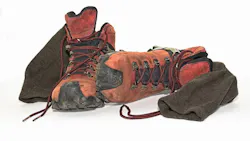
So, each morning, I wake up and throw on the biggest wool socks I can find in the drawer to help fill out those shoes. I’m excited to share my own stories, but Pat isn’t going anywhere anytime soon. Maybe we’ll even have some collaborations featuring The Kid and The Old Man.
Next time we’ll talk about a slab radiant heat job that we just completed, one with an interesting twist.
About the Author
Brady Brophy
Brady Brophy is a Hydronics Department Manager for Corken Steel Products with experience in both the contracting and distribution sides of the HVAC industry. He began his career in 2015 and became a Hydronics Specialist in 2018. Brady supports contractors with the design of radiant floor and snow melt systems, and works across design-build, bid/spec, and retrofit hydronic applications, providing equipment sizing, training and hands-on technical guidance.