Radiant Comfort and Character: Reviving a Bozeman Landmark
Key Highlights
- Bozeman's growing affluent population is driving demand for custom hydronic heating in historic homes, blending vintage charm with modern comfort
- The renovation of a 125-year-old house involved gutting, insulation, and installing advanced radiant and snowmelt systems
- Dual ALTA condensing boilers with high turndown ratios ensure efficient operation at high elevations, with systems managed via Honeywell RedLINK for remote access
Bozeman, Montana isn’t just ski country. Long winters and subzero stretches have made it hydronic country for as long as boilers have been shipped west of the Mississippi. But the Gallatin Valley’s steady growth exploded in 2020, as affluent families from across the country traded city life for the Big Sky.
Bozeman’s high‑end custom home market has become a showcase for radiant heating, snowmelt, and mechanical artistry. Winters and budgets are big, and next-level mechanical systems are often the result.
“I’ve been plumbing in The Valley for 31 years,” said Nathan Bailey, owner of Bailey’s Plumbing and Heating. “My wife and I started our own company 14 years ago. We handle everything from wastewater treatment plants to high‑end homes. Custom hydronics make up about 90 percent of our work, and the bulk of it comes through a handful of custom builders.”
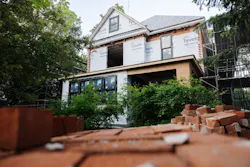
One of those general contractors—Drew Coubrough, owner of Coubrough Construction—called Bailey in 2022 to take on the mechanical scope for a 1903 home in Bozeman’s South Side historic district. The customer wanted to pair the home’s turn‑of‑the‑century architecture with modern comfort and performance.
Headed into the project, all trades involved knew that every element of the home was to be custom. The timeline reflected this. No definitive completion date was given, nor asked for. Bailey technicians were soon to encounter challenges they’d never experienced before.
Gut Job
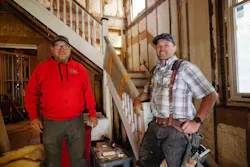
“The turning point on this project came when we found live knob-and-tube wiring running through the rafters, with scorch marks on the surrounding wood,” said Coubrough. “At that point, it was clear we weren’t patching anything. We had no choice but to gut the house. The owners understood the risk and backed the decision.”
Coubrough has been operating in Bozeman since 2009, focusing on historic renovations, timber framing, and structural steel work.
When Bailey’s crew first walked through the door, the brick house had an ancient steam system and zero insulation. Their goal was to have a home with premium comfort and efficiency while maintaining the 125-year-old aesthetic to whatever degree possible.

“The place was gutted to the studs,” Bailey recalled. “It was one of those projects that kept giving us surprises the deeper we dug. One wild example was large pieces of bone mortared between the foundation stones. We told ourselves they were deer bones.”
Bailey was involved for about four years. The timeline was so long because everything was custom. Hand‑painted tile came from Italy, Water Monopoly brand plumbing fixtures were imported from the UK, and all the lights in the home were re-wired European antiques. Nothing about it was standard, and neither were the measurements or threads.
Comfort is the Goal
To create a high-performance envelope, the entire shell was spray-foam insulated and an energy recovery ventilator (ERV) was installed for proper ventilation.
While Bailey’s experience allows him to tackle many of his hydronic designs solo, he does look outside the company when a project is intricate or unusually technical. This home—with several types of radiation and snowmelt on a historically significant property—was one of the latter.
Bailey worked with Todd Sisson, at Pacific Plumbing Supply, on the initial design. Sisson has worked in distribution in Bozeman for decades and is well known and respected among contractors. Few people in the Gallatin Valley possess such extensive hydronic experience.
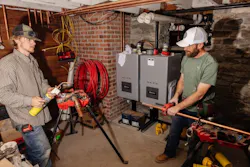
Later, Bailey leaned on long‑time partners Dave Morrell and Tim Spady at Ridgeline Mechanical Sales to ensure the most current products and design met the scale of the project. The Bozeman-based rep firm covers seven states throughout the Northwest and Mountain West.
“Dave and Todd are amazing resources,” Bailey said. “If I need a LoopCAD layout or software work, they handle it. They know boilers and controls inside and out, and if I call with a question, I get an answer the same day. Every system they’ve helped me design over the years has run flawlessly.”
Heating system design was dictated by architecture and aesthetics and approached differently from space to space. Staple-up radiant with heat transfer plates was used on the third floor.
“The first and second floors are primarily served by filigree-covered cast‑iron radiators imported from England,” said Coubrough. “That’s the aesthetic the owners wanted. The bathrooms, mudroom and kitchen nook didn’t have space for radiators, so in-floor heat was used there, too.”
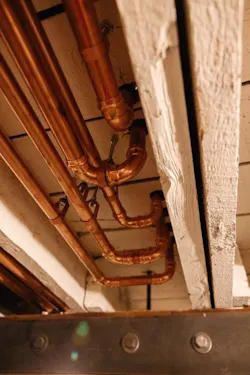
“The basement is technically unheated,” explained Bailey. “That area has a ‘steampunk’ vibe to it, so all the copper distribution piping—ranging from .75 to 1.25” diameter—is exposed. It throws enough heat to keep the basement comfortable all winter.”
The system is controlled using outdoor reset, with a maximum supply water temperature of 125°F for a central Montana design day.
“According to ASHRAE, our design temp is -18°F, but we often see much colder,” said Morrell. “We typically push our designs to -25°F.”
“Outdoor reset was key to the overall comfort and efficiency,” said Sisson. “By continuously adjusting supply water temperature based on outdoor conditions, we keep water temperatures as low as possible. That means better performance from the boilers reduced energy use, and more stable, comfortable heating without over-firing the system.”
Convenience, Too
Outside, two independent snowmelt zones keep the property clear. One covers the rear walkway to a detached garage. The second warms the front walk, city sidewalk and curb. Both are piped with .75” PEX.
“When the city plows snow to the curb, it can’t pile up here because the entire curb contains PEX,” said Bailey.
The snowmelt sensor is a DS-2, made by Automated Systems Engineering, and is mounted on the fence. Like all the inside zones, the snowmelt is controlled by Honeywell zone controllers and Redlink™ system.
“The snowmelt system can be configured to operate any way you want, but we leave the loops cold until the sensor detects moisture at temperatures below 36°F,” said Bailey. “At that point, the boilers fire to send heat to the plate-and-frame heat exchanger isolating the outdoor zones from the rest of the system.”
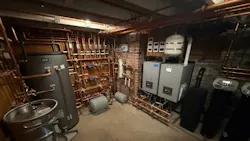
All told, the property has seven heating zones and two snowmelt zones, all supplied from a meticulously piped mechanical room. That space is shared by two ALTA condensing boilers, a 120-gallon indirect tank, and a humorous-yet-functional piece of Bozeman memorabilia. A stainless-steel beer keg stamped “Bozeman Brewing Company” hangs on the wall. It’s not decor, but rather a working urinal.
“The basement is the homeowner’s man cave,” Bailey explained. “He decided late in the project he wanted a bathroom, but we only had space for a urinal. I had the keg lying around, so we made it work. It fits the theme.”
Dual Boilers
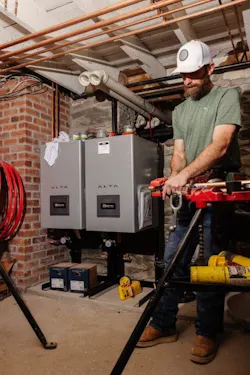
Opposite the urinal keg are two, 180 MBH ALTA condensing boilers, manufactured by U.S. Boiler Company. The boilers have a 10:1 turndown ratio, which is a benefit considering the widely varying zone loads and supply water temperatures on the property. The ALTA avoids the high-elevation combustion de-rate required by most competitive boilers. Bozeman sits at about 4,800 feet above sea level.
“I love the ALTA,” Bailey said. “We’ve installed about a dozen of them; fire them and walk away. We’ve never had a callback. We only see them again for annual service.”
Bailey’s mechanical rooms are known locally for being tidy, and this one maintained the standard. Expansion tanks, a Caleffi hydro separator, Grundfos circulators, zone controls and heat exchangers are all pressed together and labelled.
Details, Details, Details
“The homeowners wanted all the comfort, efficiency, and remote access, but they didn’t want to see any of it,” said Bailey.
A Honeywell RedLINK™ system was installed to provide remote access and eliminate thermostats from the living space. Instead, wireless sensors are hidden throughout the rooms, tied back to modules in the mechanical room.
“This required thoughtful sensor placement and control logic,” said Sisson, “But it’s definitely one of those details that makes a high-end system feel seamless and invisible.”
People with access to the system can control it remotely via their phones. Those without access can do so with a tablet that’s kept in the kitchen.
On the plumbing side of the project, Bailey’s crew faced constant adaptation to imported materials and metric threads.
“We were always converting from European fittings to American ones,” he said. “Once you get used to the metric system, it’s great, but there’s a learning curve and a component availability issue.”
“Let’s see… what else made this project tough?” continued Bailey. “Trans‑Atlantic shipping delays. Tariffs. Time zone differences between here and customer support for plumbing products, etc. This job required more babysitting than most. Everything had to be perfect, and everything took longer than expected.”
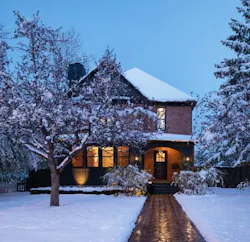
The work wrapped up in late 2025. To their credit, the homeowners were patient, knowing that prioritizing aesthetics over technology requires time.
“This project is an extreme example of what’s happening in Bozeman,” said Bailey. “People are spending serious money to upgrade old houses, often without sacrificing the home’s original character. Hydronic systems can accommodate renovations like that. They’re quiet, comfortable, efficient and, if the customer wants, invisible.”