Key Highlights
- The project involved installing a radiant floor system in a pole barn located very close to the Ohio River
- Design included a high-efficiency condensing boiler, zone controls, and a dual-purpose system that aids in both comfort heating and flood recovery efforts
- The installation process required careful planning for flue routing, LP conversion, and ensuring the PEX tubing loops were within optimal length for efficient operation
Back in December of 2025 I received a call from a contractor with a new radiant flooring opportunity to look at. The contractor is a smaller outfit, just one truck and typically a helper with him. I had helped him with a radiant floor retrofit over the summer and earned his trust. He now had another on the line.
The following week, the contractor and I found a time in which we were both free to make a site visit. This job was in a town called Patriot, IN. I hadn’t been to this area before and didn’t quite know what to expect.
After some windy back roads through Eastern Indiana, I arrived in Patriot, a small town along the Ohio River. To me the houses seemed eerily close to the river, most were stick-built houses on stilts or trailers on cinder blocks.
Checking the Slab
Next, I see a beautifully built pole barn not 100 yards from the bank of the Ohio. This must be where I’m headed. The homeowner and contractor were there in the driveway waiting for me. I apologized for my tardiness, and they both understood as I-71 is a part of their everyday lives. The barn was two stories, but we were there for slab.
The 2nd story was served by a heat pump system. The front half was all garage/workshop. A bass boat sat sparkling under the garage lighting, surrounded by tools, work benches and a golf cart for easy travel throughout the small riverside community. The back half of the slab was a future lounge and gaming area. The back wall was almost all glass looking straight at the Ohio River. The barn seemed so close to the river that it looked like an infinity pool in the backyard.
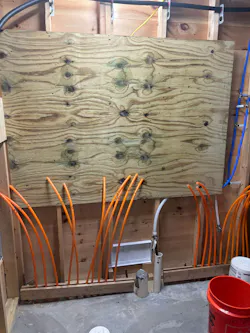
Directly in the middle of the slab floor between the garage and future rec area was a framed out mechanical room. There was a small electric water heater for the domestic side mounted to the wall supported by uni-strut. Popping out of the middle of the slab was a melee of ½” PEX tubing. The homeowner and a buddy took on the task of laying the PEX pipe before the slab was poured.
Checking the Math
I typically prefer to be able to design the infloor PEX myself, but this isn’t the first time I’ve had a homeowner tackle this part of the job. He promised all the loops of tubing were under 300’ and, based on the square footage of the slab, the math checked out. We were good to go ahead and proceed.
There were 24 loops of tubing total, 6 supplies/returns for the rec room and 6 supplies/returns for the garage. Our only problem was that the homeowner wasn’t sure which 6 loops went out to the rec room and which 6 went to the garage. No need to panic, we’ve got a 50-50 shot at getting right the first time and if we guess incorrectly, it will just be a few wires to change and we’ll be all fixed up.
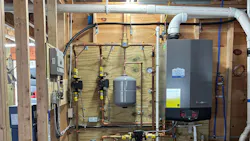
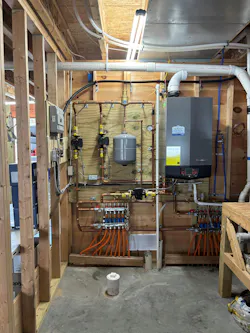
The contractor and I then devised our plan for the new boiler. A high efficiency, condensing wall mount boiler was the perfect choice for this application. I made a quick piping sketch for the contractor consisting of a primary/secondary connection and a zone pump to feed each manifold. We would control each stat and pump via a switching relay panel. The flues were our biggest hurdle. Being that we were in the middle of the house, we had some work to do. We determined that going out the East wall was our best bet. I made sure to let the contractor know that the flue must pitch back toward the boiler at least ¼” per foot of horizontal run.
The Follow-Up
The contractor ended up securing the job and over the next couple of months other than a quick phone call or two I didn’t hear much from him. A few weeks ago I got a call from the contractor, who said he was ready for me to come down to help him program the boiler and check the combustion numbers.
Warm and Dry
Now I’ll explain the little twist that I promised. Remember we are almost on top of the Ohio River, every other house on the street sits on stilts and/or cinder blocks. Obviously, this area sees its fair share of flooding.
The homeowner popped in to check on our work, we got to talking and he told me last year his barn filled 18” high with water after a flood. The process of drying out the slab took days.
Then he showed me around the perimeter of the house. On each corner of the house there were louvers, these louvers could open manually or automatically via a float. So, when inevitably mother nature shows her teeth and dumps enough rain to get over the flood line the house is able to drain. That’s where the slab heat can help assist.
Now, it won’t be the biggest help in the world, it certainly won’t rid the place of 18” of water. But the heated slab will help speed up the evaporation process and move along the drying process. While his system was designed for comfort heating, it does also have a dual purpose. The homeowner has had a few days of cold weather and loves the slab heat. He said next time it does flood, he’ll crank up the floor heat to help with the cleanup.
About the Author
Brady Brophy
Brady Brophy is a Hydronics Department Manager for Corken Steel Products with experience in both the contracting and distribution sides of the HVAC industry. He began his career in 2015 and became a Hydronics Specialist in 2018. Brady supports contractors with the design of radiant floor and snow melt systems, and works across design-build, bid/spec, and retrofit hydronic applications, providing equipment sizing, training and hands-on technical guidance.