Radiant Heating in Self-Storage Facilities
Key Highlights
- Radiant heating warms building mass and contents, reducing issues caused by air stratification and infiltration in self-storage facilities
- Proper insulation and PEX tubing layout are critical for system efficiency and ease of installation, especially in large buildings with long loop lengths
- Compared to forced air systems, radiant provides more uniform heat, lower operating temperatures, and better long-term cost predictability
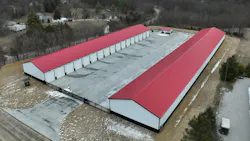
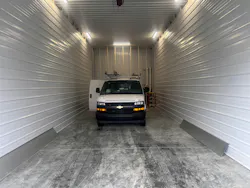
Back in 2023 I had a job come across my desk from a local contractor I work closely with, Anderson Automatic. They were bidding a new construction climate-controlled self-storage facility. It consisted of two buildings—roughly 17,000 and 14,000 square feet—facing each other across a drive aisle. The owner’s request was simple. Keep it efficient, reliable, and predictable from an operating cost standpoint.
That’s where hydronics, and more specifically radiant, start to make a lot of sense.
Let’s Talk Storage
The US self-storage industry has evolved from a niche service into a $40B+ real estate juggernaut. From 2005-2019, development surged, averaging thousands of new facilities annually. That growth accelerated again during the pandemic as relocation, downsizing and remote work reshaped how people used storage. By 2023, construction spending hit an all-time high, and a large percentage of those new builds were climate-controlled.
Most contractors first instinct would be package units, ducted systems, mini-splits or unit heaters. These are familiar, fast and relatively low first cost. But in self-storage, these options come with drawbacks. Air stratification in tall corridors makes it difficult to keep the scorched air from rising to the top of the structure. You will often see fans mounted to the ceiling to try to force the warm air to ground level. Frequent door openings cause all the warm air to quickly escape the building envelope, forcing the scorched air equipment to work hard to maintain setpoint. When using forced air in these facilities temps unit to unit are often uneven.
Self storage facilities aren’t traditional commercial heating applications. These spaces experience frequent door openings, minimal internal gains, and wide infiltration swings. Most buildings are designed for temperature maintenance rather than comfort conditioning, making them ideal for low-temperature radiant systems. Often the setpoints in these facilities are 50-60 degrees Fahrenheit.
Why Radiant Works
Instead of trying to heat air that keeps escaping, radiant heating systems warm the building mass, the slab and stored contents rather than relying on air temperature alone. This creates a thermal buffer, allowing spaces to recover quickly after infiltration events. When a roll-up door opens, you lose air—not slab temperature. PEX tubing layout provides consistent floor temperature across long corridors, eliminating cold pockets. Compared to forced air, radiant provides more uniform heat, reduced stratification, and lower operating temperatures.
Most of these systems can run with supply water temps between 90-120F. That pairs perfectly with high efficiency boilers, water-to-water geo units or even future electrification strategies. In Anderson Automatic’s case, we chose gas fired high efficiency boilers—one boiler for each building. The bigger building has one 500k btu/hr Lochinvar FTXL and the smaller building has a 400k FTXL.
Key Considerations
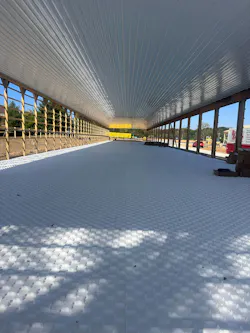
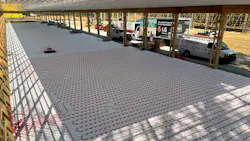
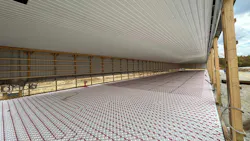
Proper design is critical. Underslab insulation is essential to prevent downward heat loss. The insulation forces the radiation up and through the slab. In this case, the concrete contractor provided a 2” foam board insulation with a PEX tubing grid. Anderson was thankful for this. Rather than zip tying the tubing to a road mesh grid every two or three feet, they were able to walk the tubing into the PEX grid on the insulation. This project has roughly seven miles of tubing (imagine the amount of zip ties!). The PEX grid insulation is quite the back saver.
A Solution That Performs
At the end of the day this project wasn’t about reinventing the wheel, it was about choosing the equipment that would make the most sense. Radiant systems in these applications aren’t just competitive, they’re often the better long-term solution when it comes to efficiency, stability and operating cost predictability.
As more storage facilities move toward climate control, expect this conversation to come up more often. Radiant is a solution that performs—not just day one, but over the life of the building.
About the Author
Brady Brophy
Brady Brophy is a Hydronics Department Manager for Corken Steel Products with experience in both the contracting and distribution sides of the HVAC industry. He began his career in 2015 and became a Hydronics Specialist in 2018. Brady supports contractors with the design of radiant floor and snow melt systems, and works across design-build, bid/spec, and retrofit hydronic applications, providing equipment sizing, training and hands-on technical guidance.