Condensing vs. Cast Iron Boiler Debate Deserves a Deep Dive
Key Highlights
- Cast iron boilers are historically known for durability and lower initial costs but now face higher maintenance expenses due to integrated controls and proprietary parts
- Condensing boilers offer higher efficiency, faster servicing, and smaller footprints, making them a better long-term investment despite a slightly shorter lifespan
- Proper venting and chimney sizing are crucial for high-efficiency cast iron boilers, potentially incurring significant additional costs
- Advancements like modulating firing rates and outdoor reset technology improve condensing boiler performance, reducing fuel bills and environmental impact
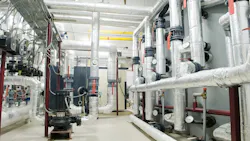
Contractors and customers frequently engage in the condensing vs. cast iron boiler debate. Cast iron’s durability and lower installation costs strike a chord with some homeowners, while others prefer the energy efficiency and advanced technology of condensing units.
The real debate that contractors should discuss with homeowners is cost of installation vs. cost of ownership. In most cases, the final analysis will reveal condensing units are a better long-term investment.
There are multiple variables that impact the cost of ownership. It’s incumbent upon contractors to paint the full picture for customers, rather than simply presenting the cast iron option and its lower purchase price.
History Lesson
In the past, a cast iron boiler was a safe bet for homeowners. Most parts were standard across all manufacturers. The gas was a simple Honeywell VR series, the aquastat was a Honeywell 8148 or something similar, and most boilers included a standard 40va transformer and a circulator, usually a B&G 100 or Taco 007. With these parts, the contractor could service and repair almost any boiler.
Today, this big plus for cast iron boilers has been removed. Manufacturers have moved to integrated boiler controls, usually Honeywell or Hydrolevel. Each control plays a specific role in programming for that boiler. The change in controls, along with proprietary wiring harness and product specific parts, have put the cast iron boiler on par with their higher efficiency counterparts.
The integrated controls improve efficiency and comfort. They often feature outdoor reset technology, which adjusts the water temperature based on the outdoor weather and prevents the boiler from over-firing.
With any boiler, however, components need to be replaced. Cast iron boilers now have technology similar to condensing units, but they are now more expensive to maintain.
Evaluating Efficiency
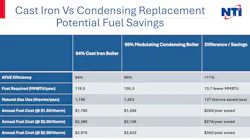
Cast iron boilers of the past ran between 75 and 82 percent efficiency. Changes adopted by the Department of Energy raised the bar, and they now run between 83 and 85 percent efficiency.
While the small efficiency improvement might seem inconsequential, it can affect how a unit is vented. The chimney that works in tandem with the boiler might be undersized.
With the lower flue temperatures produced by the more efficient cast iron boiler, the chimney will likely need to be resized or relined to allow the unit to properly pull draft. In either case, the homeowner will likely face a four-figure bill, at minimum.
That cost alone evens the field between cast iron and condensing units, but there are even more stark contrasts that should be explained to customers.
Lifespan and Servicing
Some contractors tout the longer lifespan of cast iron boilers, which can last up to 25 years, while condensing units top out at 20 years if they are properly installed and serviced.
The condensing boiler may have a slightly shorter lifespan, but energy and fuel savings will make up the difference. Also, barring no drastic changes in the installation process of a condensing boiler, the replacement of a condensing boiler is less labor intensive than that of a cast iron boiler.
Contractors should also discuss servicing with customers. Some technicians believe cast iron boilers require less maintenance. The hard truth, however, is that every piece of heating equipment needs to be serviced to ensure that it is running safely and efficiently.
A brief conversation with customers should prove enlightening. The average heating season is approximately 2,000 running hours. Compare that to an automobile. To make the math easy to comprehend, let’s use 20 mph as a nice, even number. A vehicle running at 20 mph over 2,000 running hours adds up to 40,000 miles.
No one would ever think of driving a vehicle 40k miles without getting it serviced. The same is true for a boiler.
One other noteworthy point with servicing: in most cases, it’s much easier to service and clean a condensing boiler, especially the water tube products. Most servicing can be accomplished in 90 minutes. A condensing boiler, especially the water tube style, allows technicians to properly clean the flue passages, maintaining the efficiency of the product.
Better Heat Transfer
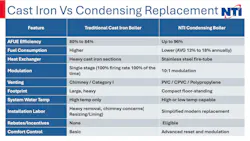
Cast iron is an inefficient material for heat transfer. Every time heat or hot water is required, 450 pounds of cast iron and up to 15 gallons of water must be heated before the boiler can start heating the home.
A condensing water tube boiler, by comparison, only holds 1 to 3 gallons on average, allowing for better heat transfer and faster recovery times.
There are a few other points about condensing boilers that contractors should inform customers. They are:
- Modulating firing rate: Cast iron boilers are always firing at 100% regardless of the load. Modulation allows the boiler system to adjust the output of the boiler to meet the heating demands of the home.
- Smaller footprint than a cast iron boiler, making more floor space.
- Variable water temperatures based on outdoor temperatures. A condensing boiler can run at much lower temperatures than a cast iron boiler. Lower temperatures reduce fuel bills.
There will always be customers who insist on cast iron boilers. But with the rising cost of energy, a more efficient heating system is more important now than ever. Combine the rebates available in most markets for condensing boilers, and the choice between cast and condensing leans more towards the higher efficiency products.
With a rapidly changing energy market, not offering high efficiency products leaves more room for your competitors to gain market share.