New Hampshire Crew Tackles Complex Renovation in Historic Building
Key Highlights
- The renovation faced unique challenges such as aging boilers, structural mismatches, and urban logistics, requiring innovative solutions and expert coordination
- Eastern Mechanical reconfigured the entire plumbing and heating systems, installing energy-efficient heat pumps and custom water heating units to meet modern standards
- The project involved complex logistics, including traffic stops and crane operations, to safely install large equipment atop the historic five-story building
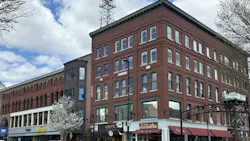
Old buildings present their own renovation challenges. It is especially important for contractors to get even the smallest details right in structures of historical significance.
The team at Eastern Mechanical faced that task in the renovation of the Dunlap Building in Manchester, N.H. Eastern Mechanical is a full-service mechanical contractor that has been in business since 2016, licensed in both New Hampshire and Massachusetts. The company prides itself on quality workmanship, tailored to their clients' specific needs.
The Dunlap Building was constructed in 1879 and was one of the city’s first large commercial buildings. The five-story brick building, whose tenants included architects, retail stores and social clubs, was named to the National Register of Historic Places in 2004.
The building was largely vacant until commercial real estate partners Anthony DeLucia and David De Lise began a $10 million, multi-year project to convert the building into a 27-unit apartment complex called Rendezvous on Elm that opened this year.
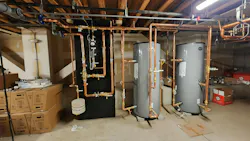
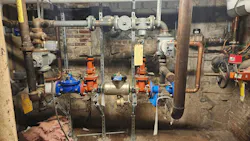
Eastern Mechanical reconfigured the entire plumbing and heating system for the renovation with new equipment and internal components. “There was a bit of a transition going from the old building to a new building,’’ said Eastern Mechanical Owner Robert Fichera. “We were boring through walls that were older than me.”
The challenges that Eastern Mechanical’s crew encountered, however, went far beyond the building’s four walls.
Unusual Issues
From the outset of the seven-month project, numerous issues confronted Fichera’s team.
The existing boilers and indirect water heating units were aging, lacked proper service and had fallen into disrepair. “We had to keep the heat going during the winter and that was quite a feat,’’ Fichera said. “They kept dying and we had to keep them limping along. They were older models, so we were robbing parts to keep them going.”
A renovation in 2010 merged two buildings into one, but some materials had been in place for far longer. Rough-cut lumber in several sections that had been in place for decades needed to be removed, discarded and replaced. “They cut into one side of the building and reframed all the joists with TJIs. Nothing was lining up,’’ Fichera explained.
Manchester, New Hampshire’s largest city, presents its own set of challenges. Parking is always difficult. Eastern’s team stopped traffic temporarily twice on Manchester’s main thoroughfare to allow a crane to hoist a 40-ton Johnson Controls Inc. chiller and RuppAir energy recovery ventilators atop the five-story building.
“We even had the place get broken into, so we had to deal with theft,’’ Fichera said. “There were a lot of challenges on this project that we don’t come across too often.”
Steeped in History
As one of Manchester’s first skyscrapers, the building has deep historical significance in the city. Two prominent architects, George W. Stevens and Chase R. Whitcher, played major roles in the building’s construction.
The application to the National Register of Places reveals that Stevens, the original owner, sold the building to ex-Governor John Butler Smith in 1895. The document reports “Smith made major alterations and repairs to the Dunlap block, following plans prepared by architect Chase Roy Whitcher.” The application states “$50,000 was to be expended to essentially rebuild the block, transforming it into one of the best office buildings in the city and ‘the most modern building in New Hampshire.’”
DeLucia and De Lise looked to embrace the building’s history while also raising the residential bar for a rental community hungry for advanced residential amenities. “The building moved some of the design choices for us,’’ DeLucia said. “We wanted to honor its uniqueness and history that has it on the National Register. People in this building have been looking at these incredible views for over 130 years. We wanted to give a more elevated perspective from the same home base.”
Starting from a solid foundation, the DeStefano and Associates design-and-build team and project manager Robert Fournier, along with architect Stephen Fleshman, went to extremes to take a 19-century structure compatible with 21st century living.
“Hiring deeply experienced teams and an outstanding project manager, we seemed to stay ahead of issues and find effective solutions—and opportunities to benefit the resident in our adjustments ahead of time,’’ De Lise said.
Team Effort
The collaborative model extended to the Eastern Mechanical team and its vendors. Designing, specifying and installing the right products for each part of the extensive HVAC system required a team effort among a range of stakeholders.
“Experience is important, and we had the team collaborating and brainstorming from the beginning,” said Fichera, who started his business in 2016. “We have a very experienced team, and they did a tremendous job on coordination and brainstorming as far as how to get stuff done.” Richard Parks of WV Engineering Associates was the Engineer of Record for the project. Jason Pianka served as Eastern Mechanical’s plumbing foreman while Keith Evans and Anthony Swanson were sheet metal foremen.
Each unit in the apartment building, which includes studio, 1-bedroom and 2-bedroom units, includes resident-controlled energy-efficient heat pumps and a fresh air makeup system.
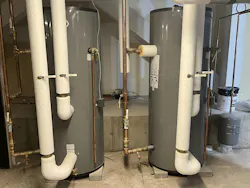
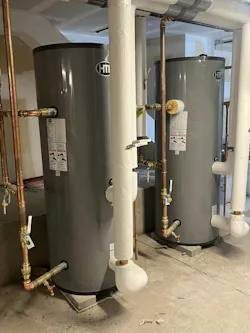
Two 119-gallon HTP SuperStor Ultra EVO indirect units deliver hot water throughout the building and are linked to boiler. The HTP water heaters were specified with support from Corey Merchant of Emerson Swan.
“A different indirect water heater was originally specified, but it was no longer available,’’ Fichera said. “We scrambled and got with Corey and came up with the idea. We bring in our vendors as part of the team to help with some challenges we encounter.”
The building engineer calculated the water heating load for the apartments and determined two HTP SuperStor Ultra EVO indirect tanks could produce enough hot water for residents.
Fichera finds several features of the HTP indirect water heaters especially beneficial. A stainless-steel tank resists corrosion and eliminates the need for anode rods. It is designed to thrive in all water conditions. The 316L stainless steel heat exchanger provides maximum efficiency.
The weight of the indirect was also important for Fichera. At 240 pounds, it is over 100 pounds less than a similarly sized glass-lined indirect.
“All around, it’s the perfect system for this project,’’ Fichera said. “The stainless-steel heat exchanger and the stainless-steel tank are great features, and they have an excellent warranty. They have a restart port built into them, and they have multiple taps on them so you can configure them a couple of different ways. They’re a good product and we’ve never had any hiccups with them.”
Signature Project
Fichera’s team has installed mechanicals for an assortment of important projects in and around Manchester, including colleges, hospitals and manufacturing facilities.
Few of them, however, match the historical significance of one of the community’s most enduring—and endearing—landmarks, and the inherent challenges of a building that dates back 137 years. There are a finite number of projects in which mechanical teams can deliver a generational signature, and this was one of them.
“We generally do a lot of mechanical room upgrades,’’ Fichera said. “This is our first big renovation for a complicated apartment building. But the more complex the project, the more we like it. It allows us to demonstrate our experience and expertise.”
Project at a Glance
What: Rendezvous on Elm is a new 27-unit apartment complex in Manchester, N.H. The structure was formerly named the Dunlap Building, which was built in 1879 and was named to the National Register of Historic Places in 2004.
Massive Renovation: Commercial real estate partners Anthony DeLucia and Dave De Lise invested $10 million into the multi-year renovation, which converted the former office building into apartments with studios and 1- and 2-bedroom units.
System overhaul: Eastern Mechanical of New Hampshire reconfigured the entire HVAC system for the complex, and faced several challenges associated with the building’s age and previous renovations.
In hot water: Two HTP SuperStor Ultra EVO 119-gallon indirect water heaters that provide hot water for all of the apartments.
Did you know? The Dunlap Building was one of Manchester’s first large commercial buildings, and tenants included architects, retail stores and social clubs.