Modern Efficiency, Old School Hydronic Comfort
Key Highlights
- Understanding the history of a boiler system helps inform effective modernization strategies that respect the original design while incorporating new technology
- Replacing an aging boiler with a high-efficiency Lochinvar combi unit significantly improves fuel savings and space utilization in the mechanical room
- Retrofitting with a condensing boiler allows for lower water temperatures, making use of cast iron radiators' large surface area for comfortable heat delivery
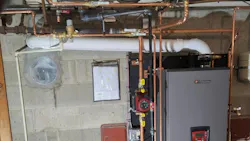
One of the most rewarding aspects of working in hydronics is seeing systems that have been quietly doing their job for generations. Recently, I worked on a boiler replacement that reminded me why understanding a system’s history remains just as important as understanding today’s technology. The project involved a 1950s home whose original boiler had provided nearly seventy years of service before finally reaching retirement age.
The call came from Jonle Heating. They had been servicing the cooling side of this house for years, but now it was finally time to replace the relic of a space heating boiler and domestic tank hogging up most of the basement.
The contractor already had the end goal planned and quoted to the homeowner but wanted me to meet at the jobsite to confirm his plan and go through the new piping arrangement.
History of the Existing Boiler
The first thing I like to do when going into a boiler room is to determine what the life cycle of the existing boiler has been. Seventy years is a remarkable service life for a residential boiler, but during those seven decades the system had undergone numerous modifications.
Walking into the house I noticed there were large cast iron radiators spread throughout the first floor. Entering the basement we passed a few more large radiators along the perimeter of the house.
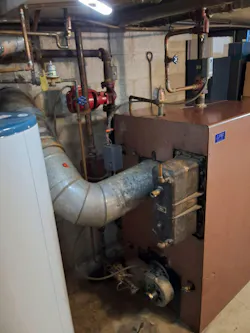
Working toward the boiler room we had to dodge the domestic water tank that was taking up half of the walkway. The domestic tank was newer and evident that at some point this was added. The contractor didn’t have space to work with, so the tank had to be jammed in and vented into the same chimney as the boiler.
If you look closely at the existing boiler, you can see a black box in front of the vent stack with the water connections cut off. That is a tankless hot water heater. This was the OG “combi” boiler. In its original life, this boiler was heating domestic water indirectly. In the black box there is a ½” copper tube coil that held the domestic water. The boiler would run all the time maintaining 140°F or so transferring heat to the domestic water in the ½” coil. This was not a very efficient way to make domestic water, but was popular on the East Coast in the 1960s and 1970s with oil-fired boilers. At some point it had failed, or the homeowner wanted something slightly more efficient. That’s when the separate hot water heater was added.
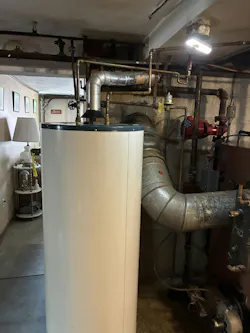
The next thing I noticed was the large diameter black iron piping looping around the basement. When this boiler was originally installed, circulators were either uncommon or rarely used. The hot water was circulated throughout the system by gravity. Eventually, kitchens or bathrooms were remodeled upstairs and radiators had to be moved. The red B&G pump you see behind the boiler was added to the system later in its life to help circulate through the smaller piping used when relocating radiators.
We’ve talked about a couple of different ways this boiler system has been delivering water to the radiators, but where has that water been getting its energy? This boiler could have been coal fired in its original days, but I’m guessing in this case it was originally oil fired. In the boiler’s current state and last leg of its life there was a natural gas power burner added to the bottom of the boiler.
Replacement Boiler Design
By the time we finished tracing the piping and identifying the various modifications, the system had effectively told us its story. The challenge now was determining which elements of that seventy-year-old design still made sense and how to incorporate modern equipment without sacrificing the comfort the homeowners had enjoyed for generations.
I mentioned earlier that the contractor had already determined an end goal. The plan was to replace the existing boiler and tank type water with a single Lochinvar combi boiler. The combi boiler is perfect for this application. The homeowner will appreciate the additional floor space and, more importantly, the fuel cost savings going from a 60-70% efficient on/off boiler and 80% efficient hot water heater, to a 95 + % efficient condensing boiler.
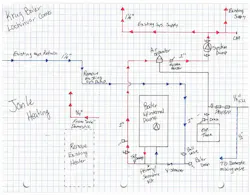
To size the new Lochinvar boiler, you want to look at both the space heating and domestic water loads. In this case, there are 2.5 baths and just 1200 square feet of living space. We chose the 199 MBH input for the extra capacity on the domestic side. We will be a little oversized on the space heating side, but we can limit the fan speed on a space heating call (essentially downsizing the boiler). This can be done through the Lochinvar Smart System control.
The highly efficient combi boiler will hang on the wall behind where the existing boiler currently sits. The existing flow control valve you see directly above the boiler can stay put. This is a good place to begin new piping on our supply side.
Earlier we spoke briefly of the added B&G circulator, this will be a great spot to start our new return piping as the circulator should be moved to the supply side, pumping away from our expansion tank connection.
Speaking of the expansion tank, the old steel tank that was jammed into the floor joist space can be abandoned in place. We will use the ½” connection on the bottom of the new inline air separator as our fill point and add a new bladder style expansion tank.
The existing system was piped as full-flow. The Lochinvar combi boiler will require primary/secondary piping. Our boiler pump is conveniently built into the jacket of the new boiler, but we will need to add a “house” or “system” pump. The location of that pump should be after the new air separator pumping toward the existing supply line.
Lochinvar offers a primary/secondary piping kit that can be used with the combination boilers. The use of this kit really simplifies the piping for the contractor. Instead of worrying about the orientation of “closely spaced tees” or a bulky hydraulic separator, this kit will do the hard work for us. From there, we simply connect the new supply and return piping back into the original.
Execution of the Plan
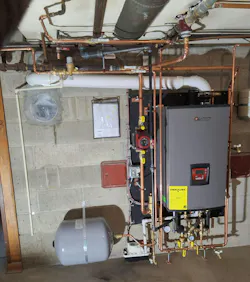
I stopped in to check on the contractor mid-morning on day two of the install. They were wrapping up running the new flue piping down the existing chimney. The boiler was carefully placed on the wall ensuring they had proper pitch in the venting back toward the boiler (1/4” per ft at least).
Installers Dave, Sam and Jared were making quick work of this project. The existing cast iron boiler had already been broken down and taken off the job site. Kudos to them for lugging out the old six section behemoth without any fingers or toes being smashed. Jonle was able to keep the old domestic tank up and running throughout most of the process, leaving the homeowner without hot water for only a short time.
Now the install is complete and the homeowner is very pleased with the new look of the updated mechanical room. The homeowner should start to see savings right away now that their domestic water is coming from the 95% efficient gas fired boiler. The savings should be dramatic this winter by pairing the modern condensing boiler with the existing cast iron radiation, especially here in Cincinnati where we tend to have milder winters. The on/off boiler we just replaced was operating at its lowest efficiency in the mild days of winter that make up roughly 70% of the winter days here in Cincinnati.
One of the biggest advantages of pairing a condensing boiler with cast iron radiation is the ability to operate at lower water temperatures for much of the heating season. The large surface area of the radiators allows comfortable heat delivery even when the boiler is running in its most efficient condensing range.
Projects like this remind us that every boiler room tells a story. Understanding how a system evolved over decades often provides valuable insight into its replacement. By respecting the original design while applying modern technology, we can deliver dramatic efficiency improvements without sacrificing the comfort homeowners have enjoyed for generations.
About the Author
Brady Brophy
Brady Brophy is a Hydronics Department Manager for Corken Steel Products with experience in both the contracting and distribution sides of the HVAC industry. He began his career in 2015 and became a Hydronics Specialist in 2018. Brady supports contractors with the design of radiant floor and snow melt systems, and works across design-build, bid/spec, and retrofit hydronic applications, providing equipment sizing, training and hands-on technical guidance.