PHCC Holds 2026 Legislative Conference: Strength and Unity
Key Highlights
- Industry leaders emphasized the critical role of skilled trades in protecting public health and safety, advocating for a fair regulatory environment
- The conference focused on the skilled labor shortage and the importance of funding apprenticeship and technical education programs
- Energy policy discussions centered on reforming the Energy Policy and Conservation Act and promoting energy choices
- Delegates learned best practices for effective advocacy, including building personal connections and staying on message during Capitol Hill meetings
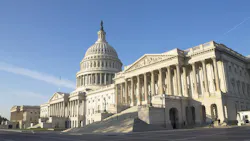
WASHINGTON, DC — This May 5th and 6th, the Plumbing-Heating-Cooling Contractors – National Association (PHCC) met in partnership with the American Supply Association (ASA) in the nation’s capital to advocate for their members.
In their joint welcome message to the conference, Jason Pritchard, President of the PHCC-NA and Kip Miller, President of the ASA, celebrated the impact industry members can make on legislative policy:
“Our government affairs program continues to thrive as legislators, regulators and industry stakeholders look more to the PHCC and ASA as critical resources for guidance in the policymaking process. For us, Legislative Day is Every Day!”
This year, the conference was easily the largest since the pandemic, with 166 badges printed for the member-delegates.
Aligned on the Issues
The key messages of the conference to those legislators and staffers they would be meeting were as straightforward and as urgent as they have ever been:
- The work of PHCC and ASA members protects the health and safety of millions of Americans every day.
- The success of this important work requires a clear, consistent, and fair regulatory environment.
- The country needs a new narrative about the value the skilled trades offer as good-paying, satisfying careers, and policies that will open opportunities for young people pursing those careers.
- The nation needs responsible energy policies that provide consumers with choices that will fit their energy needs.
“We are all aligned on our issues,” Mark Valentini, Vice President, Legislative Affairs for the PHCC-National Association—and one of the main coordinators for the Conference—said in his opening address to the members.
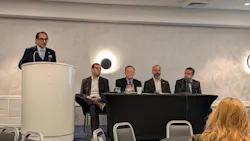
Valentini also thanked those members of the ASA at the Conference, adding that having people from diverse industries, organizations and backgrounds all speaking with the same voice to deliver the same message is the real way to make legislators pay attention. (The last time the ASA joined the PHCC for the Legislative Conference was back in 2007.)
Best Practices
The first day of the Conference was spent getting member-delegates up to speed on the key legislation now being decided in Congress, and on the right approach to take with legislators and their staff (with an emphasis on the staff, who, in many cases, are the real policy experts informing the decisions those Congresspeople will make).
At the Advocacy Best Practices meeting Valentini, Chuck White, PHCC-NA’s Vice President of Regulatory Affairs, Christopher Lindsay, Vice President of Government Relations for IAPMO, Sean Preseton, Vice President of Membership, Advocacy and Events for the Air Conditioning Contractors of America (ACCA) and Palmer Schoening, Chairman of the Family Business Coalition, advised delegates to emphasize policy over politics.
Yes, they admitted, in today’s polarized political atmosphere there are some topics that will never gain any traction with Democrats, some that will never find support among Republicans. But be polite, make a meaningful impression, outline your policy “ask”, thank them for their time and move on to the next meeting.
That meaningful impression, the panelists stressed, was key. With people who take hundreds, if not thousands of meetings a year, do your best to make some kind of human connection. Talk about your business, your industry, and the challenges you face. “Bring your own voice,” Christopher Lindsay said, “your individual stories. Tell them why they should care.”
Stay on topic, they advised, stay on message, and follow up later with an email, or better still a handwritten note.
Workforce Development
Other first-day sessions included Workforce Policy Trends with Craig Brightup, CEO of the Brightup Group, LLC, and Brandon Houston, Director of Workforce Development for SkillsUSA, Jimmy Koch, Government Relations Manager for the Association for Career and Technical Education (ACTE) and James Young, Sr. Director of Congressional Relations for Labor, HR & Safety at Associated General Contactors (AGC).
Their discussion included not just the skilled labor shortfall—118,000 unfilled vacancies in 2024 for plumbing & heating contractors—but the critical lack of teachers to educate young people who do show an interest in the trades.
Two points stood out: first, that the conversation around the skilled trades is starting to change, with the image of the trades rising in the public opinion. Second, that employers need to be more closely involved in training, whether that be through their own training programs or participating with vocational schools or community colleges in their area.
The key ask: ensuring continued funding for the Department of Labor’s registered apprentice program, the Workforce Innovation and Opportunities Act, and the Perkins Career and Technical Education program (Perkins CTE).
Keynote
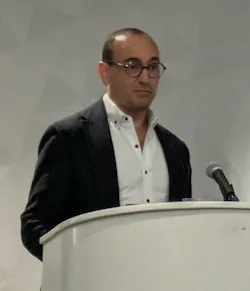
After lunch, Bob Wolfer, Manager of Government Relations at Bradford White introduced keynote speaker Brent Buchanan, President and founder of Cygnal, an international polling firm.
In his presentation, The Map. The Path. The Mood., Buchanan broke down the coming mid-term election. He emphasized that, unlike elections in years past, the mood of the country and the popularity of the president are simply not very good predictors of how races across the country might go.
In his breakdown of Congressional races, in the Senate there are 35 seats up, with Republicans defending 22 and Democrats defending 13. In the House, there are only 19 seats that could be called a toss-up.
According to the best present polling, these races present an odd mirror image: for Democrats to win the Senate they would need to “run the table”—to win nearly all of those open seats. Likewise, for the Republicans to keep the house they would need to do the same. The most likely outcome (at present) is the House flips to the Democrats, and the Senate stays Republican by a razor-thin majority.
Over and over, Buchanan returned to one central theme: anger. Anger, like it or not, seems to be the great motivator in modern politics; it is the angry people that get out and vote in the mid-terms. “And right now,” Buchanan said, “anger favors the Democrats.”
Energy Policy
Other sessions on the first day included The Chuck and Mark Show, where Chuck White and Mark Valentini partnered with the ASA’s Vice President of Advocacy Steve Rossi to look at policy agendas.
Closing out the day was the Washington Insider Panel, moderated by White and Rossi, with Alex Ayers, Vice President of Government Affairs for the Heating, Air-Conditioning, Refrigeration Distributors (HARDI), Jim Collura, Vice President and Director of Government Affairs for the National Energy and Fuels Institute (NEFI), Allison Ealey, Managing Director, Government Affairs & Public Policy for the American Gas Association (AGA), and Bradford White’s Bob Wolfer.
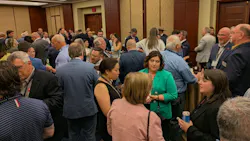
While White, Valentini and Rossi retuned briefly to workforce development, most of the rest of the day’s sessions were spent discussing energy policy. Of key concern was the Energy Policy and Conservation Act (EPCA), first signed into law back in 1975 when the country was in the grip of an energy crisis. EPCA is in need of reform, specifically the “lookback” provision that requires the Department of Energy to review regulated products in pursuit of higher efficiencies.
Other legislation of note included the Energy Choice Act (H.R. 3699), that would include preemption provisions for natural gas—meaning no state could outright ban natural gas as an energy source. (By the same token, it would also prevent deep-red states from banning wind, solar or biomass-generated energy.)
The key ask: the growing patchwork of energy efficiency regulations among the several states makes it urgent to reform EPCA. This reform should also extend the lookback period to allow sufficient time to determine if new policies are truly effective.
The Long Walk Up Capitol Hill
The next morning all the delegates were provided with a hot breakfast, a pep talk from Mark Valentini, and the thanks of the event’s sponsors: Bradford White, Federated Insurance, and SCORPION.
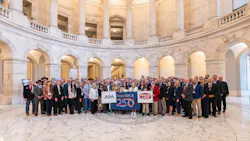
After that it was time for the long walk up Capitol Hill in a light drizzle, first for a group picture in Russell Senate Office Building, then to a long day of meetings.
About the Author
Steve Spaulding
Editor-in-Chief - CONTRACTOR
Steve Spaulding is Editor-in-Chief for CONTRACTOR Magazine. He has been with the magazine since 1996, and has contributed to Radiant Living, NATE Magazine, and other Endeavor Media properties. You can find him on LinkedIn at www.linkedin.com/in/stevespaulding.