PILC: Advocating for the Health of the Industry
Key Highlights
- PILC brings together leading industry associations to address shared challenges and promote unified advocacy for public health and water sustainability
- Key issues discussed include workforce development, trade tariffs, water regulations, and federal programs like WaterSense that support water quality and efficiency
- Trade and tariffs significantly impact costs, prompting industry strategies such as early procurement and diversification to mitigate volatility
- Advocacy efforts on Capitol Hill target legislation supporting water reuse, workforce training, and infrastructure funding to ensure industry resilience.
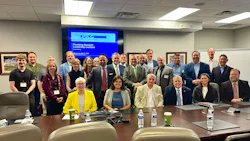
GAITHERSBURG, MD — Brought together by Plumbing Manufacturers International (PMI), the International Association of Plumbing and Mechanical Officials (IAPMO), and the American Society of Plumbing Engineers (ASPE), PILC brings leading plumbing and HVAC associations together to identify shared challenges, align priorities, and advance solutions that benefit public health, water sustainability and the built environment. The Plumbing Industry Leadership Coalition—or PILC—exists, in essence, because the plumbing industry's biggest challenges can't be solved by any one organization.
“Its mission is simple: collaborate where collaboration delivers better outcomes for the industry and the public. When the industry speaks with one voice, we can move faster and have a greater impact,” says Kerry Stackpole, CEO/Executive Director, PMI.
According to Stackpole, the future of plumbing depends on three things: people, policy, and science, and these issues dominated the discussion: workforce development, trade and tariffs, the rapidly changing water regulatory landscape, and continued support for proven federal programs.
Furthermore, Dain Hansen, Executive Vice President, Government Relations, IAPMO, says that there are a number of issues that are impacting stakeholders across the plumbing sector. “The first was trade and supply-chain resilience: tariffs are now a structural cost driver for our members, not a passing disruption, and that touched almost every other conversation we had.
“The second was the integrity of the products entering the US market: counterfeit, falsely certified, and unsafe plumbing products sold through online marketplaces, and what stronger customs enforcement and marketplace accountability should look like.
“Third was the federal regulatory and funding environment: PFAS drinking water rules, EPA's WaterSense program, the plumbing research program at the National Institute of Standards and Technology (NIST) and water infrastructure appropriations,” says Hansen.
And running underneath all of it were our core legislative priorities: the Healthy H2O Act, the Advancing Water Reuse Act, the Water Conservation Rebate Tax Parity Act, and workforce development.
Budget Pressures
Hosted on the NIST campus in Gaithersburg, MD, PILC leaders focused on ensuring the industry has the people, policies and research needed to meet future challenges. But a sense of urgency looms as NIST faces continued federal budget pressures.
“I'd describe it as real budget pressure, but not a death sentence. And the distinction matters. The administration's FY2027 request was aggressive toward both NIST and EPA: it proposed cutting NIST to roughly $854 million and characterized the agency as having a ‘radical climate agenda,’” says Hansen, “but Congress has consistently refused to make the financial cuts to the extent that the White House would like in their budget.”
For context, the House Appropriations Committee landed NIST at around $1 billion, a roughly $160 million trim from the prior year but far short of the administration's proposed cut. And the Senate, which has rejected the House's deeper cuts in recent years, is expected to release its own EPA proposal in late June, which sets up a fall negotiation that, historically, lands well above the opening offers.
WaterSense is a small, voluntary, low-cost program that's earned bipartisan appropriations-report support since the program was authorized back in 2018, and that track record is its best protection. “Nobody should be complacent. These programs have to be defended every cycle, but the question isn't really ‘kill or keep,’ it's ‘at what level,’” says Hansen.
The Real Payoff
Why are the two programs essential? NIST’s research is helping ensure the water coming out of every tap is safe, efficient, and reliable. “Their work on premise plumbing is advancing the science behind water quality, energy efficiency and building performance, making it essential infrastructure for public health in the 21st century,” says Stackpole.
EPA’s WaterSense proves what smart government investment can accomplish. In just 20 years, WaterSense has helped save nearly 10 trillion gallons of water and more than $245 billion on utility bills. “Continued funding for NIST, WaterSense and similar programs isn’t an expense—it’s an investment in public health, water security and economic savings for every American household,” continues Stackpole.
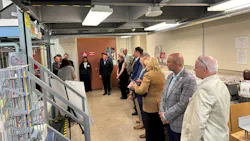
On NIST specifically, the plumbing research program was authorized in the CHIPS and Science Act, and is the only federal effort coordinating premise-plumbing research with the private sector. “We essentially walked away from this kind of work in the 1970s, and we're now paying for it in gaps around water quality, efficiency and the science behind our codes and standards. Hosting our annual meeting at NIST in Gaithersburg, touring the Plumbing Hydraulics Lab, isn't ceremonial. It's a reminder that the measurement science behind safe drinking water doesn't happen by accident. We are also excited this year that the House included report language supporting this important program,” says Hansen.
Trade & Tariffs
One of the most concrete discussions, trade and tariffs resonated deep because members are living it. According to Hansen’s numbers—and he is as locked in on the inner workings of DC as anybody—the current environment includes 50% tariffs on steel, aluminum, and copper, 25% on derivative fabricated products, 15% on industrial and electrical equipment containing those metals, and a 10% global baseline, plus added duties on lumber.
The downstream effect: roughly 70% of contractors are affected, construction input prices have been rising at about a 7% annualized clip in early 2026, materials are running 4–6% of total project cost, and projects are being delayed, rebid, or scaled back because of the volatility.
Hansen contends that the talking points landed on from the meeting were practical.
First, this is now a permanent planning factor. Members are adopting price-escalation clauses, buying and stocking earlier and diversifying suppliers.
Second, the policy ask threads a needle: strengthen domestic manufacturing without driving up costs on essential plumbing products that protect public health.
Third—and this one should be flagged as the big strategic item—the USMCA (United States-Mexico-Canada Agreement) joint review is expected to launch around July 1, 2026, and the consensus read is that the most likely outcome is "extension with modifications" rather than status quo or breakdown.
“With $1.9 trillion in annual North American trade and deeply integrated supply chains at stake, we told members this is the moment to engage early, not after the terms are set. Tariffs used to be a line item. Now they're a strategy,” says Hansen.
PFAS Developments
Hansen says the main development in regard to PFAS is regulatory rather than legislative. On May 18, 2026, EPA proposed two rules: one would rescind the drinking-water standards for four PFAS: PFHxS, PFNA, GenX (HFPO-DA), and the hazard-index mixture that includes PFBS, and the other would keep the 4-parts-per-trillion limits for PFOA and PFOS but let water systems apply for two more years, pushing compliance from 2029 to 2031. EPA frames it as correcting a procedural defect in how the Biden-era rule was issued; critics call it a rollback.
What's on the horizon? “None of this is final,” says Hansen. “It's still in rulemaking, it's tangled up in DC Circuit litigation, and several states already have their own enforceable PFAS limits that, in some cases, cover the very compounds the federal rescission would drop. EPA has also signaled it may regulate additional PFAS in the future and even floated the possibility of stricter standards later. So, the regulatory floor is genuinely uncertain.”
For PILC, the angle stays consistent regardless of where the federal numbers settle: certified point-of-use and point-of-entry treatment works today. That's why the Healthy H2O Act and the Federal Insecticide, Fungicide, and Rodenticide Act (FIFRA) compliance-pathway work discussed at the meeting matter. They get certified, tested filtration into the homes and small systems that need it now, instead of waiting on a moving regulatory target.
Capitol Hill
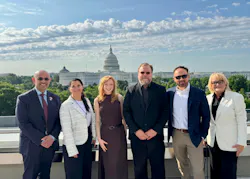
The annual PILC meeting instituted a “lobby day,” advocating on Capitol Hill for today’s most important topics. According to Hansen, the headline would read: “PILC heads into this fly-in with a tight, nine-item priority slate organized into three buckets.”
On policy and trade, it's customs enforcement against counterfeit and noncompliant products, plus tariff and supply-chain resilience. On legislation, it's four bipartisan bills: the Advancing Water Reuse Act and its 30% investment tax credit, the Water Conservation Rebate Tax Parity Act, the Healthy H2O Act, and Workforce Innovation and Opportunity Act (WIOA)-based skilled workforce development. And on appropriations, it's FY2027 water infrastructure funding, the aforementioned EPA WaterSense and NIST plumbing research programs.
Data Center Discussion
Finally, data center talk was broached at the meeting through the topics of appropriations and water. The House FY2027 Energy-Water bill drew real attention to the role data centers are playing in rising electricity bills, and appropriators added an amendment directing DOE to identify and mitigate data centers' impacts on energy and water consumption, grid reliability and ratepayers, and to evaluate technologies that make them more efficient.
“That's squarely a plumbing-and-water-systems conversation, even if people don't immediately think of it that way,” says Hansen. “A single 100-megawatt data center can use about as much water as 2,600 households, and many proposed facilities are more than 10 times that size. Congress is moving on transparency.”
There's now bipartisan interest, including a Data Center Water and Energy Transparency Act requiring facilities to disclose their energy and water usage, and the states are even more active, with hundreds of bills filed and the question shifting from "how do we attract data centers" to "who pays" for the water and grid impacts.
For PILC, the opportunity is to be a constructive voice on the water side: efficient cooling, water reuse and recycling—which ties directly back to the support for the Advancing Water Reuse Act—measurement and standards, and making sure the infrastructure buildout is done with certified, code-compliant systems and workforce. “If data centers are the next ‘industrial revolution,’ water is one of the constraints that decides how far it goes, and that's exactly the conversation of which our industry should be at the center,” says Hansen.