Key Highlights
- The effectiveness of multi-skilling varies greatly depending on the complexity and technical requirements of specific trades
- Liability concerns arise when unlicensed or improperly trained workers perform specialized tasks, risking safety and legal repercussions
- Historical examples demonstrate that rigid work rules and outdated practices can hinder efficiency, but safety and skill integrity must remain priorities
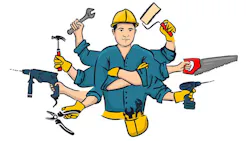
An article regarding cross-training, or “multi-skilling,” in last month’s CONTRACTOR Magazine caught my eye. The concept, as well as a whole bunch of statistics, seems to bear out the premise that cross-skills training in the construction trades would be a boon to the entire industry. It shows that the ABC (Associated Builders and Contractors) would benefit greatly from doing that very thing. According to the Simplar Foundation study, multi-skilled crews would be able to put as much as 39% more time into direct construction work versus the present system. Now an almost 40% increase in productivity is nothing to sneeze at! Further, the article claims that it could reduce crew size by 45% to 72%! That statistic seems huge to me, based on my limited understanding of the study.
Short-Sightedness
My initial reaction to the spate of “statistics” by a company whose primary task is analysis, not hands on field experience, was “hogwash.” Then I parsed the article a little deeper and realized that the general scope was broad, but in my opinion, the specifics were narrow. It seems that the gist of the data presented was not aimed at the general construction industry, but rather construction of large infrastructure projects, i.e.- bridges, roadways, etc. At least that was my takeaway.
I could see where a steel installer, or rebar installer, working on a bridge overpass might be cross trained to help with setting concrete forms. Likewise, in a more residential construct, I could envision a carpenter being cross trained to install or tape and texture drywall. After all the skill set is similar if not exact. I cannot, however, see a journeyman electrician being cross trained to install an HVAC chilled water system or a clean room plumbing system, or even a DWV system. The level of technical expertise in the major trades precludes cross-training outright.
The Liability Conundrum
Imagine, for a moment, that a GC decides that cross training people is a great idea and proceeds with that plan. He takes “Joe Roofer” and cross trains him to install light fixtures in a custom home. Sounds great, right? Look how much time he saves getting the job done quicker, instead of having to wait for the darned electrician to get there. Instead, his project is completed quickly using available manpower. Great idea, best of intentions... what could go wrong?
I’m spitballing here, so bear with me. Let’s look a little deeper into this great idea; “Joe Roofer” can twist the wires and install fans and lights, etc. Without proper trade background, he inadvertently attaches a ground to a neutral. Once the system is energized, the problem becomes more than academic.
Now, today, when most house mains are PVC, that might not sound like such a big deal. In times past (and in buildings today like hospitals) copper tubing is still used for the main water supply. The upshot of which means that the electrical system is usually “grounded” to the copper main somewhere. See where this is going? Best case, Mrs. New Homeowner opens a shower valve, only to get a little shock. Worst case, Mrs. New Homeowner gets a bigger shock and has a heart attack. When the dust clears who has the liability? Not “Joe Roofer.” The GC does.
Taking licensed trades and turning them over to unlicensed or mis-licensed people is, in this columnist’s opinion, a recipe for disaster. Not only in the custom home market but for the broader construction industry at large. There is a reason that there is a licensing requirement for the skilled trades. Much of what those trades do requires knowledge which cannot be mastered in the short term, and certainly not in the time required to “multi-skill” on-site workers.
“Jack of all trades, master of none” doesn’t work well when liability comes into focus. Much of what the skilled trade works with can be dangerous, or deadly, and should not be treated lightly in order to gain a modicum of time.
The Labor Market Circa 2026
While there is no question that the current labor market is abysmal (and not likely to improve in the near future) might I suggest that the labor pool is the problem. That is not a reason to take what has been a successful training and seasoning regimen and try to short circuit it for the sake of time and schedules.
There has always been a market for semi-skilled and unskilled labor in the construction industry. Over time these people learn and adapt and can be relied upon to do many types of jobs. The key element here is “time.” Cross-training semi or unskilled labor to perform jobs for which lengthy training is required will not end well for anyone. If the objective is to give the worker a sense of “accomplishment” or some other esoteric “feel good” outcome, then say so. Don’t pretend that a supposed 39% increase in productivity is the panacea for which this entire effort is made.
History Can Bear Out the Premise
Now, I’m not saying that things need to go back to the way they were 70 or so years ago, but there is an old adage that says (paraphrasing), “Those who do not learn from history are doomed to repeat it!” Living history is replete with anecdotes showing how badly things can go if innovation is not taken seriously.
Forgive an old guy for using the “when I was a boy” cliche, but back in the late 1950s and early 1960s, when all DWV and sanitary systems were installed in cast iron, there was an apartment building being constructed on Long Island.
There were five or six plumbers and apprentices working on the underground. At one point they ran out of pipe. A semi truck load of cast iron was delivered to the job site. In order to keep the job moving, the pipe needed to be unloaded. Being a union project, not one of the six, big burly plumbers or apprentices was permitted to move a single piece of that cast iron off the truck. That work fell to the teamsters, who were not yet present on site. So, the plumbers and apprentices got to stand around and wait (all while being paid) for the teamsters to show up and unload the truck.
Anyone with a lick of common sense could see the waste in that arrangement. That extreme example of rigid, self-protecting work rules could lead to the idea, eventually, of multiskilling.
That little story is worth remembering in the discussion of multiskilling, but perhaps not for the reason its proponents might think. There is a wide gulf between allowing a skilled worker to perform a basic task, and attempting to cross-train that same worker into another specialized trade. On the one hand, cross-training a simple task eliminates needless inefficiency, one the other hand it can introduce serious questions of competency, safety and liability.
History certainly shows that work practices must evolve, and outdated, inefficient practices should not be maintained simply because “that’s the way we’ve always done it.” Neither should the pendulum swing so far in the other direction that efficiency, alone, becomes an excuse for diminishing or bypassing training, experience and expertise required of the skilled trades.
About the Author
Al Schwartz
Founder
The Brooklyn, N.Y.-born author is a retired third generation master plumber. He founded Sunflower Plumbing & Heating in Shirley, N.Y., in 1975 and A Professional Commercial Plumbing Inc. in Phoenix in 1980. He holds residential, commercial, industrial and solar plumbing licenses and is certified in welding, clean rooms, polypropylene gas fusion and medical gas piping. He can be reached at [email protected].