From Warehouse Work to True Fabrication: How MEP Contractors Can Unlock Prefab’s Full Potential
Key Highlights
- Prefabrication success depends on designing a production system, not just relocating tasks indoors
- Lean manufacturing principles and facility layout are essential for creating predictable, scalable operations
- Digital tools and data integration improve workflow visibility, reduce errors, and enable proactive decision-making
- True fabrication reduces waste, enhances quality, and allows for efficient scaling without proportional increases in staff
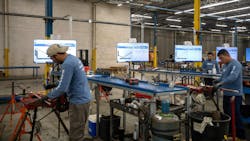
Across the MEP industry, more contractors are moving toward prefabrication. However, there is a significant difference between performing construction tasks in a warehouse and running a true fabrication operation. Understanding that difference can affect productivity, predictability, and profit.
Construction in a Warehouse: Same Work, Different Location
Many contractors begin their prefabrication journey by relocating field work indoors. Crews, processes, and tools that are used on the jobsite are simply transferred to a warehouse environment. On the surface, this appears to be progress. Work is protected from weather, and coordination may improve slightly.
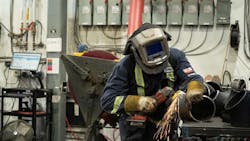
The reality is that much remains unchanged. Crews often build one-off assemblies rather than standardized products. Facility layouts are frequently driven by convenience rather than production flow. Materials and tools are stored wherever space allows. Schedules respond to immediate project demands rather than planned capacity.
This approach may offer small improvements, but it does not create a fabrication system. The warehouse becomes another construction site under a roof, carrying the same challenges of unpredictable throughput, variable quality, and difficulty scaling operations.
Fabrication as a Designed System
True fabrication requires designing a production system that integrates with the overall delivery workflow. Contractors who achieve success in fabrication apply manufacturing principles to every aspect of the operation.
Lean production methods remove waste and create flow. Work cells are organized to follow consistent sequences, maximizing repeatability. Statistical monitoring tracks variation and enables continuous improvement. Data from design and planning systems, including BIM and ERP, drives production schedules.
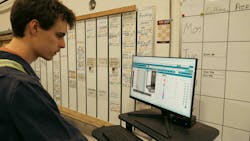
Facility design reflects these principles. Material flow follows a deliberate path. Assembly stations are arranged to support consistent production cycles. The shop operates as part of a larger system that connects estimating, project management, and field installation. Production is not isolated from project delivery; it becomes a measurable and predictable part of the process.
The benefits of this approach are tangible. Operations produce consistent output with fewer people. Lessons learned in production feed back into design and planning. Predictable throughput and standardized quality create a strategic advantage, improving the overall efficiency of projects and increasing profit margins.
Technology and Data Integration
Digital tools play a critical role in bridging construction and manufacturing. Software solutions allow contractors to track materials, monitor work progress, and integrate production planning with project delivery. Data from design models, ERP systems, and material tracking provides visibility into bottlenecks and identifies opportunities to optimize flow.
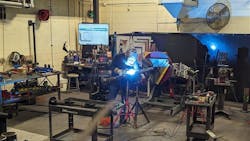
Automation and AI can help reduce repetitive manual tasks and provide early warnings for potential delays. Scheduling software can align production capacity with project timelines, enabling contractors to anticipate and adjust for changes before they disrupt workflow. Accurate, real-time data makes resource planning more precise and helps maintain quality standards across multiple projects.
Technology also supports workforce efficiency. Teams can focus on value-added work while software handles scheduling, material allocation, and reporting. This reduces the risk of human error, keeps production moving at a predictable pace, and allows management to make decisions based on measurable metrics rather than assumptions.
The Impact on Business Performance
Adopting true fabrication practices changes how a business operates. It moves the focus from firefighting and rework to repeatable processes and predictable output. Contractors can scale operations without adding proportional staff or overhead. Cost savings emerge from reduced waste, improved labor utilization, and minimized project delays.
Standardized processes also improve safety and quality. With clearly defined workflows and fewer one-off assemblies, mistakes are easier to prevent and detect. Teams gain confidence in predictable production cycles, and clients see consistent, reliable results.
Successful contractors treat their fabrication facilities as production systems rather than simply indoor construction sites. Every step, from layout to workflow to scheduling, is designed with efficiency in mind. Digital tools amplify these benefits, providing the information needed to keep operations synchronized and optimized.
Shifting from Reactive to Proactive Workflows
The difference between a warehouse and a fabrication facility often comes down to mindset. Moving work indoors without changing how it is organized keeps teams reactive. Implementing structured, repeatable processes allows organizations to plan ahead, monitor performance, and continuously improve.
Facilities that embrace this approach can deliver higher-quality products faster, use fewer resources, and achieve better margins. Data-driven decision-making replaces guesswork, and production becomes a predictable and scalable component of the business.
Contractors that commit to building a fabrication operation see measurable gains in productivity, workforce efficiency, and project outcomes. Moving to prefab is more than a change of location. It is a fundamental shift in how work is organized, measured, and executed. When the facility operates like a high-performance manufacturing system, contractors unlock the full potential of prefabrication.
The Bottom Line
Contractors must ask whether they are simply relocating construction tasks or truly transforming production. Facilities designed as fabrication operations improve consistency, reduce waste, and create a competitive advantage. Digital tools, structured processes, and data-driven planning make this possible. Moving to prefab without these systems only shifts existing problems indoors.
About the Author
Jake Olsen
Jake Olsen is the CEO of Stratus, a high-growth construction tech company that transforms MEP construction through digital prefabrication and software. With over 20 years of experience in engineering and construction technology, he specializes in solving skilled labor shortages, optimizing large-scale project delivery with AI, BIM, and digital workflows, and building high-performance, outcome-driven teams.