Powering Collaboration: How Common Data Environments Enable Real-Time Connectivity and Collaboration
Key Highlights
- CDEs serve as a single source of truth, consolidating data from design, construction, and maintenance to improve project visibility and coordination
- Digital twins enhance project quality by identifying conflicts early, reducing rework, and supporting predictive maintenance for long-term asset management
- Implementing CDEs benefits construction firms of all sizes by improving workflows, reducing risks, and delivering better project outcomes

Data is growing exponentially in all industries, especially construction. According to research from Deloitte Access Economics, construction managers and company leaders spend nearly 12 hours each week searching for and analyzing data, yet more than 60% of it won’t be used to make business decisions. Information is powerful, valuable and transformative when it’s well-managed – but without strategic oversight, that same data can quickly turn into information overload.
This is especially true given that every construction company today is a data company, creating data from notes, photos, 3D models, various reports, accounts payable and receivable analytics, etc. This reality is fueling the rapid adoption of common data environments (CDEs), which serve as a central location for project information to be accessed and shared, seamlessly connecting the office, field and broader technology ecosystem. CDEs transform project efficiency by eliminating wasted hours spent searching for information—much of which often goes unanalyzed and unused.
The Golden Thread of Data: Powered by CDEs
Serving as a single source of truth, CDEs are transforming how project teams capture, share and act on information. By consolidating critical data from every stage of the project lifecycle—from design and construction to commissioning, operation and maintenance—CDEs provide a secure, accessible hub that connects all stakeholders. This unified foundation enables real-time collaboration, greater visibility, faster decision-making and ultimately, stronger project outcomes. Centralized access ensures that everyone is working from the same current information, helping teams maintain schedules, control costs and improve coordination across disciplines.
The benefits of CDEs extend well beyond efficiency. By bridging the divide between physical and digital construction data, CDEs pave the way for advanced capabilities such as digital twins—virtual, real-time representations of physical assets. These interactive models allow teams to plan, design and construct with greater precision while also supporting long-term operations and maintenance. By connecting data across systems, disciplines and phases of a project, CDEs help teams anticipate issues before they occur and optimize performance throughout an asset’s lifecycle.
Digital twins, in particular, enhance quality and reduce risk by identifying design conflicts, material inefficiencies and safety hazards early in the process, minimizing costly rework. Steel fabricators, for example, overlay steel data onto 3D models to detect clashes before construction begins, while civil contractors use survey and machine control data to ensure excavation and grading meet design specifications. In both instances, teams provide proactive insights to accelerate approvals and keep projects on track.
Beyond construction, digital twins serve as enduring assets for owners, providing a comprehensive, real-time view of a building or infrastructure. This digital foundation supports predictive maintenance, operational monitoring and performance optimization, extending asset life and reducing unexpected downtime. By integrating digital twins within a CDE’s golden thread, stakeholders gain enhanced visibility, streamline workflows and unlock long-term savings—turning fragmented data into actionable intelligence and redefining the future of connected construction.
Smarter Collaboration, Better Build with CDEs
A powerful CDE gives project stakeholders a centralized platform to collaborate seamlessly. Licensed users can easily access and update project information in real time, while shareable links extend visibility to non-licensed participants. This flexibility allows teams to exchange information and gather feedback efficiently, regardless of a collaborator’s technical expertise or software access. At the same time, customizable permissions ensure that sensitive or confidential data remains securely controlled, granting access only to authorized users.
For Canam Group, a leading designer and manufacturer of steel components, the value of an effective CDE is clear. The company regularly uses Trimble Connect as its digital collaboration hub, connecting internal departments with external partners across every project it undertakes. When stakeholders or customers lack their own compatible platform, Canam provides them with access to Trimble Connect, ensuring all parties can engage with the same set of accurate, up-to-date information.
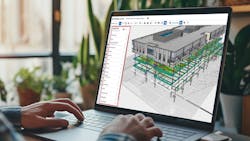
This unified approach has streamlined communication and coordination across disciplines. Canam relies on the publication and management of internal and external Issued for Construction (IFC) drawings within its CDE to maintain alignment throughout the workflow. This real-time availability means customers and trade partners can review updates instantly, reducing delays and misunderstandings that often accompany version mismatches or scattered documentation.
The benefits are particularly evident in complex coordination efforts. Early-stage, iterative collaboration has proven invaluable when aligning joist geometry and bridging positions with HVAC systems and sprinkler lines—areas where precision and timing are critical. By leveraging a single, shared digital environment, Canam fosters transparency, accelerates feedback loops and keeps every stakeholder working from the same page, literally and figuratively.
Driving Collaboration Through a Common Data Thread
Centralizing project information through a CDE ensures all stakeholders work from the same accurate, up-to-date data—breaking down silos, enhancing communication and accelerating decision-making. The result is smoother workflows, higher-quality outcomes and more confident project delivery. Importantly, the ROI of real-time collaboration and data sharing isn’t limited to large construction firms. In fact, companies of all sizes can harness a CDE’s benefits to streamline operations and drive efficiency.
About the Author
Chris Peppler
Chris Peppler is the vice president of platform for Trimble, with a focus on the Trimble Connect collaboration platform, which lets project teams securely share, view and coordinate 3D models, documents and data in real time.