Key Highlights
- Sustainability in plumbing now extends to faucet performance, with stricter flow rate targets and integrated water quality considerations
- Modern faucets incorporate smart controls, such as automatic shut-off and app-based adjustments, to optimize water use and reduce callbacks
- Modular designs with replaceable components enable easier repairs, longer service life, and reduced waste
Sustainability requirements are no longer coming only from designers or facility owners—they are showing up directly in plumbing submittals, inspections, and replacement specifications. For contractors, faucets have become one of the most visible ways projects demonstrate water efficiency, code compliance, and long-term value.
According to a report by Bluefield Research, water prices are going up in many places across the US are rising twice as much as inflation due to aging infrastructure needing major repairs (like lead pipe replacements). Climate change is impacting supply, with 80% of the states experiencing water shortages affecting supply, leading to increased operational costs, with utilities implementing significant rate hikes to fund these necessary upgrades.
The challenge is not understanding sustainability—it is delivering it without increasing callbacks, maintenance headaches, or unnecessary fitting replacement.
Codes and Programs Are Setting the Floor, Not the Ceiling
Most contractors are already familiar with EPA WaterSense®, LEED® via USGBC, and CALGreen if in California. What has changed is how aggressively these frameworks are pushing fitting performance. What is at stake here is that many regions are facing water shortages. And compounding this is the growth of data centers nationwide.
In meeting these requirements, faucet performance is stepping up and is three times more efficient than it was in 1992. Flow rates at 0.50 GPM used to be the benchmark. Today, many projects are targeting 0.35 GPM at the faucet—and expecting performance to hold up in real-world conditions. That puts more pressure on faucet design, flow rate selection, and control strategy than ever before.
Showers are facing similar pressure to meet stricter water-efficiency targets while still supporting health and operational requirements. Low-flow 1.50 GPM shower systems must now balance reduced GPM limits with performance expectations, particularly in facilities with intermittent use where stagnant water can become a concern. As a result, newer shower designs are addressing both conservation and water quality by minimizing standing water in piping after use—demonstrating that compliance increasingly requires solutions that meet multiple performance objectives at once, not just lower flow rates.
Flow Rate Is Only Part of the Equation
At ultra-low flow rates, sustainability success depends heavily on aerator performance. Contractors know that not all aerators behave the same at reduced flow. Spray patterns, pressure compensation, and application matching all matter—especially in high-traffic or healthcare environments where user complaints quickly turn into service calls.
Getting sustainability right at the faucet means selecting components designed to work together, not just hitting a number on a submittal sheet.
Manual, Metering, and Touchless: Choosing the Right Tool
There is no universal “best” faucet type—only the right choice for the application.
Manual to Metering faucets remain viable in many commercial settings when paired with low-flow outlets, especially where simplicity and durability are priorities. In commercial kitchens where water flow needs to be strong, think “Pressure Compensating Outlet.” Select manual deck faucets that are equipped with a pressure compensating outlet to not only save water but to also provide a consistent flow rate over varying pressure ranges. These can range from 1.5 GPM to 2.2 GPM. Pressure compensating outlets are available with a laminar flow as well. Replace the pre-rinse faucet nozzle, which is typically 1.6 GPM or higher, with a high pressure, low-flow pre-rinse valve now available at 1.0 GPM.
Metering faucets continue to be one of the most effective ways to reduce water waste by controlling run time. From a sustainability and cost perspective, an often-overlooked advantage is that many existing commercial manual faucets can be converted to metering in the field using a metering cartridge and body avoiding full fitting replacement. That reduces material waste, labor, and downtime—key sustainability wins that do not always show up in green scorecards.
Touchless faucets provide the most control, particularly in high-use environments. Adjustable run times, automatic shut-off, and consistent operation help reduce water use while minimizing user-induced wear. There is the added benefit of passing hands by the sensor rather than activating a handle to reduce the spread of germs.
Smart Controls Reduce Guesswork and Callbacks
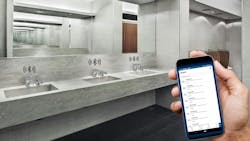
Touchless faucets paired with monitoring phone apps give contractors and facility teams tools that did not exist a decade ago. Instead of mechanical adjustments or trial-and-error tuning, run times and shut-off settings can be dialed in precisely.
Power Matters: Eliminating Batteries from the Maintenance Cycle
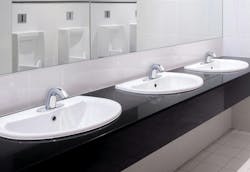
Battery replacement is rarely discussed in sustainability conversations, but contractors know the maintenance burden it creates. Self-powered faucets that use water turbines eliminate that issue entirely.
Faucet design can generate power from normal use, reducing maintenance labor and eliminating battery disposal. Over the life of a building, which translates into real operational savings and fewer service calls—another form of sustainability that owners increasingly value.
Sustainability Includes Serviceability
True sustainability is not just about water savings—it is about keeping fittings in service longer. Faucets designed with replaceable cartridges, sensors, and electronics allow worn components to be swapped without removing the entire fitting.
For contractors, this modular approach means:
- Faster repairs
- Lower material costs.
- Less waste sent to landfills.
- Happier owners who do not have to replace fittings prematurely.
In many cases, upgrading internals or converting operation types delivers more environmental benefit than full replacement.
Proving the Numbers
Potentially, water efficient faucets enable buildings to reduce usage by 20%.
Water savings calculators help move sustainability from theory to reality. Being able to show estimated water and cost savings helps contractors support fitting selections, justify upgrades, and align with owner expectations—especially on retrofit projects where ROI matters.
The Contractor’s Role in Sustainable Plumbing
Plumbing contractors are not being asked to reinvent sustainability—they are being asked to execute it smarter. That means understanding how flow rates, controls, power sources, and serviceability work together over the life of a fitting.
When faucets are selected and installed with that full picture in mind, sustainability becomes less about chasing certifications and more about delivering durable, efficient systems that perform day after day.
About the Author
Pat Tanzillo
Pat Tanzillo is Lab Commercial Manager and the Product Expert for Chicago Faucets. His focus is the laboratory market—providing technical and product support. In addition, Tanzillo provides general customer support and works with sales on national account development.