Five Best Practices for Fabrication-Ready Piping Design
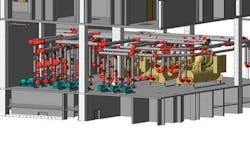
According to Autodesk and FMI, nearly 52% of all rework in construction stems from insufficient project data and poor communication. As schedules tighten and margins face increasing pressure, contractors are searching for better ways to control their operations.
Fabrication-ready design offers a solution by enabling mechanical contractors to cut material waste, speed installations and free up their workforce to take on more projects. This approach involves planning piping systems in the office using standardized components, consistent measurements and shop-friendly assembly sequences that translate directly into efficient fabrication workflows. Although most of today's contractors have BIM tools that make fabrication possible, many haven't fully adapted their design processes to leverage these capabilities. The following five practices bridge the gap between engineering specifications and day-to-day fabrication shop operations.
Best Practice #1: Standardize Pipe Lengths and Spool Sizes
The first step toward fabrication efficiency is rounding measurements to establish standard sizes that reduce assembly variation in the shop. While most mechanical drawings specify pipe to the nearest 1/16th of an inch, this level of precision creates unnecessary complexity. A 10-foot-3 9/16-inch spool and a 10-foot-3 1/2-inch spool require separate processing. Round both to 10 feet in the design and the fabrication process creates half as many unique parts. BIM add-ins such as Victaulic Tools for Revit® (VTFR) can help automate this process by standardizing lengths and suggesting appropriate fittings during the modeling phase.
Beyond simplifying individual cuts, organizing spool fabrication schedules by size allows shop teams to work with one size at a time. When cutting three-inch pipe all morning, workers set up the cutting station once and run through 50 pieces without interruption. Switching to six-inch pipe means reconfiguring the station, a changeover that takes 30 to 60 minutes. Batching by size eliminates these interruptions.
The benefits extend beyond the shop floor as well. Standard-length spools stack efficiently in delivery trucks, maximizing space and reducing transportation costs.
Best Practice #2: Create Repeatable Connection Details
Moving beyond individual pipe lengths, contractors should develop standardized approaches for common connections like pump hookups, equipment installations and valve assemblies. A typical pump hookup includes isolation valves on both sides, a check valve, pressure gauge, flexible connector, drain valve and multiple supports. Creating each connection from scratch wastes design time and complicates fabrication.
Transform these common connection types into documented "products" that can be replicated across multiple projects. Specify the exact sequence—for example: isolation valve, flexible connector, check valve, isolation valve—and define support locations relative to the pump centerline. That pump connection becomes a product the shop can fabricate identically, whether it's going into a hospital chiller plant, office building mechanical room or school boiler room.
Standardized details reduce fabrication time and eliminate field guesswork about proper assembly. Train both fab shop workers and field crews on these standard connections to ensure consistent quality.
Best Practice #3: Use Technology to Bridge Mechanical Design and Fabrication
By leveraging BIM software and mechanical manufacturer libraries, construction teams can streamline the design-to-shop transition. Certain manufacturer-specific BIM tools such as VTFR integrate component libraries to ensure designers work with parts shops can actually procure and fabricate. For example, with VTFR, when selecting a grooved coupling from a digital library, the software automatically accounts for exact dimensions, installation requirements and compatible pipe schedules, eliminating scenarios where designers specify incompatible connection types or fittings the shop doesn't stock.
Technology also enables flexibility through automated conversion tools that quickly switch between piping connection types without requiring designers to redraw connections. When a section of welded pipe needs to change to grooved connections because of space constraints, conversion tools allow designers to select the affected segments and replace all connections while maintaining routing and overall dimensions.
Taking integration further, contractors can connect design software directly with mechanical fabrication equipment to eliminate manual handoffs where errors occur. When cutting and grooving machines read directly from the BIM model, contractors eliminate manual transcription of measurements, removing a common source of fabrication errors—provided designers model with the detail fabrication requires. Digital libraries of standard mechanical components further ensure consistency across piping projects. When designers can access documented pump connections rather than recreating them, they use the standards and everyone works from the same information.
Best Practice #4: Structure Production Cycles to Balance Efficiency and Flexibility
Once standardization and technology integration are in place, contractors optimize their production scheduling by establishing structured production cycles that match their operational needs. The challenge is balancing two competing demands: long production runs maximize shop efficiency but lock contractors into single projects, while short runs maintain flexibility but reduce productivity with constant changeovers.
The solution lies in determining the right cycle length for your operation. Calculate how much material your field crews consume in a typical week, then structure production cycles that keep them supplied while maintaining the ability to switch between projects. Many fabrication shops find cycles of three to five days strike this balance, but the optimal length depends on shop capacity, crew size and the number of active projects.
Regardless of specific timeframe, structure each cycle with distinct production phases. Group similar operations together: cutting and grooving in one phase, assembly and supports in another and final inspection and staging in a third. This allows supervisors to catch issues while they're still in process rather than discovering problems after an entire cycle is complete.
This structured approach also provides natural decision points. When projects encounter delays or design changes, contractors can adjust a single production cycle rather than unraveling weeks of committed work. Spool tracking systems such as the Victaulic SpoolTracker App can help shops monitor component status through each phase and maintain visibility across multiple projects, making it easier to coordinate production with field demand.
Best Practice #5: Design Mechanical Systems for Shop Advantages
With standardization, technology and scheduling optimized, the next step is to leverage controlled shop environments where maintaining consistent work quality is easier than under field conditions. Shop floors offer consistent lighting, climate control and bench-height work surfaces that improve both speed and accuracy. A pipe assembly that takes 45 minutes to fabricate on site with multiple interruptions can often be completed in 20 minutes in a shop. Pre-fabricated spools arrive at the job site ready for installation, with components designed to fit into allocated space, reducing conflicts and minimizing field adjustments.
Shop fabrication helps preserve the coordination established during the design phase. Pre-fabricated assemblies reduce the number of connections that must be made in the field. A mechanical room that would require 80 connections with stick-built pipe might need only 30 with shop-fabricated spools. Fewer field connections mean faster installation and more consistent joint quality since shop-controlled conditions enable more precise assembly work.
Avoiding Common Pitfalls
While these five practices provide a roadmap, implementation requires careful attention to avoid common missteps.
Don't jump into fabrication without proper training. Assess current BIM skills and coordination experience before beginning. If designers don't understand how to coordinate mechanical, electrical and plumbing systems in 3D, fabricating from those models will produce field conflicts.
Rather than trying to standardize everything at once, start with the most common connection types: pump hookups and valve assemblies. Get those right and documented before expanding to more complex scenarios.
Success also requires training design teams, fabricators and field crews together so they understand each other's challenges and capabilities. When a designer understands that a routing decision adds fabrication time, they route differently.
Establish metrics to track progress. Measure material waste percentages, installation hours per ton of equipment and rework incidents to identify which standards are performing and which need refinement.
About the Author
Ralph Schoch
Ralph Schoch is the Revit, Technology and Internal Support Manager at Victaulic, where he leads BIM implementation and fabrication-ready design initiatives for mechanical contractors. With more than two decades of experience in construction technology, Schoch has developed standardized approaches that help contractors bridge the gap between engineering specifications and shop fabrication. He regularly trains contractor teams on leveraging BIM tools for improved project outcomes.