The Evolution of Low-Flow Fixtures in Commercial and Foodservice Applications
Key Highlights
- Low-flow has evolved: Modern fixtures no longer sacrifice performance—today’s designs optimize pressure, spray and system efficiency, not just reduce flow
- System-level thinking matters: Real savings now come from how fixtures perform across the entire plumbing system, including hot water demand, energy use and lifecycle costs
- Workforce + workflow impact: In high-demand environments like healthcare and foodservice, properly engineered fixtures can improve speed, sanitation and consistency while still reducing water use

Efficiency expectations in commercial facilities have shifted significantly over the past several decades. What was once viewed primarily as regulatory compliance has become a core operational priority. Organizations are now expected to reduce water and energy consumption while maintaining the performance and reliability required in high-demand environments.
High-use fixtures in restrooms, healthcare facilities, schools, and hospitality settings face increasing pressure to reduce water demand without compromising hygiene standards, user satisfaction, or peak traffic capacity. Fixtures must support sanitation protocols, operate consistently under heavy use, and avoid disrupting workflows.
In foodservice environments, the challenge can be even greater. Commercial kitchens rely heavily on water for food preparation, cleaning, and sanitation, requiring operators to balance sustainability goals with operational speed and strict hygiene standards. Dishrooms, prep stations, and janitorial areas depend on fixtures that support efficient task completion while helping reduce overall water and hot water demand.
For many years, low-flow fixtures were met with skepticism in high-demand settings due to concerns about weaker performance and longer task times. Advances in engineering have reshaped that perception. Modern low-flow fixtures optimize spray dynamics, pressure, and flow characteristics rather than simply restricting water volume. As a result, efficiency is now evaluated at the system and lifecycle level, not just by a fixture’s flow rating.
Early Low-Flow Designs Delivered Compliance Without Performance
The first major regulatory catalyst for low-flow plumbing fixtures arrived with the Energy Policy Act of 1992 (EPAct). The law established national water efficiency standards for common plumbing fixtures, including faucets, showerheads, and toilets, with the requirements taking effect in 1994. These standards set maximum allowable flow rates and created a new compliance framework that manufacturers and facility operators had to follow.
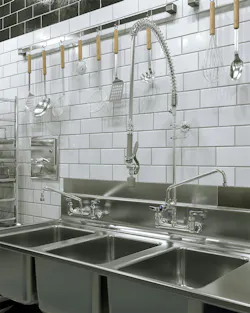
Many early implementations relied on simple design approaches. Residential-style aerators and mechanical flow restrictors were applied directly to commercial fixtures, though they were not always engineered for high-use duty cycles.
As deployment expanded, performance issues surfaced. Reduced flow sometimes weakened rinsing, lowered spray velocity, and lengthened fill times, slowing workflows. Maintenance teams often responded by removing restrictors or installing higher-flow components, undermining conservation goals.
The problem was a technical mismatch. Early designs reduced flow without reengineering hydraulic performance for commercial use. By the early 2000s, the industry recognized that flow ratings alone did not predict real-world efficiency, helping drive application-specific low-flow designs built to support both conservation and operational performance.
The Shift to Application-Specific Engineering
By the mid-2000s, the commercial plumbing industry reached an inflection point. Facility managers, engineers, and foodservice operators increasingly demanded measurable water and energy savings without sacrificing throughput, sanitation performance, or user experience. Compliance alone was no longer sufficient. Efficiency solutions needed to perform reliably in real-world operating conditions.
Several policy developments accelerated this shift. The Energy Policy Act of 2005 introduced the first federal efficiency standard for commercial pre-rinse spray valves, limiting flow to 1.6 gallons per minute beginning in 2006. Around the same time, the EPA launched the WaterSense program, promoting plumbing fixtures that demonstrated both water efficiency and verified performance. These developments pushed manufacturers beyond simple flow restriction toward more engineered approaches to efficiency.
Manufacturers began developing purpose-built fixture platforms for specific environments rather than applying generic low-flow components across all fixtures. Distinct engineering approaches emerged for restrooms, healthcare handwashing stations, foodservice cleaning operations, and janitorial service sinks.
This shift emphasized task-based performance. Fixtures were engineered to maintain rinse coverage, stable pressure performance, and effective soil removal while using less water. As a result, low-flow technology evolved into application-driven engineering that supports sanitation, productivity, and water efficiency in demanding commercial environments.
The Rise of System-Level Efficiency and Smart Controls
From the early 2010s forward, efficiency in commercial plumbing has increasingly been evaluated at the system level rather than at the fixture alone. For facility owners and operators, the conversation expanded beyond simple gallons-per-minute ratings to include total water use, energy demand, operating costs, and long-term maintenance. EPA guidance now explicitly frames water efficiency in commercial buildings as a business case tied to water shortages, rising costs, and strain on water infrastructure.
That broader view also reflects the water-energy nexus. In commercial facilities, reducing hot water use can lower both water consumption and the energy required to heat, store, and deliver it. EPA’s WaterSense guidance specifically notes that facilities with substantial water-heating needs can reduce hot water demand by retrofitting or replacing fixtures, fittings, and appliances, including kitchen and sanitation equipment.
At the same time, smart controls became more common in commercial restrooms and institutional settings. Automatic sensor faucets, metering faucets, and self-closing designs introduced tighter control over run time and shutoff behavior. The EPA notes that these technologies can provide hands-free sanitation benefits, while also emphasizing that their water-saving value depends on proper application and programming.
In foodservice, system-level thinking became even more visible. The DOE’s framework for commercial pre-rinse spray valves now evaluates both flow rate and spray force, reinforcing the industry’s shift toward performance-based efficiency rather than simple restriction. The EPA likewise highlights that high-efficiency pre-rinse spray valves can reduce both water and energy costs in commercial kitchens.
Today, that is the industry reality. Benchmarking, metering, and water-use analysis increasingly help operators judge fixtures by how they perform in context: how much water a task actually consumes, how much hot water demand it creates, and how reliably the fixture performs over time. In that environment, high-efficiency fixtures are often expected to outperform legacy higher-flow designs not just on paper, but across the full operating life of the system.
The Future of High-Efficiency Commercial Faucets
The next phase of high-efficiency commercial faucet design will likely be defined by deeper system integration, better data visibility, and closer alignment between fixture performance and building operations. As water and energy management become strategic priorities, fixtures are increasingly viewed as part of a connected plumbing ecosystem rather than isolated points of use.
One area of evolution is integration with building management and water monitoring systems. In larger commercial facilities, operators value fixture-level usage visibility, faster identification of abnormal consumption patterns, and diagnostics that help reduce unplanned maintenance. This supports a more proactive approach to system performance, particularly in campuses, healthcare environments, hospitality properties, and other high-use facilities.
System optimization is also becoming more sophisticated. Instead of evaluating faucets solely by flow rate, project teams increasingly consider how fixture performance interacts with building pressure zones, water heater sizing, and recirculation design. In new construction, this encourages more holistic plumbing system modeling and more deliberate specification decisions early in the design process.
In foodservice, innovation will likely focus on lowering hot water demand without compromising sanitation or workflow. That includes improving spray performance for cleaning tasks, refining ergonomics to support labor efficiency, and balancing water savings with sanitation protocols.
Taken together, these trends reflect a broader industry shift. Water efficiency is now viewed as an operational strategy shaped by collaboration among manufacturers, engineers, contractors, and facility operators, with lifecycle cost and long-term system performance playing a larger role in specification decisions.
The Value of Low-Flow Solutions for the System’s Full Life Cycle
While the earliest era of low-flow fixtures was largely defined by restriction, the industry has shifted toward performance-driven design over the past few decades. In modern systems, efficiency is not determined by flow rate alone. Instead, it is measured by how effectively fixtures perform across the full lifecycle of a plumbing system, including water heating demand, task completion speed, and maintenance reliability.
Low-flow technology now centers on intelligent water management. When fixtures are engineered for specific applications, high-efficiency designs can advance sustainability goals while supporting the operational demands of commercial and foodservice environments.
Today’s high-efficiency fixtures demonstrate that true water conservation is achieved not through limitation, but through engineering solutions that align sustainability with operational performance, an evolution that today’s engineers can continue to learn from.
About the Author
David Scelsi
David Scelsi is Director of Product Development at T&S Brass and Bronze Works, where he leads the development and launch of innovative products that drive sales growth and expand, product categories focused on real-world customer needs.