The Gas or Brake Matrix™: How Contractors Should Pick Their First AI Workflow
Key Highlights
- Use the Gas or Brake Matrix to identify workflows with high upside and low build difficulty, such as AR, for quick AI wins that improve cash flow
- Prioritize simple, existing tools and data to build confidence and demonstrate AI's value before tackling complex, long-term projects
- Build organizational discipline by inventorying all workflows, evaluating their potential upside, and systematically deploying AI where it counts most.

A mechanical contractor pulled me aside last month. His mid-market firm is profitable and growing. But he’s out of cash. His days sales outstanding (DSO) has stretched past 95 days. His line of credit is drawn down hard. Every new project means paying crews now for work the general contractor (GC) won’t sign off on for three months. Growth is eating him alive.
He’d already tried the usual fixes. Tightened collections cadence with his AR clerk. Talked to his banker about expanding the line. None of it moved DSO meaningfully, and none of it would scale with the firm. The work he was managing had outgrown the tools he was managing it with. He didn’t come to me looking for an AI solution. He came looking for a way out of the cash trap. AI turned out to be the answer.
The J-Curve Problem
His situation isn’t unusual. Most contractors I talk to already know AI is part of the answer. The harder question is what to actually do with it.
The lagging companies fall into two categories: those not using AI at all, and those using it without discipline. Rebuilding processes around AI has a start-up cost. Staff experiment, and several people build AI tools to solve the same problem independently. Work gets done twice: once the old way and once with AI. A 2025 working paper from the US Census Bureau's Center for Economic Studies, drawing on data from tens of thousands of US manufacturers, found AI adoption follows a J-curve: productivity drops before it accelerates, and only the companies that make it through the drop leave non-adopters behind.
The Gas or Brake Matrix™
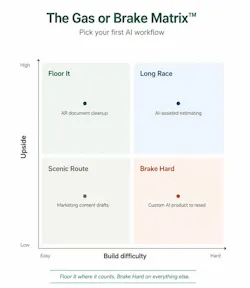
A simple two-by-two called the Gas or Brake Matrix™ brings order to the chaos. Two axes: the upside of fixing a workflow, and the difficulty of building the AI solution. Four quadrants: Floor It (high upside, easy build), Long Race (high upside, hard build), Scenic Route (low upside, easy build), Brake Hard (low upside, hard build).
How to Use the Matrix
The exercise has two passes. The first is an inventory. Sit down with your leadership team and list every workflow in your business where AI could plausibly help, without filtering as you go. Customer intake, dispatch, estimating, AR, payroll, recruiting, marketing, safety, training, performance reviews, anything. The list should run long. If it’s short, you’re filtering already.
The second pass is an evaluation. For each workflow, ask two questions. First, what’s the upside (cash, hours, productivity, quality) when the workflow runs well? Workflows where the honest answer is “not much upside” go to the bottom. If there is high upside, it goes to the top of the matrix. Second, ask how hard is the build? If you can build it with a tool you already pay for and an employee who’s willing to learn, it goes to the left. If the build needs integration, a development partner, clean data you don’t yet have, and the kind of organizational change that makes processes stick, it goes to the right. Plot each workflow.
The honesty of the exercise is the value. Most owners learn more about their business in the second pass than they do in the first.
What Each Quadrant Means
Floor It
This quadrant is for workflows where the upside is undeniable and the build is light. You can do them with a tool you already pay for, documents you already have, and a person on staff who’s willing to learn. These are the workflows that pay back fastest and prove to your team that AI is real, which matters more than it sounds. An example: cleaning up AR submission documents before they go to the GC, catching errors that would otherwise come back as a rejected pay app three weeks later.
Long Race
Workflows landing in this quadrant should have serious upside potential and a real project behind them, the kind that runs six to twelve months and needs a partner, clean data, and organizational change. The mistake is trying to do too many of these at once, or starting one before you’ve earned the runway in Floor It. An example that could land here: rebuilding how your company prices jobs, so historical cost data and labor productivity feed an AI-assisted estimator that catches underwater bids before they go out.
Scenic Route
Projects that are easy to build but don’t materially change your business, things like marketing content drafts or social posts, land here. The temptation is real because the build is fast, but starting here is how firms spend a year producing AI-generated content while estimating and AR still operate the way they did in 2018. Take the scenic route after your Floor It work is humming, not before.
Brake Hard
This is for workflows where the build is expensive and the upside is thin. Custom AI products you imagine selling to other contractors, or agentic systems built on top of data that still lives in spreadsheets. The mistake is assuming that because something is AI-related, it must be valuable. Companies who chase Brake Hard work first stay in the productivity drop the longest. Pull over until you’ve earned the runway.
From Framework to Action
Remember the contractor with DSO past 95 days, a line of credit drawn down hard, and growth that was eating him alive?
He sat down with the matrix and listed every workflow he could think of. AR landed at the top because the upside was undeniable: getting cash he had already earned into his bank account fifteen days sooner. The build was the harder call. His first instinct was to outsource it, which would have put the project in the Long Race quadrant. I convinced him it wasn't necessary. He had every rejected pay app from the last few months sitting in a folder, and he was already paying for ChatGPT.
The right first move cost nothing and took fifteen minutes. He pulled up one rejected pay app, opened ChatGPT with his PM, and pasted in the application alongside the underlying contract. He asked where the two didn't line up. The model spotted three things in seconds: two line-item math errors, a missing schedule of values, and a retainage formula that didn't match what the contract called for. His PM submitted clean the next day. The pay app was approved.
That fifteen minutes did two things at once. It put cash in the door faster, and it proved to him and to his PM that the workflow was worth building around.
Floor It where the upside is real. Brake Hard is where it isn't. Run the matrix to know the difference.
About the Author
Brandon Pipkin
Brandon Pipkin is VP of Business Development at Autobahn Consultants, contributing deep expertise in sales strategy, execution, and operational efficiency. His work focuses on helping sales organizations move from hustle-driven performance to disciplined, repeatable systems that scale. He is co-author of the upcoming book, Rock Your Business: Navigating the Road from $50 Million to $500 Million and Beyond.