The Hidden Job-Cost Leak in Multi-Trade Commercial Mechanical Contractors
Key Highlights
- Most jobs have revenue recorded but lack detailed cost data, leading to hidden margin leaks over time
- Multi-trade projects are especially vulnerable due to sequencing dependencies and poor real-time data capture, causing costly delays and misallocations
- Key leak points include delayed time capture, unclosed work orders, invoicing slips, indirect labor misallocation, and untracked change orders
- Operational habits like capturing labor at the source, enforcing work order closeout, and weekly dashboard reviews are essential to fixing leaks

Last month, a mechanical contractor in Ohio walked me through his year-end numbers on a 14-week hospital retrofit. On paper, the job closed at a 22% gross margin. When his controller finally reconciled the phase codes three weeks after closeout, the rough-in phase had actually run 11 points under bid and the trim-out had bled 19.
The job looked healthy in aggregate. Underneath, one phase was subsidizing another, and the estimator was about to bid the next hospital using numbers that lied to him. That kind of blind spot is not rare. A 2026 index from Level CFO found that 91% of jobs have revenue recorded but no cost data coded to the job itself.
For plumbing, hydronic, and mechanical shops running commercial work with mixed crews, that gap is where margin quietly disappears. It rarely shows up as one big loss. It shows up as a slow drip: a plumber idling while the electrician finishes a panel, a service tech closing out a work order two days after leaving the site, a supervisor's four hours of coordination time posted to overhead instead of the job. Individually, none of it triggers an alarm. Aggregated across a fiscal year, it is the difference between a shop that reinvests and a shop that refinances.
Where the Leak Actually Starts
I have spent a lot of time reading through LinkedIn threads and Reddit posts from mechanical contractors, and then calling operators to compare notes. The pattern that keeps repeating is not that shops lack job-costing systems. Most have something, even if it is a spreadsheet stapled to QuickBooks. The pattern is that the data feeding those systems is late, incomplete, or coded to the wrong level.
Jonas Construction Software makes the point that labor is the largest cost on most construction projects, and paper timesheets create lag, misallocation, and hidden variances across cost codes. That matches what I hear on the phone. A service manager for a 40-tech plumbing and mechanical shop in the Carolinas told me his techs were turning in weekly time sheets on Monday morning for the prior week. By the time payroll ran and hours got coded to jobs, the job might already be substantially complete. If a plumber had worked three jobs in a day and guessed at the split, nobody was going back to correct it.
Knowify puts a number on the consequence: contractors who properly track hidden costs often find real job costs are 15% to 20% higher than originally calculated. K38 Consulting reports the same range and adds that labor expenses can make up 20% to 50% of a project's total cost, with indirect costs typically representing 15% to 25%. Read those two figures together. If a fifth of your total cost is indirect, and your indirect allocation is guesswork, your true margin on any given job is a rumor.
The Multi-Trade Multiplier
Single-trade shops have job-cost leaks. Multi-trade commercial mechanical shops have them squared.
Here is why. On a mixed plumbing, hydronic, and controls install, the sequencing dependencies compound. If the plumber finishes rough-in a half day late, the insulation crew shifts, the hydronic tie-in shifts, and the controls startup gets pushed into a Saturday at time-and-a-half. Somebody eats that premium. Usually it is not the customer.
FieldEx describes a multi-trade commercial water-heater job where plumber and electrician coordination on a whiteboard created expensive idle time. That whiteboard is the tell. Most mechanical shops I talk to still run their multi-trade dispatch off a whiteboard, a shared calendar, or a text thread between two supervisors. None of those tools produces a labor record that ties back to a job phase. The hours get worked. The hours get paid. The hours do not always get coded correctly.
BuildOps points out that slow RFI response times are a major jobsite delay, and bad project data plus miscommunication drive rework. In multi-trade work, an RFI on the mechanical side can strand two other trades. From contractors I work with directly, the operators who get the most out of leads management are the ones who consistently log lead source, so within a season they actually know which marketing channel is funding their growth. The same discipline principle applies to job costing: the shops that win are the ones logging the small stuff in real time, not the ones with the fanciest reports.
The Five Places Money Leaks First
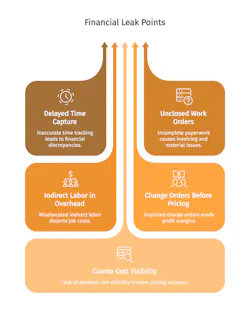
From the operator conversations and the third-party reporting, five leak points show up over and over on commercial multi-trade mechanical work:
-
Delayed time capture. Hours coded to the wrong job or the wrong phase because a tech filled out his card at the end of the week. Jonas and a 2025 J-Stage study both point to objective, real-time tracking as the fix.
-
Unclosed work orders. A tech leaves the site with the work done but the paperwork open. Invoicing slips. Materials pulled from the truck never get posted to the job. Most operators report that the hardest part of going from paper to digital isn't the software, it's getting field techs to consistently close out work orders before leaving the site, and shops that enforce that one habit see almost everything else fall into place.
-
Indirect labor left in overhead. Supervision, PM time, drive time between jobs, and payroll burden get parked in a G&A bucket instead of the job. Saltmarsh Advisors recommends including payroll taxes, workers' comp, benefits, and per diem or travel in the labor line.
-
Change orders performed before they are priced. Construction Business Owner lists this among the top causes of margin distortion. On commercial mechanical work with an owner's rep on site, the pressure to keep moving often beats the discipline to stop and paper it.
-
Coarse cost visibility. Jonas argues, and I agree, that job-level totals can look healthy while specific phases are already bleeding cost. If you cannot see rough-in versus trim-out versus startup, you cannot fix pricing on the next bid.
What Actually Fixes It
None of the fixes are exotic. They are operational habits, enforced weekly, with tooling that removes the friction from the habit.
First, capture labor at the source. If a tech's phone can clock him in and out against a specific job and phase, the reconciliation problem shrinks. Deloitte's 2026 Engineering and Construction outlook notes U.S. construction wages were up 4.2% year over year as of August 2025. Every hour miscoded now costs more than it did two years ago.
Second, enforce work-order closeout before the truck leaves. This is the one habit that separates the shops that scale from the ones that stall. Materials, notes, photos, customer signature, all captured on site. When the tech leaves, the job is billable.
Third, get the indirects into the job. Housecall Pro cites Ruth King on the need to include overhead in job costing and to know overhead cost per hour and net profit per hour. If you do not know your loaded hourly cost by trade, you are bidding blind.
Fourth, read the dashboard weekly. Not monthly. Weekly. The typical contractor on our platform runs somewhere in the 15-30% range of jobs as emergency calls, and those shops lean hardest on real-time dispatch reassignment rather than fixed-route planning to keep technicians billable. That kind of volatility means the difference between a healthy quarter and a soft one shows up in three or four weeks of drift. In our customer base, HVAC and plumbing shops that integrate their accounting through Xero rather than running parallel books cut their month-end close time meaningfully, with the biggest gains showing up at shops with three or more office staff.
Fifth, do an estimate-versus-actual review on every closed job over a set dollar threshold. Projul's 2026 job-costing guide emphasizes weekly reviews, phase-level tracking, and equipment rates. SVA Accounting adds change orders and material tracking to the same review discipline. The point is not the software. The point is that the next estimate improves because the last one was audited.
The Compounding Effect
Here is what makes this urgent right now. PeopleReady's Q4 2025 Construction and Skilled Labor Report says average hourly earnings are up roughly 4.0% year over year while positions remain difficult to fill. Dodge Construction Network's 2026 report says 62% of trades firms are emphasizing training as a response to labor pressure.
Translation: your labor is more expensive, harder to replace, and less experienced on average. That means every hour of a senior technician's time posted to the wrong job or lost to coordination idle time costs more, hurts worse, and is more likely to happen. The tolerance for coarse job costing was already thin. In 2026 it is gone.
The mechanical contractors I talk to who are growing profitably are not necessarily the ones with the biggest backlog. They are the ones who know, on Friday afternoon, which of their open jobs are on track and which are three cost codes into trouble. That knowledge is a habit, and the habit is built one closed-out work order at a time.
An Operator Takeaway
If you run a multi-trade mechanical shop and you cannot answer three questions right now (what did we spend on labor this week by job, how many work orders closed same-day, and which two phases on your largest current job are running hot), the leak is already there. You just haven't found it yet. Start with the habit, add the tooling to make the habit easy, then read the numbers weekly until the shape of the leak reveals itself. The margin has always been in the details. In 2026, it is only in the details.
About the Author
Bhargavi Halthore
Bhargavi Halthore is a content writer at Field Promax, a field service management platform serving trades businesses across the USA and Canada. With over a decade of experience writing for business owners, she brings detailed, ground-level insight to every topic she covers. Her research goes beyond search results: she digs into LinkedIn groups, Facebook communities, and Reddit forums to understand what field service business owners are actually dealing with on the ground. She speaks directly with industry professionals, understands their day-to-day challenges, and translates that into content that is practical and actionable. What you read in her articles reflects real conversations with operators, not theory. Connect with her on LinkedIn.