Five Insurance Questions to Ask Before the Next Leak
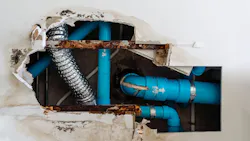
Every plumber knows some version of the call.
“There’s water coming through the ceiling.”
The original job may have been routine: replace a valve, reconnect a supply line, install a fixture. The failed part may cost less than the service call. By the time anyone notices, however, water has crossed rooms or floors and the owner is counting damaged finishes, equipment, inventory and lost operating time.
The repair is still plumbing. The dispute that follows is not.
That gap is why an insurance review should begin with the work, not the policy binder. Before the next renewal, put these five questions to the person handling your coverage.
1. What happens when a small failure causes a large loss?
A plumber can usually identify the immediate fix. Shut off the water. Open the wall. Replace the failed component. Dry the area. Restore service.
An insurance claim separates that work from the wider damage. The cost to correct a defective connection may be treated differently from damage to flooring, drywall, tenant improvements or property belonging to someone else. There may also be mold allegations, lost-income claims or demands from parties the contractor never dealt with directly.
Ask how the quoted policy approaches resulting damage after completed work. Then make the question concrete: a connection fails six months after the invoice is paid and damages two occupied floors. What part of that scenario is the policy intended to address, and which endorsements could change the answer?
Pay particular attention to the completed-operations limit and aggregate. Many plumbing losses arrive long after the crew leaves, when records are harder to find and several trades may have touched the system. Good documentation helps establish dates, scope and responsibility, but it cannot repair a coverage gap.
No responsible broker can promise how a hypothetical claim will be decided. Facts, allegations, state law and policy wording all matter. A broker should still be able to explain where the uncertainty sits.
For a broader look at liability, employee injuries and quote preparation, Kinro’s general liability insurance guide for plumbers provides a useful companion checklist.
2. Does the application describe the company you actually run?
Consider two businesses.
One handles residential service, fixture replacement and interior remodeling. The other cleans drains, excavates sewer laterals, installs gas piping, works on water mains and subcontracts excavation. Both may write “plumbing” on an application. An insurer will not necessarily see the same risk.
The submission needs the shape of the operation, not just the trade label. Revenue split between service and new construction matters. So do residential versus commercial work, maximum excavation depth, largest project, hot work, gas or LP-gas operations, water treatment, fire-protection work and the use of subcontractors.
This is not paperwork for its own sake. A quote built for interior service work can look excellent until someone discovers that street connections, deep excavation or fuel-gas work were never contemplated.
There is no advantage in making the company appear simpler than it is. The classifications and descriptions on the policy are evidence of what the insurer believed it was covering.
3. Which exclusions come closest to the work on your schedule?
Plumbers tend to think of a service area geographically. A policy can redraw it by activity.
A water-damage limitation can affect the loss a contractor worries about most. An excavation endorsement may remove work below a stated depth. A hot-work warranty may require a permit, fire watch or other controls. Restrictions may also involve mold or fungi, pollution, gas work, tract housing, condominiums, apartments, healthcare occupancies or work performed by subcontractors.
Not every restriction is a problem. A contractor that never performs LP-gas work does not need a program designed around it. The trouble begins when an excluded activity appears on the company’s website, invoices or schedule every week.
Do not settle for “full coverage.” There is no useful insurance review hiding inside that phrase. Ask the broker to identify the three exclusions or limitations that come closest to the work actually performed.
Then discuss real jobs, not abstract policy language.
If the company has added drain cleaning, excavation, hydronic work, gas piping, design-build responsibility or a new type of commercial customer, say so before renewal. Small operational changes can move a contractor into a different underwriting conversation.
4. What, exactly, is the cheaper quote pricing?
Price matters. Contractors should expect their broker to compete for it. The comparison only works when each insurer is looking at substantially the same business.
To see how wide the market can be, we reviewed a set of roughly 100 general-liability quotes provided to small-business applicants through Kinro during June and July 2026. The average total for the quoted term was $1,144.91. The median was $830.68.
The difference between the average and the median matters. The offers ranged from $459.96 to $5,392.24, and a small number of higher-priced risks pulled the average upward. The records also span several small-business industries, not only plumbing.
This is not a plumbing-industry benchmark, an indication or an offer. It is an all-industry snapshot. Its value is not predicting your quote; it is showing why a price without its assumptions is nearly meaningless. A sewer contractor excavating to the street, a hydronic contractor performing hot work and a residential service plumber are not interchangeable simply because all three touch pipe.
Compare total annual cost, limits, deductibles, classifications and endorsements. If one option is dramatically cheaper, ask what work the insurer believed it was pricing. Sometimes the answer is healthy competition. Sometimes it is a different company on paper.
5. Is your broker still testing the market after the policy is placed?
An independent broker should do more than collect the same renewal from the same carrier once a year.
At Kinro, we are not tied to one insurer. We compare the direct, wholesale and specialty markets available for the contractor’s state, class and actual operations. We review price signals month by month and challenge a client’s program when the market, the coverage or the business has materially changed.
That does not mean replacing policies every month. Constant churn can create its own problems. It means keeping pressure on both price and coverage, and making a change when the evidence supports it.
Help the broker do that work. Provide a current breakdown of operations, payroll and revenue. Flag new states, vehicles, services, employee groups and materially larger projects. Explain where the company wants to grow. A clean, accurate submission gives more insurers a fair opportunity to compete and makes their differences easier to see.
The best renewal meeting may still end with the current carrier. The point is to know why.
A leak may begin with a fitting. The insurance outcome begins much earlier—with the description of the business, the restrictions accepted and the questions asked before the water moved.
If you want to test these five questions against your current program, compare business insurance options for plumbers with Kinro at kinro.com/industries/plumbers.
About the Author
Corentin Hugot
Corentin Hugot is co-founder and COO of Kinro, a commercial insurance brokerage focused on making business insurance easier for small companies to understand and prepare for. He works at the intersection of insurance operations, technology and customer experience, helping contractors organize the business details, documents and coverage questions that shape a commercial insurance submission.