Before Renewal, Walk the Boiler Room
Key Highlights
- Begin with a representative project to accurately describe the work, occupancy, and potential risks involved
- Ensure the renewal file details the scope of work, site conditions, and any restrictions related to water damage, hot work, or chemicals
- Specify the actual work performed, including hot work procedures, fuel handling, and subcontractor responsibilities, to clarify coverage needs
- Use a comprehensive comparison of quotes to understand differences in coverage, restrictions, and costs, rather than focusing solely on premiums.
Most insurance renewals begin with a form. Revenue, payroll, vehicles and claims history all matter. The form still may not show what a contractor actually does on a job.
Consider two companies with similar sales. One replaces boilers in single-family homes. The other retrofits mechanical rooms in occupied apartment buildings, reuses parts of old systems, performs hot work and programs controls. Both may be described as contractor, but they do not present the same work to an insurer.
That difference matters when comparing quotes. A lower price is useful only if the insurer understood the business it was pricing.
Before renewal, choose one representative project and walk it with the company’s broker. The goal is simple: show how the work is performed, identify the questions the policy should answer and give each insurer the same accurate description.
Begin With the Building
Ask what would happen if water escaped from the mechanical room. In a home, the damage may be limited to a basement. In a hospital, hotel or apartment building, water can travel through shafts and floor penetrations into electrical equipment, finished space or occupied units.
The broker does not need a tour of every project. A useful renewal file should show the company’s mix of residential and commercial work, the occupancies it regularly enters and the size of its largest typical job.
Why does that matter? Some policies restrict water damage or work in apartments, condominiums, healthcare buildings or other occupancies. The contractor should not be expected to recognize every endorsement. The broker should identify the restrictions closest to the work and explain them in plain language.
Hydronic retrofits rarely provide a clean boundary. A crew may replace the boiler and near-boiler piping while leaving distribution mains, terminal units and controls in service. If an old component later fails, the owner may still argue that the new work caused the problem.
A proposal should state what was inspected, what was tested and what remained outside the project. Broad promises about total system performance should be accepted deliberately, not copied into every contract.
Insurance may treat the cost of correcting the contractor’s own work differently from resulting damage to other property. Coverage after the crew leaves also matters. Bring a representative proposal and contract to the renewal meeting, then ask the broker how the policy addresses completed work and damage involving the existing system.
Describe the Work the Crew Actually Performs
The renewal application should match an ordinary day in the field.
If the crew brazes, solders, welds or cuts, say so. Show the broker the hot-work procedure that is actually followed. Then ask whether the policy excludes hot work or requires a permit, fire watch or other control.
Be equally specific about fuel. Who installs and tests gas piping? Does the company work with propane, oil tanks, chimneys or combustion controls? If a subcontractor performs part of the job, who remains responsible under the contract?
Controls can also change the insurance discussion. Installing equipment to a specified sequence is different from designing the sequence, changing an engineer’s plans, programming a building automation system or promising a performance result. The second group may raise professional-liability questions that a general-liability policy was not designed to answer on its own.
Not every contractor needs every policy. The broker does need an accurate description before recommending coverage or comparing prices.
Check What Goes Down the Drain
System water may contain glycol, inhibitors, cleaners or material left in old piping. A spill during transport, an accidental discharge or disposal into the wrong drain can create cleanup costs beyond the mechanical repair.
Ask who supplies, stores and disposes of treatment chemicals. If chemicals, unknown fluids or environmental cleanup are a regular part of the work, ask the broker to explain the policy’s pollution exclusion and whether separate pollution coverage deserves consideration.
Startup is where the physical work and the promises meet. Clarify who owns commissioning, combustion testing, balancing and owner training. Define what constitutes acceptance and when monitoring or seasonal follow-up ends.
Also separate proof of insurance from the contract itself. A certificate summarizes the policies and limits listed when it was issued; it does not expand the policy. Kinro’s HVAC contractor certificate-of-insurance guide explains what a certificate shows and why the underlying endorsements still matter.
At this point, the broker should have a clear picture of the building types, project scope, hot work, fuel, controls, chemicals and contractual responsibilities. Use that same description for every carrier.
Two recent Kinro quote applications show why premium cannot be read from one exposure alone.
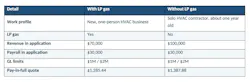
These were separate applicants. Each price reflects the full application, not LP gas alone.
Ask for a Comparison You Can Use
Many renewal proposals lead with premium. Price matters, but the contractor also needs to know what each insurer believed it was quoting.
Ask the broker for a short comparison showing the total annual cost, major limits and deductibles, the operations and classifications used, and the restrictions closest to the company’s work. For a hydronic contractor, those restrictions may involve water damage, hot work, pollution, particular building types or professional services.
This summary does not replace the policy. It makes the tradeoffs visible before a decision is made. If one quote is substantially cheaper, the broker should be able to explain whether the difference comes from healthy competition, a different deductible or a narrower view of the work.
A good renewal meeting should produce more than another certificate and invoice. The contractor should leave knowing what the policy assumes about the business, which restrictions deserve attention and why the selected quote was the best fit.
Bring a representative proposal, a customer contract with insurance requirements, the revenue split between residential and commercial work, the largest typical project and any written hot-work or chemical-handling procedures. Those items give the broker a practical picture without creating another long questionnaire.
After placement, update the broker when services, occupancies, project sizes or contract responsibilities change. The program should evolve when the business materially changes, not simply roll forward each year.
To compare the current program against the work the company actually performs, review contractor insurance options with Kinro.
About the Author
Corentin Hugot
Corentin Hugot is co-founder and COO of Kinro, a commercial insurance brokerage focused on making business insurance easier for small companies to understand and prepare for. He works at the intersection of insurance operations, technology and customer experience, helping contractors organize the business details, documents and coverage questions that shape a commercial insurance submission.