What Every Contractor Should Know About Air Admittance Valves
Key Highlights
- AAVs are one-way valves that allow air into the plumbing system to prevent negative pressure, while sealing to block sewer gases when pressure normalizes
- They reduce the need for extensive vent piping, minimizing roof penetrations, material costs, and installation time, especially in remodels and space-limited applications
- Proper installation height, orientation, and accessibility are critical to ensure AAV functionality and compliance with plumbing codes
- AAVs are recognized by major codes and standards, but local jurisdiction approval is essential before use, as some regions restrict their application

Every plumbing contractor has faced it: a fixture that needs venting, limited wall space to run pipe, and a roof penetration that adds time, labor and risk. In those situations, air admittance valves can offer a practical alternative. When approved by code and installed properly, an AAV can simplify vent routing, reduce material costs, and speed up installation without sacrificing system performance.
Still, many contractors remain cautious. Questions about reliability, inspection approval, and long-term durability persist in the field.
The reality is that modern air admittance valves are tested, code-recognized devices designed to protect trap seals and maintain proper drainage. The key is understanding exactly what they do, where to add them, and how to install them correctly.
What Is an Air Admittance Valve?

An air admittance valve is a one-way mechanical valve installed locally at a plumbing fixture. It allows air to enter the drain, waste, and vent (DWV) system when negative pressure develops, and it closes when pressure equalizes to prevent sewer gas from escaping.
All buildings still require at least one main vent stack that penetrates the roof. An AAV does not replace that requirement. Instead, it replaces secondary or branch vents in jurisdictions that approve it.
AAVs, such as the Oatey Sure-Vent, use a gravity-operated elastomeric diaphragm that responds instantly to pressure changes. When negative pressure occurs, the diaphragm lifts to admit air. Once the system stabilizes, it seals tightly to prevent sewer gases from escaping.
This simplicity is key. With only one moving internal component, there are fewer failure points compared to more complex mechanical assemblies.
Why Contractors Use AAVs
From a contractor’s standpoint, the primary drivers are efficiency and material savings.
Traditional vent stacks require:
● Additional pipe installation
● Fittings and connections
● Roof penetrations with flashing
● Coordination through framing and ceilings
Each added connection creates another potential leak path. By allowing local air intake without running pipe to the roof, AAVs reduce overall vent system footprint.
For contractors, that translates into:
● Less pipe and fewer fittings
● Reduced labor time
● Fewer roof penetrations
● Simpler remodel routing
AAVs are available in multiple sizes, ranging from small residential branch loads to higher commercial DFU ratings, making them scalable across different job types.
Common Jobsite Applications Where AAVs Make Sense
1. Island sinks: Island sinks traditionally require loop vents that run back to a wall and tie into the main vent system. That can mean 10 feet or more of additional pipe and labor. An AAV installed inside the island cabinet eliminates that loop and simplifies the layout.
2. Remodels and additions: When tying into an existing vent stack requires cutting into finished walls or ceilings, AAVs provide a localized solution. Contractors can add fixtures with less disruption and fewer structural modifications.
3. Basement bathrooms: Remote bathroom groups often require complex vent routing. A properly sized AAV can simplify installation when allowed by code.
4. Reducing roof penetrations: Every roof penetration requires flashing and sealing. Fewer penetrations reduce leak risk and long-term maintenance exposure.
Code Compliance and Limitations
AAVs are recognized and permitted by major plumbing codes, reflecting broad acceptance as a compliant venting method.
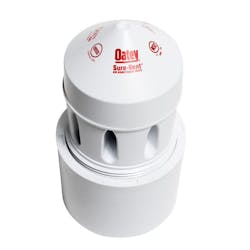
The Oatey Sure-Vent® AAV, for example, is manufactured to meet ASSE Standards 1050 and 1051 and is listed with the International Association of Plumbing and Mechanical Officials for verified performance and reliability. Sure-Vent models are available in four sizes, ranging from 8 Stack/20 Branch Drainage Fixture Units (DFU) to 160 Branch/500 Stack DFU, providing contractors with scalable options for both residential and commercial projects.
However, the local code remains the final authority. Even if a state permits AAV use under a particular plumbing code, individual jurisdictions may restrict or prohibit them. Some regions, including certain areas of California, do not allow AAVs, regardless of statewide code alignment.
Contractors should always verify local requirements before specifying an AAV.
Choosing the Right AAV for the Fixture Load
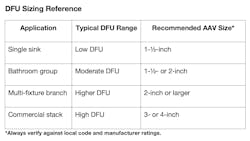
You can determine which size AAV you’ll need based on the DFU load—such as an island sink or bathroom group—it will vent. An AAV’s ability to breathe is measured in DFUs. The higher the DFU rating on the valve, the more air that can enter the DWV system.
DFU loads are assigned to plumbing fixtures based on discharge volume rate, operating duration, and time between operations. Common fixture load ratings are shown in the table below.
To ensure proper breathing capability, determine all fixtures to be vented and calculate the total DFU load. Then select the appropriate AAV for the application. Proper AAV sizing is critical because under-sizing will prevent the plumbing system from operating properly.
AAVs are typically available with 1-½-, 2-, 3- and 4-inch adapter connections. The adapter size is based on the diameter of the vent pipe it is being installed on. Generally, a vent should be sized to be half the diameter of the drain it serves. (Refer to local codes for specific vent size recommendations.)
Installation Best Practices to Prevent Callbacks
Most AAV issues stem from improper installation.
Height requirements: An AAV must be installed at least four inches above the horizontal branch drain. While code permits installation below the flood level rim in many cases, installing the valve higher when possible provides additional protection against overflow conditions. For washing machine standpipes, installing above the flood level rim is recommended due to suds exposure.
Vertical orientation: AAVs must be installed within 15 degrees of vertical. Improper orientation can prevent the diaphragm from sealing correctly.
Accessibility: AAVs must remain accessible for inspection and potential replacement. They cannot be permanently sealed inside walls.
Indoor use only: Sure-Vent AAVs are not designed for UV exposure and cannot be installed outside.
Troubleshooting in the Field
Understanding how an AAV operates makes service calls more efficient. AAVs open only during negative-pressure events and remain closed during positive-pressure events. That means the valve allows air into the system when a fixture drains, but will not allow sewer gases to escape when pressure pushes back through the line.
If sewer odor is present near a fixture with an AAV installed, the valve may not be sealing properly. A simple diagnostic method is to temporarily tape plastic over the valve and wait 30 to 60 minutes.
● If the odor disappears, the AAV may be compromised and should be replaced.
● If the odor persists, the issue is likely elsewhere in the system, such as a dry trap, a cracked vent line, or another breach allowing sewer gas into the space.
Slow drains or gurgling sounds are often attributed to the AAV. But in many cases, the root cause is a partial blockage in the drain line, not the valve itself.
Grease buildup, especially in kitchen lines, can restrict flow and prevent proper negative pressure from reaching the valve. When the pipe fills due to a restriction, the pressure conditions needed to activate the AAV may not be met. Clearing the line typically resolves the issue. Contractors can also remove the valve and gently shake it to confirm the diaphragm moves freely. If it does, the problem likely lies somewhere else in the drainage system.
View the video below for step-by-step instructions on how to install an Oatey Sure Vent Air Admittance Valve.
Frequently Asked Questions
What is the purpose of an AAV?
The purpose of an AAV is to allow air to enter the DWV system when negative pressure develops, preventing trap siphonage and protecting the water seal in plumbing traps. When pressure stabilizes, the valve closes to block sewer gases from entering the building.
Can an AAV replace the main vent stack?
No. Every building must have at least one vent penetrating the roof.
Are AAVs code-compliant?
Yes, under IPC and IRC. However, local jurisdictions may amend or restrict use.
Do AAVs require maintenance?
No routine service is required when installed properly. The valve should remain accessible for replacement if necessary.
Are they reliable long-term?
Modern AAVs, such as Oatey Sure-Vent models, use a simple diaphragm mechanism with minimal moving parts. When installed according to code and manufacturer guidance, they provide long-term performance without routine adjustment.
About the Author
Sean Comerford
Sean Comerford is the Applications Manager at Oatey Co. He is a third-generation tradesman with nearly 20 years of plumbing experience, including serving as the lead plumber for commercial/residential new construction, service, and fire protection jobs. He holds a State of Ohio Fire Protection License for Sprinkler and Standpipe.