2026 Sewer Stress Index Flags Rising Risk Across US Wastewater Systems
Key Highlights
- Identifies the most stressed sewer systems across 20 major US cities
- Highlights $690 billion infrastructure gap and rising failure rates
- Breaks down regional risks, from legacy systems to coastal saltwater intrusion
GILBERT, AZ — Nationwide Waste Service has released the 2026 Sewer Stress Index, a city-by-city analysis ranking the wastewater infrastructure of 20 major US cities based on their vulnerability to failure.
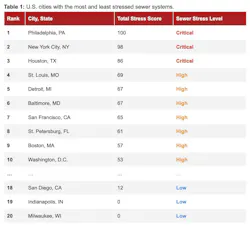
The index evaluates systems across four key factors: capacity and utilization, overflow frequency and volume, infrastructure age and condition, and investment gap. Combined, these metrics produce an overall stress score that highlights where systems are under the most pressure.
Aging Infrastructure and Growth Driving System Stress
Decades of deferred maintenance, rapid urbanization and increasingly intense rainfall are pushing sewer systems toward capacity limits nationwide.
The American Society of Civil Engineers assigned US wastewater infrastructure a D+ grade in 2025, with system failures increasing from 2 to 3.3 per 100 miles of pipe over the past decade. The US Environmental Protection Agency estimates up to $690 billion in infrastructure investment will be needed over the next 20 years.
Costs are already impacting ratepayers, with water and sewer bills rising at roughly twice the rate of overall inflation since 1998.
New York City Highlights Scale of Combined Sewer Challenges
New York City ranks second in the index, reflecting the complexity of operating one of the largest sewer systems in the world, with more than 7,400 miles of mains.
Much of the system is combined, carrying both sewage and stormwater in the same pipes. During heavy rainfall, this design leads to the discharge of billions of gallons of untreated wastewater into surrounding waterways.
Ongoing remediation efforts remain delayed, including the Gowanus Canal Superfund tank project, now more than six years behind schedule. With a population of nearly 8.3 million and millions of annual visitors, the system’s performance has significant public health and environmental implications.
Critical Tier: Philadelphia, New York City and Houston
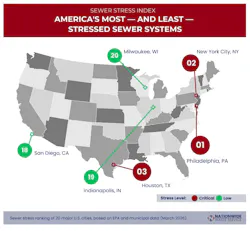
Three cities were classified as “Critical” in the index.
Philadelphia ranked first overall, discharging an average of 12.7 billion gallons of untreated sewage annually, with modernization costs rising from early estimates of $1.5–2 billion to approximately $4.5 billion.
Houston ranked third, reporting more than 6,000 sanitary sewer overflows between 2021 and 2025, despite having a comparatively newer system.
Legacy and Coastal Cities Face Different Risks
The index identifies two additional clusters of concern beyond the critical tier.
Legacy industrial cities such as Detroit, Baltimore and Cincinnati face ongoing challenges tied to aging infrastructure, frequent wet-weather overflows and limited municipal funding for upgrades.
Coastal cities, including Miami and St. Petersburg, are experiencing a different but growing issue: sunny-day flooding. Rising sea levels are pushing saltwater into sewer systems even in dry conditions, accelerating corrosion in aging pipes and creating maintenance challenges not addressed by traditional inspection cycles.
This issue is expected to intensify through 2030 and beyond.
Low-Stress Cities Offer a Model for Proactive Investment
Only three cities ranked in the low-stress category, demonstrating the impact of long-term infrastructure planning and investment.
Milwaukee’s deep tunnel system, in operation since 1994, has captured or treated more than 138 billion gallons of wastewater that would otherwise have entered Lake Michigan.
Indianapolis recently completed its DigIndy deep tunnel network, designed to capture and treat overflow before discharge.
San Diego benefits from a dry climate and a largely separated sewer system, helping reduce overflow risk.
Infrastructure Investment Becomes Urgent Priority
Sewer system failures extend beyond infrastructure concerns, introducing untreated wastewater containing pathogens, bacteria and pollutants into waterways, streets and, in some cases, residential areas.
For cities ranked in the Critical and High categories, the report underscores a shifting reality: the question is no longer whether to invest in wastewater infrastructure, but how long systems can continue operating without significant upgrades.
For more information about this study, including a detailed overview of the methodology and sources used, visit nationwidewasteservice.com/the-2026-sewer-stress-index-ranking-the-vulnerability-of-u-s-sewer-networks.