2026 Sewer Stress Index Examines America's Most Vulnerable Wastewater Systems
Key Highlights
- New study identifies saltwater intrusion as a growing threat to coastal sewer systems
- Miami and St. Petersburg face unique wastewater infrastructure challenges tied to sea-level rise
- Traditional inspection programs may miss corrosion damage caused by saltwater infiltration
GILBERT, AZ — Nationwide Waste Service, a leading provider of portable sanitation solutions, has released its 2026 Sewer Stress Index, a city-by-city assessment ranking the wastewater infrastructure of 20 major US cities based on their vulnerability to failure. The report evaluates systems across four key categories: capacity and utilization, overflow frequency and volume, infrastructure age and condition, and investment gaps.
While aging infrastructure and underinvestment remain major concerns, the study identifies an emerging challenge for utilities, municipalities, engineers and water infrastructure professionals: saltwater intrusion driven by rising sea levels.
Saltwater Intrusion Accelerates Infrastructure Deterioration
According to the report, rising sea levels are allowing saltwater to infiltrate aging sewer systems even during normal weather conditions. Unlike storm-related events that generate immediate attention, this process occurs gradually, corroding underground infrastructure from within and reducing the lifespan of pipes and related assets.
The study describes saltwater intrusion as a "silent multiplier" that compounds existing infrastructure challenges by accelerating deterioration faster than many inspection and maintenance programs are designed to detect.
The findings come as coastal communities face increasing pressure from climate-related impacts. According to data cited in the report, the pace of global sea-level rise has more than doubled since 1993, while US coastal sea levels are projected to rise an average of 10 to 12 inches by 2050.
Coastal Communities Face Unique Wastewater Challenges
Among the cities highlighted in the report, St. Petersburg, Florida, ranked eighth overall but stood out because of the unique risks associated with its coastal geography.
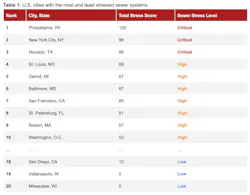
Unlike older industrial cities where aging infrastructure and heavy system demand are the primary concerns, St. Petersburg's sewer network operates at low elevations across a peninsula surrounded by Tampa Bay, exposing portions of the system to routine saltwater infiltration.
The report notes that Miami faces similar challenges due to its flat limestone geology, which allows saltwater to move laterally through underground formations and reach wastewater infrastructure with relatively little resistance.
In both markets, wastewater systems are increasingly operating under environmental conditions that differ significantly from those anticipated when much of the infrastructure was originally designed and installed.
Conventional Inspection Methods May Miss Hidden Damage
The report suggests that saltwater-related deterioration presents challenges that traditional sewer inspection programs may not fully capture.
While standard inspections are effective at identifying cracks, blockages and structural defects caused by age, wear and hydraulic pressures, corrosion driven by saltwater often develops gradually and externally, producing few visible warning signs until significant damage has occurred.
As a result, municipalities may be underestimating the extent of deterioration within portions of their wastewater networks, particularly in coastal areas where saltwater intrusion is becoming more common.
Infrastructure Investments Highlight Different Paths Forward
The index also identifies examples of cities that have made substantial investments to reduce wastewater system stress.
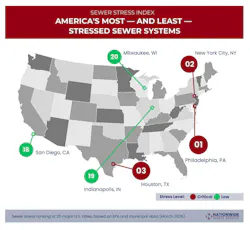
Milwaukee's deep tunnel system has captured more than 138 billion gallons of overflow since 1994, while Indianapolis recently completed a comparable large-scale infrastructure project aimed at managing wet-weather events and reducing system overflows.
However, the report notes that these investments were designed primarily to address rainfall-driven challenges rather than the long-term chemical degradation associated with saltwater intrusion.
For coastal cities such as Miami and St. Petersburg, utilities and infrastructure planners face a different engineering challenge—one that may require new approaches, updated planning assumptions and sustained investment to address future risks.
Long-Term Planning Becomes Increasingly Critical
The 2026 Sewer Stress Index concludes that coastal wastewater systems face mounting pressure from factors that may not appear in traditional overflow reports or rainfall data.
As sea levels continue to rise, municipalities, engineers and water infrastructure professionals may need to incorporate saltwater intrusion and corrosion risks into future asset management, inspection and capital improvement strategies to help extend system life and avoid costly failures.
To learn more visit nationwidewasteservice.com/the-2026-sewer-stress-index-ranking-the-vulnerability-of-u-s-sewer-networks.