How Mechanical BIM Supports Prefabrication from Shop to Field
Key Highlights
- Learn why leading contractors use BIM to plan fabrication, transportation, and installation.
- Explore why the biggest limitation in many prefab programs is not shop capacity.
- See how early planning contributed to labor savings, schedule gains, and safer installation with two case studies.
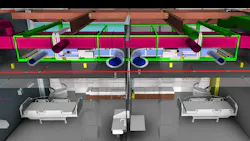

Many mechanical contractors already use Building Information Modeling (BIM) to coordinate MEP systems. Yet, on prefab-driven projects, BIM coordination is only the starting point. For prefabrication to reduce labor, improve schedule performance, and support safer installation, the model should be used as a tool to inform decisions beyond clash resolution, to include standardization, spool-level detailing, shop coordination, and field planning.
The biggest limitation in many prefab programs is not fabrication capacity but the treatment of BIM as a coordination exercise rather than an execution-planning tool.
What Mechanical BIM Has to Do Before Prefabrication Can Deliver Results
The 3D model must support execution, not just fit in place or be clash-free. The following two projects show how this approach enhances schedule, labor, cost, and safety.
Penn State Lancaster: Building Prefabrication into the Workflow Early
At Penn State Lancaster Medical Center, prefabrication started early. The 129-bed hospital remained on schedule and under budget. The project team used prefab across the central utility plant, modular headwalls, operating room ceilings, bathroom pods, exterior wall panels, and the precast parking garage.
In the Mechanical scope, multi-trade racks drove the approach. Early layout reviews identified repeated and mirrored room conditions, which supported rack standardization. The 3D model then aligned piping, med gas, plumbing, and ductwork with final rack locations. BIM Coordination also addressed installation constraints, including corridor clearance, ceiling clearance, and a 10-foot pathway for moving racks on wheels. Spool drawings documented pipes, hangers, valves, clamps, weights, and floor-plan references for shop fabrication.
According to the project case study, that approach supported 20% faster schedules, 30% labor savings, and safer installation conditions.
Atlantic Constructors: Scaling the Workflow Across Five Buildings
For Atlantic Constructors’ manufacturing facility project, the BIM team applied the same discipline on a larger scale. The scope included 90,000 to 95,000 linear feet of big bore piping across five buildings, with pipe sizes ranging from 4 inches to 24 inches, more than 2,000 spool sheets, about 100 multi-service steel racks, and a nine-month installation window.
The workflow linked coordination, pipe prefabrication, and field execution. Project resources included two fabrication shops, an in-house transportation group, and a facility located just five miles from the jobsite. The case study attributes the reported return to three changes: shifting labor into controlled shop conditions, reducing connections and routing complexity, and sending install-ready assemblies to the field instead of loose components.
The case study reports 40% fewer field labor hours, 20% lower material costs, about 10,000 linear feet of pipe installed per month, and zero safety incidents.
Lessons Learned: What Successful Prefabrication Projects Have in Common
Across both projects, the common thread was not prefabrication itself, but the transfer of execution decisions from the field into the BIM process. The more planning captured in the model, the less coordination, adjustment, and troubleshooting remained for installation crews. Ultimately, the two projects differed in size and scope, but they relied on several of the same BIM-driven practices
- Standardization starts early. Repeated room layouts and system configurations create opportunities for rack and spool standardization before fabrication begins.
- Fabrication planning happens during coordination. Decisions about spool breaks, assembly sizes, transportation, and installation sequencing are incorporated into the model rather than deferred to the field.
- Field constraints are modeled, not discovered. Access to routes, ceiling clearances, lifting requirements, and installation tolerances are considered during coordination.
- The shop and field work from the same source of truth. Detailed fabrication information reduces interpretation and minimizes field adjustments.
Why Coordination Alone Does Not Make Prefabrication Work
Prefabrication can reduce labor, improve schedule performance, and support safer installation. However, those outcomes depend on how BIM supports the work beyond coordination into execution.
A coordinated model can show that systems fit in the same space. That is important, but it does not mean the work is ready for fabrication or installation. For mechanical prefabrication to succeed, the model must also answer practical execution questions, such as where spool breaks should occur. Which assemblies can be standardized? How will they be transported and installed? What access, clearance, and lifting constraints will crews encounter in the field?
Many projects invest in fabrication capabilities but leave those decisions unresolved until after coordination is complete. That is where they lose time and labor. If the 3D model stops at coordination, the shop and field teams still have to figure out how to build, move, and install the work.
Conclusion
As mechanical prefabrication becomes more common, the contractors that gain the most value will be the ones that make execution planning part of the BIM process early. The strongest results come when spool logic, rack standardization, transport requirements, access constraints, and installation sequencing are resolved before fabrication begins.
The Penn State Lancaster and Atlantic Constructors projects show that prefab success is the result of coordinated decisions made upstream, where the model becomes the shared planning tool between design, fabrication, and field teams.
*The case studies were taken from ENG, the largest US BIM company delivering reliable VDC services to MEP and General Contractors, Owners, and AE firms.