The High-Pressure Jetting Boom: Why Jetters Are Becoming Contractors’ Go-To Tool
Key Highlights
- Water jetting is increasingly replacing traditional cable cleaning for grease, sludge, and ice removal, providing more comprehensive and lasting results
- Water jetters handle long pipe runs, recurring buildup, and cold climate challenges effectively
- Electric jetters are ideal for smaller, indoor jobs, while gas-powered units are better suited for larger pipes and longer distances
- Proper nozzle selection, such as forward-facing, traction, or rotary nozzles, enhances cleaning efficiency and reduces job time.
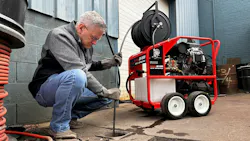
High-pressure water jetting has been a staple in professional drain cleaning for years. But today, many contractors say it’s no longer just another tool in the truck, it’s becoming the preferred solution for residential and commercial work.
From restaurants and hotels to hospitals, schools, apartment complexes and industrial facilities, water jetters are increasingly the go-to method for clearing and maintaining drain lines. The reason is simple, when it comes to grease, sludge, sand and even ice, nothing cleans a pipe quite like high-pressure water.
Why Grease Changed the Game
Traditional cable drain cleaners remain essential for cutting tree roots and retrieving objects. But when it comes to grease, they often fall short.
Grease creates what many professionals call a “self-healing stoppage.” A cable machine can punch a hole through the blockage to restore temporary flow. But because grease coats the pipe walls, the clog often reforms quickly behind the cable path.
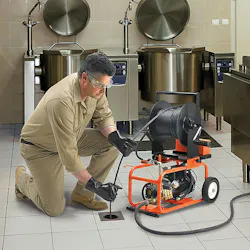
Water jetters approach the problem differently. Using a high-pressure stream of water, jetters cut grease off the pipe walls and flush it downstream. The force of the nozzle pulls the hose through the line while providing wall-to-wall cleaning action.
The result? More thorough cleaning and fewer callbacks.
For facilities like restaurants and industrial kitchens, where grease buildup is constant, jetting has become a preventative maintenance solution rather than just an emergency fix.
Ideal for Multi-Unit and Commercial Properties
Multi-unit residential buildings and commercial properties present unique challenges. Long pipe runs, recurring buildup and high usage demand more than a quick fix.
Water jetters are particularly effective in:
- Restaurants and food service facilities
- Hotels and multi-family housing
- Hospitals and care facilities
- Schools and universities
- Factories and industrial plants
- Shopping centers and sports arenas
In colder climates, gas-powered jetters can even clear ice blockages. Larger units can cut through significant ice accumulation in four-inch lines, which is something cable machines simply cannot do.
For contractors, many are building recurring maintenance programs around jetting services, scheduling cleanings before peak business hours rather than responding to emergencies.
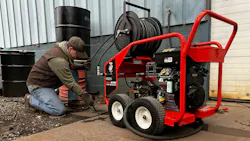
Electric vs. Gas: Choosing the Right Jetter
When considering a jetter, application matters.
Electric units typically deliver up to 1,500 PSI at around two gallons per minute (GPM). These machines are well-suited for indoor work and smaller lines ranging from 1-1/2" to 4" in diameter, particularly in shorter runs.
Gas-powered units step up performance significantly, producing 3,000 PSI up to 8 GPM and 2,500 PSI and 12 GPM for a trailer jet. This combination allows contractors to handle larger diameter pipes and longer distances, sometimes up to 600 feet.
Some contractors leave a gas-powered unit outside and run a smaller hose reel inside a building. This approach allows them to leverage higher pressure and flow rates while keeping exhaust safely outdoors.
Importantly, jetters do not replace cable machines. Each tool has its place. Cables remain the preferred solution for heavy root intrusion and solid obstructions, while jetters excel at grease, sand, sludge and ice.
Choosing the Right Nozzle
The effectiveness of a water jetter often depends on selecting the right nozzle for the job. With dozens of nozzle styles available, each designed for specific pipe conditions and cleaning tasks, choosing the proper configuration can make a significant difference in performance.
Forward-facing nozzles are typically used when debris needs to be broken apart before it can be flushed downstream. These nozzles help penetrate heavy buildup and open the line.
Traction-style nozzles focus on pulling power. Their rear-facing jets propel the hose deeper into the pipe while blasting sand, sludge or loose debris back toward the operator.
Rotary nozzles take a different approach. By spinning inside the pipe, they deliver wall-to-wall cleaning that scours grease and build-up from the entire pipe surface rather than simply punching a hole through the blockage.
Selecting the right nozzle can significantly improve cleaning performance and reduce the amount of time needed to clear a line.
A Strong Return on Investment
Beyond cleaning performance, many contractors report strong revenue generation from jetting services. Maintenance contracts with restaurants and commercial properties can quickly offset the initial investment.
In today’s competitive environment, efficiency and reliability matter. High-pressure water jetters offer both.
For grease-heavy applications, the message from experienced professionals is clear. When it comes to thorough cleaning and preventative maintenance, jetting isn’t just an option, it’s often the smarter solution.
As drain cleaning demands evolve, so do the tools contractors rely on. High-pressure water jetting has moved beyond being a specialty service and into the mainstream of professional plumbing and maintenance operations. Its ability to deliver wall-to-wall cleaning, reduce callbacks and support preventative maintenance programs makes it a powerful complement to cable machines.