Matching Electrode Boiler Configuration to Facility Requirements
Key Highlights
- High-voltage electrode boilers can deliver tens of megawatts, suitable for large-scale industrial applications
- Selection of boiler configuration depends on factors like available space, height restrictions, retrofit needs, and process requirements
- Vertical configurations are better suited for higher outputs exceeding 12 MW, especially when vertical space is available, offering greater capacity without increasing floor footprint
- Steam boiler choices include jet-type and immersed-electrode designs, each offering different control, modulation, and pressure capabilities to match varying demand profiles.
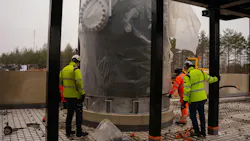
Fossil fuels used to be the go-to power source for industrial-scale steam and hot-water applications. Now, advances in high-voltage electrode boilers can deliver outputs in the tens of megawatts, delivering the capacities these larger systems require.
But for these high-capacity systems, required output is only part of the specification. Available floor space, building height, retrofit limitations and the operating requirements of the process can all influence which boiler configuration makes the most sense.
Depending on the application, the available choices can include horizontal or vertical immersed-electrode boilers for hot water, along with vertical immersed-electrode and jet-type designs for steam. Each has advantages, but those advantages tend to become more apparent only when considered against the actual requirements of the installation.
In some cases, the limiting factor is simply how much output is required. In others, it may be available height, floor area, an existing boiler room that was never designed around this type of equipment, or the need for specific steam operating characteristics. Often, several of these factors come into play at the same time.
As a result, selecting the appropriate electrode boiler is less about identifying one configuration as inherently better than another, and more about matching the design to the thermal requirements and physical realities of the facility.
Horizontal or Vertical for Hot Water
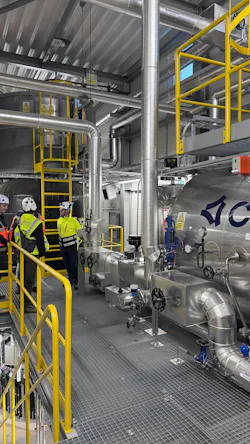
For hot-water applications, the comparison between horizontal and vertical configurations is perhaps the most straightforward because both utilize immersed-electrode technology.
Immersed-electrode boilers operate with the electrodes submerged in water at a selected conductivity. Electric current passes through the water between the electrodes and counter electrodes, and the resistance of the water generates heat directly. Output is adjusted by changing the exposure between the electrode and counter electrode using a motorized insulating shield. The manufacturer’s CEJW hot-water boilers provide stepless control from approximately 10% to 100% output.
The larger difference between the horizontal and vertical versions is how that boiler capacity is physically accommodated. This becomes especially important in a retrofit.
Many existing gas-fired boilers are horizontal and occupy considerable floor space. Removing the equipment may create plenty of room in one direction, but nothing has changed overhead. The ceiling is still where it was, as are structural members, piping, ductwork and other utilities.
Existing gas fired boilers are typically very big and they are usually horizontal. So if the approach is to remove existing gas fired boilers, the floor space is available, but the question is whether there is enough height.
That is where a horizontal immersed-electrode boiler can have a distinct advantage.
According to CT Industrial Oy (CTI), which integrates the manufacturer’s electrode boilers into industrial and district heating systems in Europe, horizontal boiler configurations typically extend to approximately 10 to 12 MW and can be limited to about 3.5 meters in height, while vertical models commonly range from six to eight meters tall.
According to Juha Mäntynen, Chief Executive Officer of CT Industrial Oy (CTI), the manufacturer’s horizontal hot-water boiler is particularly well suited for retrofit projects because it does not require the same height as a vertical configuration.
There is a trade-off, of course. What is saved in height is generally consumed in length. For a facility where floor space is at a premium and sufficient height is available, a vertical boiler may be the better fit.
Going Vertical for Higher Output
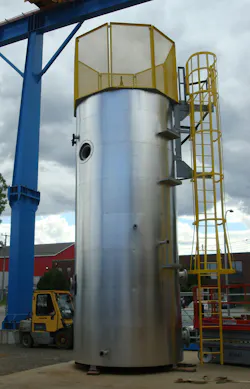
At some point, however, output requirements can push the design in the other direction.
The manufacturer’s CEJW immersed-electrode hot-water line ranges from 2.5 MW up to 68 MW. According to CTI, horizontal configurations are typically used up to the 10 to 12 MW range; when substantially greater output is required, a vertical configuration becomes necessary.
This is not simply because vertical is somehow a more advanced configuration. It is a matter of geometry.
If sufficient height is available, orienting the pressure vessel vertically allows much greater capacity without continuing to extend the boiler across the floor. In a new boiler house, district heating installation, or industrial facility with adequate vertical clearance, this can make considerably more sense.
Steam Changes the Selection
With steam, the selection is different because the two configurations considered are both vertical. The choice instead is between jet-type and immersed-electrode technology.
In the CEJS jet-type boiler, water is circulated from the lower section of the pressure vessel to a nozzle stock and forced through jets that strike electrode target plates, creating an electrical current path. Unevaporated water then flows from the electrode toward the counter electrode, creating a second current path before returning to the lower section of the boiler.
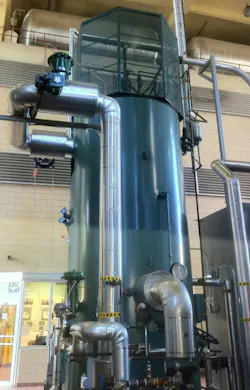
The amount of steam produced is controlled by raising or lowering a control sleeve that diverts selected water jets back to the lower portion of the boiler. In this manner, the CEJS provides control from zero to 100% of boiler capacity and can reach full output from hot standby in approximately one minute.
This wide modulation can be significant in applications where steam demand changes considerably.
The turndown means the boiler can be left in standby at low pressure and, when needed, brought to full capacity in about 90 seconds. With the electric boilers, the energy input and adjustment are very precise and virtually immediate.
Jet-type boilers are also available for higher steam pressures. The manufacturer lists CEJS operating pressures from 75 to 500 psig, with output controlled automatically to hold steam pressure and match system demand.
The Immersed-Electrode Steam Option
The vertical immersed-electrode steam boiler accomplishes the same basic task without directing water jets at electrode targets.
Instead, the electrodes remain immersed in the water and a concentric insulating shield is positioned between the electrode and grounded counter electrode. As the shield moves, exposure between the two increases or decreases, changing current flow and steam production.
The CEJWS can progressively control output down to approximately 10% of rated capacity, essentially a 10:1 turndown ratio. To reduce output below that level, supply power is interrupted.
The design also operates at lower water conductivity, which makes it suitable for pure steam requirements, according to the manufacturer. From hot standby, the immersed-electrode boiler can reach full load in approximately one minute; from a cold start, full load is reached in approximately 30 to 40 minutes.
At that point, the choice comes down to how the boiler needs to perform. Pressure, modulation, conductivity, total output, and the nature of the steam demand all become part of the specification, and one design may be a better fit than the other, depending on which of those factors carries the most weight.
At higher boiler capacities, there is little value in separating boiler performance from the facility around it. The equipment needs to deliver the required load, but it also needs to work within the realities of the installation and the way demand actually moves through the process.
That is why configuration deserves more attention than it sometimes gets. In many projects, it is one of the decisions that determines whether the boiler can deliver the required performance once it is actually installed and operating.
ACME Engineering Products is a manufacturer of industrial and commercial boilers. To learn more contact Robert Presser at [email protected] or visit acmeprod.com/high-voltage-electrode-steam-boiler. Juha Mäntynen at CT Industrial Oy can be contacted at [email protected], or visit www.cti.fi.