Biorefinery Optimizes Energy Footprint Through Advanced Thermal Upgrades
Key Highlights
- Green Plains integrated new boilers and heat recovery systems to improve energy efficiency and reduce emissions at its Nebraska biorefinery
- The project included installing three gas-fired boilers, upgrading burner controls, and implementing a ConDex waste-heat recovery system to reclaim energy from exhaust gases
- Energy recovery from the system preheats process water, saving over 8,000 tons of CO2 annually and reducing NOx emissions by more than 5 tons
“Sustainability is ingrained in our culture and guides us in all of our decision-making.”
That is the core of Green Plains, a major agricultural technology and biorefinery company headquartered in Nebraska. The company transforms corn into biofuel, animal feed and low-carbon ingredients, requiring large amounts of thermal energy. Upgrading boiler systems is a core focus of its efficiency strategy.
“Our biorefinery operations are focused on measures to conserve energy and water … to reduce our carbon footprint year after year,” the company’s website notes. With nine biorefineries across the Midwest, it has executed boiler and energy-efficiency projects to optimize steam production, lower fuel costs and reduce emissions.
Modernized Steam Generation
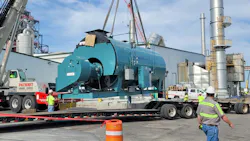
A recent project at the Central City, Nebraska, plant involved the turnkey installation of a boiler and heat recovery system. This is when Rasmussen Mechanical Services (Council Bluffs, Iowa) entered the picture. To modernize the plant’s core process steam generation, the mechanical contracting team transported three boilers from off-site storage to the site using specialized trucks and cranes for installation, setting them in place.
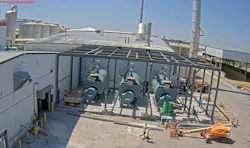
Burner controls and flame safeguard systems were upgraded with AutoFlame Mk8 systems to align with existing Superior boiler controls. This ensures that the new boilers burn natural gas as efficiently as possible.
The Rasmussen team fabricated and installed all required steam, feedwater, blowdown, gas, vent and relief piping—complete with supports, insulation and jackets—to integrate the new boilers seamlessly into the existing system.
They also erected custom boiler platforms and catwalks, recertified and added safety relief valves to meet code, and installed three gas-fired make-up air units to support reliable operation.
Waste-Heat Recovery
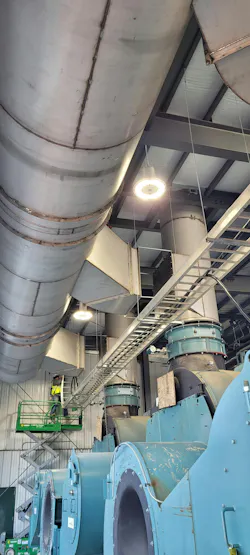
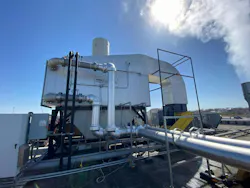
To overcome steam capacity limitations without adding a fourth boiler, Rasmussen engineered and installed a ConDex condensing waste-heat recovery system designed to reclaim energy from boiler exhaust gases. They assembled all fan and duct components, and installed boiler stacks with roof curbs. Interconnecting ductwork from each boiler stack was supported, insulated and jacketed per Green Plains’ specifications.
The recovered energy now preheats process water before it enters the plant’s direct steam injection liquid heaters, which previously consumed large amounts of live steam and fresh make-up water.
By raising the water temperature from 45° F to 92° F, the system recovers 10 MMBTU/hr. of waste energy, resulting in an annual reduction of 8,155 tons of CO2 and 5.46 tons of NOx emissions.
This efficiency upgrade not only reduces emissions but also improves energy efficiency, with the condensing heat exchanger recovering latent and sensible heat to deliver greater savings than traditional methods.
At the project’s end, expert start-up and commissioning ensured efficient, code-compliant and reliable operation.
To learn more, visit www.rasmech.com.
About the Author
 Kelly L. Faloon
Kelly L. Faloon
Freelance Writer/Editor
Kelly L. Faloon is a contributing editor and writer to CONTRACTOR, Contracting Business magazine and HPAC Engineering and principal of Faloon Editorial Services. The former editor of Plumbing & Mechanical magazine, Faloon has more than 26 years of experience in the plumbing and heating industry and more than 35 years in B2B publishing. She started a freelance writing and editing business in 2017, where she has a varied clientele.
Faloon spent 3 1/2 years at Supply House Times before joining the Plumbing & Mechanical staff in 2001. Previously, she spent nearly 10 years at CCH/Wolters Kluwer, a publishing firm specializing in business and tax law, where she wore many hats — proofreader, writer/editor for a daily tax publication, and Internal Revenue Code editor.
A native of Michigan’s northern Lower Peninsula, Faloon is a journalism graduate of Michigan State University. You can reach her at [email protected].