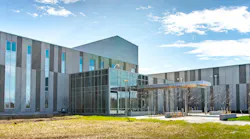
Inside NYC’s State-of-the-Art Brooklyn 3 Sanitation Garage
Key Highlights
- The nearly 100,000-square-foot facility includes a truck garage, repair shop, staff amenities, and mechanical rooms
- Two electrical services, an emergency generator, and provisions for a portable backup generator support continuous operations
- Solar panels, a green roof, stormwater retention, and water reuse support sustainability goals
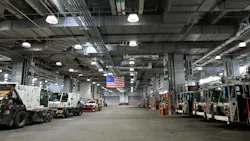
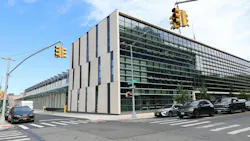
NEW YORK, NY — The NYC Department of Sanitation has opened a completely new, state-of-the-art, sanitation garage. The Brooklyn Community District 3 sanitation garage (known as Brooklyn 3) fills an entire city block in Bedford-Stuyvesant, at the intersection of its residential and industrial zones. Its Mechanical-Electrical-Plumbing engineering takes support for sanitation to a whole new level.
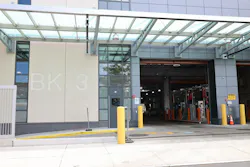
The facility consists of a massive garage for storage and cleaning of sanitation trucks, a major shop for maintaining and repairing the trucks, a personnel block with amenities for truck drivers and other workers, and mechanical rooms with the boiler plant, chiller plant, and new electrical and gas services. The entire facility is just under 100,000 sq. ft.
Redundant and Resilient
Goldman Copeland Consulting Engineers was chosen as the mechanical engineer on the Brooklyn 3 project. Goldman Copeland has been in business since 1968, and the firm prides itself on balancing the creative with the practical to serve the needs of their clients.
“The Brooklyn 3 project has been kicking around for the better part of 15 years from concept to completion,” said Vinod Palal, a Principal with Goldman Copeland who served as a Project Manager for Brooklyn 3.
The city placed high demands on the project for reliability and redundancy. In addition to trash removal, the facility also handles snow removal and road salting, both critical for keeping the city moving during harsh winter weather.
“When snowstorms come, they go into snow emergency mode,” Palal said. “The garbage trucks get plows attached to them, the salt spreaders go to the salt sheds, they load up and they're off to the roads.”
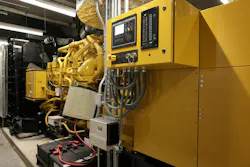
Because of the facility’s need to always be operational, no matter the conditions, the MEP design is especially innovative and standard- setting. That design includes two electrical services, with each backing up the other, as well as an on-site emergency generator.
If that weren’t enough, the emergency generator has its own backup. “They have provisions for a roll-up generator,” Palal explained. “In the event they lose electrical service and they lose the generator, they can roll up a generator and still get the building up and running as needed.”
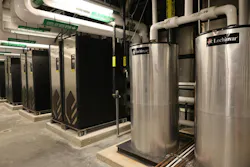
Along with redundancy, resiliency is critical for the facility. Many of the building’s MEP systems (electrical service, emergency generator, and chiller plant) were installed on the upper floors to prevent the potential of damage in the event of a flood or heavy rain event. Even though it was back in 2012, memories of Superstorm Sandy and the billions of dollars it caused in property damage were an influence on the design team.
Efficient and Sustainable
The city also wanted the new facility to meet US Green Building Council’s LEED certification requirements for sustainability and efficiency—requirements Goldman Copland was able to achieve via innovative design and cutting-edge technology.
First, the garage itself has a robust infrastructure for electrical vehicles: chargers, spaces, and modifications to the electrical service. That infrastructure supports the Department’s cars and other small vehicles.
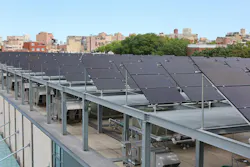
The facility has solar panels on the roof, which generate about 10% of the building’s energy. The energy produced from the panels is distributed back into the base building and utilized based on the electrical needs at the time.
The roof also has a green roof system, tied to a stormwater retention system. “The non-potable water is brought back in and reused in the wash bays and other areas that require non-potable water,” Palal said.
Brooklyn 3’s main non-potable water application is regular power washing for the trucks. Since these are garbage trucks, runoff from the washing is high in debris. Goldman Copeland designed a three-weir screening system (basically a series of low dams) to allow solids to settle and water to then pass through a series of filters before heading to the sanitary system and draining.

“All of the floor drainage goes through an oil/water separator before they go down out to the street,” Palal said. “It was a unique system that we put in there.” The city—which is following the handoff 100% in charge of operation and maintenance—periodically cleans the screening system out.
The mechanical systems implement energy-efficient designs, such as the chilled water plant and the high-efficiency condensing boilers that heat the building. “We’re using condensing boilers for the personnel block areas,” Palal said. The boilers deliver hot water to a hydronic loop supplying radiators around the block’s perimeter.
Brooklyn 3 was completed early in 2026. “Some of the contractors still have obligations to meet, some cleanup responsibilities, but the building's up and running and they're using all the facilities,” Palal said.
About the Author
Steve Spaulding
Editor-in-Chief - CONTRACTOR
Steve Spaulding is Editor-in-Chief for CONTRACTOR Magazine. He has been with the magazine since 1996, and has contributed to Radiant Living, NATE Magazine, and other Endeavor Media properties. You can find him on LinkedIn at www.linkedin.com/in/stevespaulding.