Integrating Architecture Services into Mechanical Contracting Projects for Value-Led Builds
Key Highlights
- Traditional construction models operate in silos, leading to miscommunications, delays, and increased costs due to reactive problem-solving
- Early integration of architectural and mechanical services allows for better space planning, energy efficiency, and lifecycle cost reduction, shifting focus from initial costs to long-term value
- Tools like Building Information Modeling (BIM) and Computational Fluid Dynamics (CFD) facilitate clash detection and airflow optimization, improving project accuracy and performance

The traditional construction model often functions like a relay race where runners pass a baton without speaking. An architect finishes a design. They hand it to an engineer. The engineer adds systems and passes it to a mechanical contractor. Information drops in this linear path. Mistakes lead to change orders. Change orders lead to delays.
Today, a shift is occurring. Mechanical contractors are bringing architectural services in-house or partnering deeply at the earliest stages. This integration moves the industry toward value-led builds where the goal is to optimize the entire lifecycle cost rather than just the construction budget.
Architecture’s Role in Mechanical Contracting
In a standard project, the mechanical contractor manages the "lungs" of a building. This includes Heating, Ventilation, and Air Conditioning (HVAC), plumbing and refrigeration. Architecture defines the "skin" and the layout.
When these two fields operate in silos, conflicts arise. A beautiful glass curtain wall might look stunning, but it can create a massive heat load that forces the mechanical team to install oversized, expensive cooling units.
By integrating architecture, mechanical contractors stop being reactive. They no longer just fit pipes into pre-designed spaces. Instead, they influence the building's shape to accommodate high-efficiency systems.
This synergy ensures that the spatial requirements for mechanical rooms are planned with precision. These rooms typically occupy 6% to 9% of a building’s total square footage. Planning them early prevents the loss of valuable leasable space later.
Why Integration Creates More Value
Integration replaces the "lowest bid" mentality with a "highest value" strategy. When architecture and mechanical services merge, the project team can focus on Total Cost of Ownership (TCO).
Initial construction costs represent only about 15% to 20% of a building's cost over a 30-year lifespan. The remaining 80% goes toward operations and maintenance. An integrated team can design a building that reduces energy consumption by 25% to 40%.
For a 100,000-square-foot office building with an annual energy bill of $2.10 per square foot, a 30% saving equals $63,000 per year. Over 20 years, that is $1.26 million in value created purely through better initial coordination.
This focus on quality directly impacts the asset's marketability. Brady Bridges, owner of Reside Real Estate, notes that "buyers are increasingly educated on building performance, meaning properties with integrated, high-efficiency systems often hold their value better than those with outdated or poorly planned infrastructure."
Design-Build as a Team Effort
The Design-Build (DB) delivery method is the primary vehicle for this integration. In 2024, research showed that Design-Build projects were delivered 33.5% faster than traditional Design-Bid-Build projects.
In this environment, the architect and the mechanical contractor sit at the same table on Day 1. They function as a single entity. This eliminates the adversarial relationship between the designer and the installer. If the architect proposes a complex ceiling feature, the mechanical contractor can immediately flag how it impacts ductwork. This prevents the need for redesigns that typically cost between $5,000 and $50,000 per instance depending on the project scale.
Early Design Input Saves Cost
The "Ability to Influence Cost" curve shows that the greatest impact occurs during the conceptual phase. Once the concrete is poured, the cost of change skyrockets.
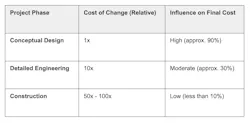
By having architectural input within the mechanical scope, contractors can suggest "Value Engineering" before the budget is locked. For example, changing a building's orientation by just 5 to 10 degrees or adjusting window-to-wall ratios can downsize a chiller plant. Reducing a chiller from 500 tons to 400 tons can save $150,000 in equipment costs alone.
Tools That Support Coordination
Modern integration relies on Building Information Modeling (BIM). This is no longer just 3D drawing. It is a data-rich environment.
-
Level of Development (LOD) 400: This stage of BIM includes specific fabrication details. Integrated teams use this to find clashes virtually before they happen on site.
-
Computational Fluid Dynamics (CFD): Architects and mechanical teams use CFD to simulate airflow. This ensures that a large lobby remains comfortable without over-engineering the HVAC.
-
Prefabrication: When architecture is coordinated with mechanical needs, contractors can move work off-site. Prefabricating mechanical skids can reduce on-site labor hours by 20%. It also improves safety and reduces waste by roughly 15%.
Where This Approach Works Best
Not every project requires a deep architectural-mechanical merger, but complex builds thrive on it.
-
Data Centers: These facilities require massive cooling. The architecture must facilitate "hot aisles" and "cold aisles." Integration here is mandatory to achieve a Power Usage Effectiveness (PUE) of 1.2 or lower.
-
Healthcare: Hospitals have strict air exchange requirements. Integrating the architectural layout with duct routing prevents headroom issues in crowded surgical suites.
-
Adaptive Reuse: Converting an old 1950s warehouse into modern lofts is difficult. Architectural constraints are fixed. An integrated team can find creative ways to hide modern high-efficiency heat pumps within the existing historic fabric.
-
Laboratory Spaces: Lab projects often see 40% to 50% of their total budget allocated to mechanical and plumbing systems. In these cases, the mechanical needs actually drive the architectural design.
Conclusion
Integrating architecture into mechanical contracting is a response to a more complex building environment. Owners no longer want a building that is simply "to code." They want assets that perform. By breaking down the walls between design and installation, firms can eliminate the waste that accounts for nearly 30% of all construction activity.
This value-led approach changes the math of a project. It shifts the focus from the cheapest pipe to the smartest system. As energy regulations tighten and material costs fluctuate, the ability to coordinate the skin and the systems of a building will become the gold standard for the industry.
About the Author
Aaron Mears
Aaron Mears is a professional writer dedicated to exploring the nuances of real estate and environmental sustainability. Known for his ability to translate complex market trends into engaging, practical content, Aaron helps readers navigate the evolving landscape of homeownership and green living. With a commitment to clarity and creative storytelling, he has established a reputation as a reliable industry resource.