Overcoming the Confidence Gap in the Skilled Trades
Key Highlights
- Focus on teaching the 'why' behind systems to develop problem-solving skills and confidence among technicians
- Implement structured 30-, 60-, and 90-day learning plans that balance technical and soft skills development
- Create a safe environment for practice, allowing technicians to build muscle memory and learn from mistakes through simulations and online tools
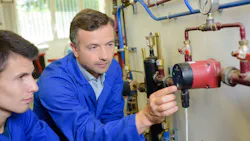
There’s been plenty of talk about the skilled labor shortage that contractors currently face. The issue isn’t only a lack of available personnel, but also a real confidence deficit among today’s technicians. Many plumbing, electrical and HVAC professionals feel comfortable with standard repairs, but may not have as much self-belief when it comes to more complex troubleshooting, diagnostics or creative problem-solving.
The issue isn’t that they’re bad technicians, but rather that they’ve not been trained in a coherent way. For many contracting companies, on-the-job training tends to be reactive and fragmentary, disconnected from actual field performance. Technicians are taught the “how” of their work without ever fully understanding the “why,” and they don’t always get the practice time needed to truly build confidence.
The good news is that there are plenty of practical steps contractors can take to develop confident and field-ready technicians. It all starts with rethinking the learning process.
The How and the Why
One of the big problems with today’s skilled trades training is that it tends to focus entirely on how to perform certain tasks, whether repairs or installations. When technicians learn the how, they are simply learning a step-by-step process that can be repeated in the field. They’re receiving actions that they can mimic once they’re on the jobsite.
The problem is that jobsites are rarely predictable, and problems are seldom presented in a linear or uncomplicated way. Once a technician enters a home or business, conditions may be quite different than they are in a practice setting. Simply mimicking the how-to process they learned proves insufficient.
It’s only when technicians understand the why, when they are trained not only in how to fix things but in the underlying reasons systems work in the way that they do, that they can foster the problem-solving and analytic thinking skills they need to deal with the unknown.
In other words, today’s technicians are often equipped with the skills and processes required to do their jobs only when things go exactly according to plan. But technicians know fully well that, in the field, things rarely unfold that way. That’s where the confidence gap comes from.
The Problem with Tech Training
So why don’t more contractors invest in a more structured and robust training program, allowing technicians more time to understand systems and to practice their skills before heading into the field?
There are a couple of factors. One is time. Learning the why takes a lot more time than just memorizing a basic how-to, and a lot of contractors feel like they don’t have any time to spare. There are simply too many jobs to get to, which makes it hard to justify keeping techs out of the field and in a training program for long stretches.
It’s also important to note that trades training can resemble a game of telephone. New techs are trained by more senior techs, who may have never been fully trained in the “why” themselves. They pass on their knowledge in exactly the same way they were taught, and each new generation of techs becomes further removed from a deep understanding of the way systems work.
Why Confidence Matters
It’s understandable why contractors might feel like they simply can’t afford to invest more time in technician training; and yet, the benefits of a more structured, comprehensive training program are numerous.
When technicians are more confident in their work, it means contractors can be more confident, too—confident that their technicians will do the right thing on the jobsite, and say the right thing when they’re talking with customers. Additionally, an investment in training is really an investment in safety, significantly reducing the risk of techs making careless errors that end in injury.
Technicians who can confidently problem-solve and troubleshoot will ultimately create a better experience for the customer. And, when they accomplish difficult tasks in the field, it gives them greater confidence to tackle even harder jobs, seeking out additional training to bolster their skillsets. In this way, an investment in training can also be a significant investment in technician engagement and retention.
Practical Steps Forward
How, then, can contractors begin shifting their training from the how to the why, ensuring technicians foster not just basic competency but true confidence?
A few suggestions:
● Develop an actual learning strategy, revolving around 30-, 60- and 90-day learning plans that cover both technical and soft skills. Having an actual plan helps contractors avoid event-based learning, where technicians learn a certain skill only if and when they encounter it on a job somewhere.
● Try to help technicians get a quick win. Position them to master some basics so that they can complete a few tasks early on, building some early momentum and confidence. With skills they can apply immediately, technicians can stack wins and keep that momentum going.
● Create an environment in which technicians can build muscle memory and feel safe making mistakes. This is crucial for building confidence faster. Virtual reality, simulator-based and online learning can all be invaluable here.
In the skilled trades, the confidence gap is real. A new paradigm for learning can help overcome it.
About the Author
Dan Clapper
Dan Clapper is the Head of Learner and Business Outcomes at Interplay Learning, the leading provider of online and simulation based training for the essential skilled trades. He started in the field as an HVAC technician, moved into manufacturer technical training, and now designs career development programs for contractors nationwide. For more information, visit www.interplaylearning.com.