Avoiding Common Pipe Fitting Specification Mistakes In Commercial Plumbing And Mechanical Work
Key Highlights
- Mismatched materials and improper transitions can cause leaks, damage, and safety risks in plumbing systems
- Correct sizing and matching pipe schedules are essential to maintain pressure and prevent failures over time
- Flow direction must be carefully followed to ensure consistent pressure and avoid turbulence
- Proper sealing methods, including threading, flanges, or welding, are crucial for leak-proof connections
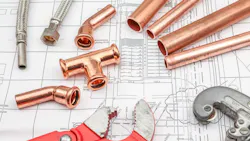
Commercial plumbing and mechanical work require significant investment in pipes and pipe fittings. Although there are a handful of standard options that plumbers tend to rely on, they require specific fittings to operate as intended. Mismatching doesn’t always work and can lead to disastrous consequences. With this guide, plumbers and other professionals will better understand the importance of proper pipe fitting selection, as well as a number of common errors to avoid.
Impacts of Pipe Fitting Errors
From an outsider perspective, pipe fitting failures may seem to be an easy problem to solve. Unfortunately, the ability to weld fittings to pipes, use reducers or transition from one material to another does not necessarily mean that the decision will result in functional or safe plumbing. Improper use of fittings can lead to leaks, pipe damage, flow restrictions and safety risks. Taking the time to confirm the correct fitting for each application can save a great deal of frustration and risk.
Common Oversights in Selecting Pipe Fittings
Mismatched materials
Retrofitting plumbing, or connecting different systems together, requires a careful examination of the materials. Although it is technically possible to use fittings and pipes of different materials, the selection must be appropriate to the application and conclude with functional plumbing.
For example, contractors can use copper and brass, or copper and PEX, but they must install the proper transition fittings. Failure to ensure the correct transition can lead to an improper seal. Using incompatible materials may result in damage to the plumbing system, structure or systems around it.
Improper sizing
Pipes have different sizes, requiring coordinating fittings to keep a tight seal. Contractors cannot simply reduce to a smaller or larger size for convenience because it can change the pressure of the fluid or gas moving through the pipes.
The dimension of the pipe depends on the application. For example, water distribution lines may use 3/4-inch pipes, while drain lines are usually much larger. Approximations between imperial units (inches) and metric (millimeters) may seem to fit, but differences increase risk of failure over time.
Wrong flow direction
The flow of the pipe has to go in a specific direction, and fittings like tee reducers must go with the flow. Reducing tees split the flow of fluids or gas into multiple directions, but the line should go through the run, not the branch. If the fitting forces the main flow through the branch, it dramatically drops the pressure and increases turbulence in the line. Keeping the flow running straight leads to more consistent control.
Schedule inconsistency
Even if the pipe and the fitting are the same size, they must also be the same schedule in order to operate properly. Pipe schedule refers to the thickness of the pipe, independent of outer dimensions. A higher pipe schedule is thicker, providing more protection against high pressure. Using a Schedule 40 fitting for a Schedule 80 pipe may weaken the fitting or cause leaks over time. Using a Schedule 80 fitting for a Schedule 40 pipe could change the pressure.
Improper choice in reducers
Reducers can be a useful practice in retrofitting plumbing, allowing plumbers to transition seamlessly from one material or size to another. The trick lies in getting the reduction accurate. Reducers need to fit the dimensions on both sides, which can call for some sorting through the options to find the right one. Contractors also must consider pressure impacts when selecting reducers. Custom pipe fittings may provide an effective solution to this problem, along with extra care when selecting sizes.
Pressure and temperature rating disparity
Each plumbing system has a specific application, with pressure and temperature requirements to accommodate it. The fittings must comply with those requirements or risk damage to the system, leaks or other hazards. Plumbing pipes used for high-temperature or high-pressure applications usually rely on stainless steel. Copper or brass may be used as an alternative, depending on the application. PVC and PEX are much less expensive and easy to install, but they typically don’t work for these scenarios.
Fluid incompatibility
The pipe fittings must be able to handle the fluids or gases flowing through. Although many plumbing systems run plain water, others transport chemical waste, deionized water or other uncommon solutions. These fluids must not contaminate or damage the pipes, to risk leaks or spreading toxins to the people in the area. The pipe fittings must also be compatible and verified not to leach into the fluid, which could contaminate it.
Incompatible sealing methods
Each pipe has an individual sealing method. Although the traditional approach calls for welding everything together, more modern options have threads or flanges to provide a tight seal. The fitting must have a sealing method that works with the pipe. Flanged fittings require exact sizing to ensure a leakproof seal. Threaded fittings must have the same design to confirm that the pipe will fit snugly into the fitting.
No gaps when welding ends
The sealing method affects how the pipe must be fit into the fitting. Welding can provide a tight seal under most circumstances, but contractors must consider how the weld will hold up under environmental pressures. As a rule, plumbers should leave a gap between the socket shoulder and the end of the pipe. Without the gap, the pipe may expand under heat and eventually crack the fitting.
Finding the proper fitting for commercial plumbing applications requires careful examination of a variety of aspects. Contractors who fail to make the appropriate choice could end up with leaks or system failures that require complicated replacements. By comparison, plumbers who choose fittings with a coordinating material, size, pressure rating and sealing method are more likely to get better performance.
About the Author
Colin Folk
Colin Folk is the Vice President of Sales at Missouri Pipe Fittings Company (MOPIPE), a manufacturer and supplier of pipe fittings for distribution and OEM customers nationwide. He joined the company’s leadership team in 2025 to support its continued growth. With a background in the PVF industry, Folk has led talent development and built sales teams for distributors, manufacturers, and independent representatives.