Southland Industries: Looking Back at the Post-9/11 Pentagon Renovation
Key Highlights
- Southland Industries was awarded the mechanical and plumbing contract for the Pentagon renovation, leveraging design-build methodology and in-house engineering expertise
- The 10-year project involved complex technical challenges, including space constraints and maintaining Pentagon operations, requiring innovative solutions like fan-powered induction units
- The renovation preserved the Pentagon's historic exterior while modernizing its systems, earning multiple industry awards and setting a benchmark for integrated project delivery
As the nation marks the 25th anniversary of the 9/11 attacks, we rightly honor the commitment and sacrifice of the police, firefighters, emergency medical teams and other first responders who worked to save lives that day and in the days that followed.
But in the weeks and months that followed, engineers, contractors, demolition and construction specialists and infrastructure workers of all types labored to clear debris and repair damage from the attacks while restoring utilities, spaces and services.
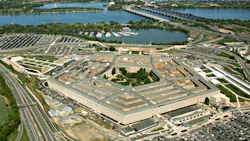
Built in 1941–1943, the Pentagon, located in Arlington, Virginia, is the world's largest low-rise office building and home to the US Department of Defense. On the morning of September 11, 2001, the western side of the building was struck by the hijacked American Airlines Flight 77, killing 64 people on the plane and 125 on the ground.
That number on the ground might have been considerably higher, but at the time the building was undergoing renovations and only half populated. One of the companies performing those renovations was Southland Industries, an MEP contractor whose team members suddenly found themselves called to service in one of our nation’s defining moments.
Southland Industries
Southland Industries has been in business since 1949 and had its start as a local heating and cooling company. Today, it prides itself on its collaborative “people first” culture, delivering solutions for the full building lifecycle, at whatever scale its customers might demand.
Southland Industries was awarded the mechanical and plumbing contract for the Pentagon renovation in the early 2000s. Several factors helped them win the bid, including:
Design-build methodology — The Pentagon Renovation Office shifted from the traditional design-bid-build approach (used for Wedge 1) to an integrated design-build delivery model for the remaining wedges. Southland’s integrated engineering and construction approach allowed design and construction activities to proceed efficiently and in parallel.
In-house engineering capabilities — The Pentagon's low floor-to-floor heights created significant mechanical and architectural constraints, and building engineers were looking for a way to increase ceiling heights and increase the infiltration of natural light into the interior spaces.
Federal project experience — Southland had a proven track record in government facilities.
The company had already been working at the Pentagon for approximately two years on the Metro Entrance Facility and Remote Delivery Facility when general contractor Hensel Phelps approached them to join its team responding to the RFP for the complete renovation of Wedges 2-5.
Wedge 1 had just completed its renovation, and portions of Wedge 2 were being cleared for the next phase of work when the attacks took place.
The Day Everything Changed

“I was only two years into my career at Southland when September 11 occurred, and that morning we were approximately two miles from the Pentagon in the kickoff meeting for the renovation project,” said Tim Michael, Regional President of Southland Industries. “We heard and felt the impact and could see the smoke in the distance.”
The following ten-year renovation was, for the entire Southland team, an experience that went beyond the projects the company typically performs. “A profound sense of purpose and responsibility certainly permeated every context of what we did,” Michael said. “Our team understood they were contributing to the restoration of a critical national institution during an incredibly vulnerable moment for our country. As for Southland, it most definitely represents a defining moment and a demonstration that we can look back on and share what we're capable of delivering.”
The attacks fundamentally altered the project's scope, priorities, and schedule.
Immediately following the attacks, Project Phoenix was established to reconstruct the damaged areas. Southland collaborated with the Wedge 1 construction team to restore critical portions of Wedge 2 that had sustained damage, helping restore essential infrastructure to operational status within the year.
Continuously Adapting
However, even before the tremendous impact of the attack, the Pentagon project itself presented extraordinary technical challenges. Aside from its architectural complexity, the structure had not undergone any major renovations in over 60 years—although there had been numerous (almost completely undocumented) additions and modifications throughout the period.
“Our team had to continuously adapt engineering solutions as existing conditions that needed to be addressed were often uncovered as we moved along the renovation process,” Michael explained.
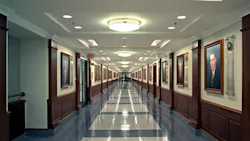
The work was also completed while the Pentagon remained occupied and operational. That included designing and constructing temporary mechanical rooms so mission-critical operations could continue throughout construction. By project end, Southland completed a full decommissioning, demolition, and replacement of all mechanical and plumbing systems across 4.3 million square feet, renovating Wedges 2–5 down to their structural skeleton while preserving the Pentagon's historic exterior.
The compressed schedule demanded adaptive engineering, constant collaboration, and innovative scheduling. In the face of these challenges, at peak production Southland averaged the completion and turnover of approximately one square foot every minute of every day of the project.
Space Constraints – Efficiency Demands
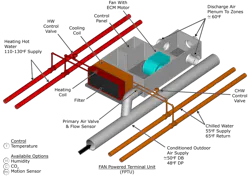
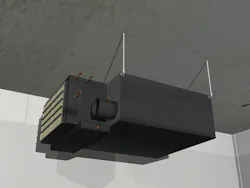
The Pentagon's inherent low floor-to-floor heights made conventional ducted air distribution systems impractical. Southland proposed and developed a solution utilizing fan-powered induction units (FPIUs) equipped with chilled water-cooling coils and air valves to supply a constant stream of conditioned outdoor air.
This approach delivered significant advantages:
- Space efficiency: By leveraging chilled water piping for cooling delivery, Southland was able to reduce required mechanical ductwork by approximately 50% and save considerable above-ceiling space
- Architectural benefits: The 23-inch reduction in above-ceiling space allowance enabled architects in the restoration project to raise ceilings. The result was a substantial and welcome increase in natural lighting throughout occupied zones and the creation of higher ceilings in exterior zones with systems discreetly hidden within bulkheads
- LEED certification support: The new system incorporated the environmental, ventilation, and energy efficiency elements required for LEED certification while maintaining beneficial and precise indoor environmental conditions
- Operational efficiency: The dedicated outdoor air system with sensible cooling delivery optimized energy performance throughout the ten-year renovation program
Today, the company specifically includes "fan-powered induction units for government facilities," as a documented core competency.
Ten Years Later, Fifteen Years Ago
Southland’s work was recognized with the 2011 AGC Alliant Build America Award, the 2011 DBIA National Best Overall Award for Rehabilitation/Renovation/Restoration, and the 2011 DBIA National Design-Build Excellence Award for Civic projects.
The Pentagon Renovation and the Phoenix Projects are still used today as a master class in demonstrating the importance and value of an integrated, incentive based, design-build delivery model that promotes innovation, increased collaboration and overall behavior-based engineering and contracting strategies.
While the project has left a mark on the industry, it has certainly left its mark on Southland Industries.
“It is absolutely a project we are very proud of, and we are cognizant of the impact it had on our business and everyone who worked on it—it was such a difficult, challenging but at the same time rewarding endeavor,” Michael said.
“We weren't just solving mechanical engineering problems—our teams had to problem solve under amazing constraints, work in parallel phases of design and construction, coordinate across multiple disciplines and teams to make it all happen. Teams that worked through those challenges together developed bonds different from the typical project experience.
“Southland remains proud to have had the opportunity to support the Pentagon Program in this nation’s time of need. The relationships and learnings developed over the decade following that fateful day are unparalleled and remain strong 25 years later.”
In this brief video Tim Michael, Regional President, and Scott Winkler, VP of Engineering at Southland Industries talk about their involvement in the Pentagon renovation, the Pheonix Project.
About the Author
Steve Spaulding
Editor-in-Chief - CONTRACTOR
Steve Spaulding is Editor-in-Chief for CONTRACTOR Magazine. He has been with the magazine since 1996, and has contributed to Radiant Living, NATE Magazine, and other Endeavor Media properties. You can find him on LinkedIn at www.linkedin.com/in/stevespaulding.