Revolutionizing Hydronic Heating with High-Temp Heat Pump Water Heaters
Key Highlights
- High-temperature heat pumps now deliver water at 160-180°F, suitable for applications previously served by boilers and high-temp coils
- CO₂ refrigerant technology enables higher heat rejection temperatures, improving performance in high-temperature water applications
- Integrating heat pumps with hydronic systems enhances efficiency, temperature stability, and system redundancy, reducing disruptions and emissions

Heat pump technology has been around for decades, with proven efficiencies and myriad water heating applications. However, most of those applications have been focused on delivering water at around 120-140ºF—the typical operating range for commercial heat pump water heaters.
But times change, technology advances, and now a new generation of commercial HPWHs can deliver temperatures in the 160-180ºF range. This significantly changes the equation, particularly on the retrofit side.
Where a conventional HPWH might struggle to replace a boiler serving old cast-iron radiators, fin-tube baseboard or air handlers with high-temperature coils, a high-temperature HPWH can potentially serve those applications while allowing for electrification and maintaining required system performance.
What’s Changed?
These advances have been mostly driven by advances in refrigerant technology and system design, with carbon dioxide (CO₂ - R-744) being the most notable. “CO₂ operates in a supercritical range as part of a transcritical cycle,” Matt Rash, PE, Sr. Project Manager, Hydronics, Mitsubishi Electric Trane HVAC US (METUS) said. “This allows for higher achievable heat rejection temperatures and higher delta T. This capability is critical for single pass air-to-water (ATW) heating applications.”

In practical terms, the transcritical CO₂ cycle allows the heat pump to reject heat at temperatures significantly higher than those typical of conventional HPWH systems, making it better suited to applications requiring high-temperature water.
Advanced compressor technologies (such as vapor injection to control discharge superheat) also contribute by allowing sustained high-speed operation while preventing excessive superheat.
The Hydronic Heating Advantage
Both heat pump technology and hydronic heating systems are known for delivering high energy efficiency; one is moving thermal energy (instead of generating it), while the other takes advantage of the thermal capacity of water. A system that combines heat pumps with hydronics—which high-temperature HPWHs make possible—can reap the advantages of both.
“By combining advanced, extended-range, inverter-driven heat pump technology with hydronic heating systems, designers can harness the extended operating range and high coefficient of performance (COP) heating performance typically associated with VRF systems,” Rash said. “Hydronic loops can then provide additional benefits through their thermal capacitance, helping improve temperature control while reducing disruptions to the occupied space.”
This approach combines the efficiency of the inverter-driven heat pump technology with a more centralized system design, helping facilities reduce carbon emissions compared to conventional fossil fuel heating sources—depending on electricity sources and operating conditions.
“The combination also helps minimize disruptions within the building,” Rash notes. “It enables easier integration of N+1 redundancy at a central plant level compared to zoned VRF heat pump systems where equipment failures may affect specific areas.”
The Hybrid Approach
Depending on climate and load profile, a hybrid approach—combining a HPWH with a boiler, water heater or tankless unit—is often the most economical option. Taking such an approach can help maximize operating hours at a high COP while delivering a strong ROI.
In a hybrid system the heat pump handles the base load while the boiler handles extreme outdoor temperatures or peak recovery, allowing the heat pump to operate during conditions where its COP is strongest.
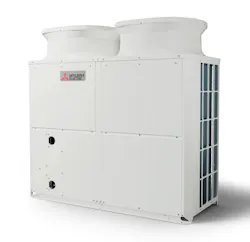
“The most suitable approach will depend on the project’s needs, objectives, and available decarbonization incentives,” Rash said. “These factors help determine the best solution for the application.”
When it comes to individual applications, cold weather performance may be a key concern, and that performance typically depends on the manufacturer’s technology.
“Look for manufacturers that publish guaranteed subzero ambient temperature operating ranges and thermal lockout temperatures in negative double digits, along with maximum runtime capabilities,” Rash said. “These technologies can continue to deliver COPs greater than 1.0 even under extremely cold conditions. For example, Mitsubishi Electric publishes guaranteed heat pump performance data down to -13° F for ecodan®Pro CAHV solutions.”
Applications
Most METUS projects using high-temp HPWHs have been in the domestic hot water sector, particularly in regions with aggressive electrification and decarbonization mandates and/or related incentives.

In these applications, the majority of the domestic hot water load is handled by the companys Heat₂O® solution, while recirculation loads are typically managed by conventional electric swing tanks.
The ecodan®Pro CAHV solution is a newer addition to the U.S. market, but has been available for over a decade in other markets. For example, the Americas Pavillion at the Toronto Zoo operates a large CAHV system with backup condensing boilers, and the system has been successfully running for several years.
About the Author
Steve Spaulding
Editor-in-Chief - CONTRACTOR
Steve Spaulding is Editor-in-Chief for CONTRACTOR Magazine. He has been with the magazine since 1996, and has contributed to Radiant Living, NATE Magazine, and other Endeavor Media properties. You can find him on LinkedIn at www.linkedin.com/in/stevespaulding.