Optimizing Hydronic Systems with Modern Air-to-Water Heat Pumps
Key Highlights
- Unlike boilers, heat pumps have variable output influenced by outdoor temperature and water demand, requiring a different approach to sizing and system design
- Proper sizing should be based on detailed heat loss calculations rather than relying on existing boiler ratings to avoid inefficiencies and short cycling
- Modern heat pumps can deliver supply water temperatures around 120-140°F, making low-temperature emitters like radiant floors and panel radiators more effective
- Incorporating outdoor reset controls and buffer tanks enhances system efficiency, reduces short cycling, and accommodates defrost cycles, improving overall comfort and performance
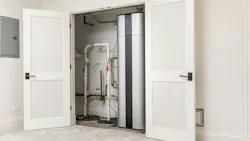
Heat pump water heaters are seeing increased adoption for a number of reasons. They offer amazingly efficiencies, they can help achieve electrification goals, and they are often candidate for government and utility rebates.
And naturally, since they are heating water, pros are beginning to install them for hydronic heating applications. But heat pump water heaters demand special considerations, particularly in retrofit applications.
We talked to some of the experts at LG Electronics—manufacturers of the LG Inverter Heat Pump Water Heater—to walk us through design, sizing, emitter selection and more.
What makes a hydronic heat pump system different from a conventional boiler system when it comes to sizing and design?
The biggest shift is that a heat pump's output isn't a fixed number the way a boiler's is. A boiler's nameplate capacity is generally less dependent on outdoor air temperature than a heat pump’s capacity.
A heat pump's capacity and efficiency both move continuously with two variables: outdoor air temperature (the source) and the water temperature you're asking it to produce (the sink). As outdoor temperature drops, available capacity may decrease, depending on the equipment and operating conditions. As you ask for a hotter supply-water temperature, capacity drops further and COP drops with it. Some design considerations:
Consider a "balance point," not a single design-day number. Contractors are used to sizing a boiler to cover the 99% design-day load with margin. With a heat pump, you may select equipment to cover the load down to some outdoor temperature—the balance point—below which supplemental/auxiliary heat (electric resistance, or a small existing boiler left in place) may pick up the remainder. Sizing purely for the coldest hour of the year, the way we might with a boiler, may result in an oversized heat pump that shortcycles and may experience reduced part-load efficiency under certain operating conditions.
Lower and more variable supply-water temperatures may affect hydronic system considerations, including pipe sizing, flow rates, emitter selection and controls, which should be evaluated for the specific application rather than carried over from the boiler-era assumptions of 180°F supply water.
Defrost cycles need to be accounted for. An air source heat pump operating below roughly 30-40 F outdoor air may periodically frost the outdoor coil and need to reverse into a brief defrost cycle. In a hydronic system this draws heat from the buffer tank or the building's own water volume rather than from indoor air, which may help reduce the effect of defrost operation on indoor comfort compared with certain ducted configurations.
A Manual J/heat-loss calculation matters more. Because oversizing a heat pump may reduce efficiency (short-cycling, more time spent at low-COP, higher temperature operating points) in addition to first cost, rule-of-thumb sizing should be avoided in favor of an appropriate load calculation for the application.
How should contractors determine the appropriate heat pump capacity for a hydronic application, particularly in retrofit projects?
The process should start the same way good hydronic design always has—with an actual room-by-room or whole-building heat loss calculation (Manual J or equivalent) rather than the old boiler's nameplate rating. Boilers may be oversized relative to a building’s actual heating load, so relying solely on an existing boiler’s nameplate capacity may result in an oversized, inefficient heat-pump application.
In retrofits specifically, the existing emitters usually set your achievable supply-water temperature, and that temperature sets your real-world capacity — so the sizing exercise has to be done in that order: heat loss → required emitter output at various supply temperatures → what supply temperature the existing emitters can actually deliver adequate output at → heat pump capacity at that supply temperature and your design outdoor temperature.
Skipping straight to "how many tons" without working through emitter output at a realistic water temperature is a common retrofit sizing mistake.
What supply-water temperatures can today’s heat pumps realistically deliver, and how does that affect emitter selection and system design?
Modern air-to-water heat pumps with enhanced vapor injection and inverter-driven compressors—including LG's AWHP—may be capable of delivering supply-water temperatures in the 120-140°F range under specified operating conditions, depending on the model and application. The key relationship to consider when evaluating an application is: the higher the supply-water temperature, the lower the heat pump's COP may be and, in many cases, the lower its available capacity.
So the entire design goal is to run the system at the lowest supply-water temperature that still meets the room-by-room heat loss with the available emitter surface area—not to just match whatever temperature the old boiler used, which has direct implications for emitter selection:
Radiant floor, panel radiators and low-temperature fin-tube baseboard are often well suited for heat pump supply temperatures, since they're designed around lower delta-T, higher-surface-area heat transfer and may be capable of meeting room loads at 100-120°F supply water depending on the application and equipment selected.
Standard fin-tube baseboard and older cast iron radiators were originally sized around much hotter water (often 180°F+), so at heat pump-friendly temperatures they output substantially less heat per linear foot—this is the core of nearly every retrofit design decision (discussed further below).
Outdoor reset control becomes an important consideration, continuously adjusting supply water temperature to the minimum needed for current outdoor conditions rather than running at a fixed high temperature year-round. This is a commonly used approach with modern hydronic heat pumps.
Also, a buffer tank is frequently incorporated into the system, both to help prevent shortcycling of the inverter compressor at low loads and to supply heat during defrost cycles while helping maintain space temperature.
How well do heat pumps work with existing cast-iron radiators, baseboard and other conventional hydronic emitters? When do those systems need to be modified?
They can work—but almost never as a straight drop-in replacement for the boiler, and the answer really depends on how oversized the existing emitters are relative to the building's actual (not assumed) heat loss.
Cast iron radiators are, somewhat counterintuitively, often well-suited for a heat pump retrofit. They have large surface area and high thermal mass, and many original systems were designed with generous radiator sizing by modern standards. In some applications, cast iron radiators sized for 180°F water may provide sufficient output at 120-140°F water to a building’s calculated (often improved through added insulation/airsealing) heat loss—the mass may also help moderate heat-pump cycling. The way to know for sure is to calculate each radiator's actual output (based on its type, size and number of sections) at the reduced supply temperature and compare it to that room's calculated heat loss.
Standard fin-tube baseboard is the tightest fit. It was designed for high water temperatures and relatively small surface area per foot, so its output falls off sharply at heat-pump-friendly temperatures. Baseboards sized for 180°F water may deliver substantially less heat 120°F; actual output depends on the specific emitter, entering water temperature, flow rate and other application conditions.
Panel radiators and low-temperature-rated baseboard products are often well-suited as the rated operating temperature is often less than 140°F.
In all retrofit jobs, building load calculation should be considered as part of equipment selection and application evaluation.