Bathroom Renovations Shift Toward Larger Showers and Sculptural Bathtubs
Key Highlights
- The 2026 Houzz study finds that 58% of homeowners upgrading showers increase their size, while low-curb and curbless designs continue to gain popularity
- Freestanding flat-bottom tubs now account for 57% of new or replacement bathtubs, and soaking tubs represent 72% of upgraded tubs
- Porcelain and ceramic tile dominate shower floors, while horizontal brick and vertical stack are the leading shower wall patterns
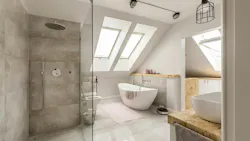
Homeowners renovating bathrooms are increasingly opting for larger showers, low-curb and curbless entries, frameless glass doors and freestanding soaking tubs, according to the 2026 US Houzz Bathroom Trends Study. The research from Houzz, an AI-powered software platform for home construction and design, examines the styles, materials and features influencing residential bathroom renovations.
The findings point to changing priorities for two of the bathroom's largest fixtures, with shower expansions and freestanding tubs gaining ground while traditional shower-over-tub combinations and standard bathtubs lose popularity.
More Than Half of Upgraded Showers Increase in Size
Among homeowners upgrading their showers, 58% increase the shower's size. Most expand by less than 25% (23%), while 19% increase the footprint by 25% to 50%, a 5-percentage-point increase year over year. Another 16% expand their showers by more than half.
The share of homeowners keeping their showers at the original size fell 5 percentage points to 41%. Just 2% end up with a smaller shower.
Low-Curb and Curbless Designs Gain Ground
Low-curb showers remain the most popular upgraded style, selected by 47% of renovating homeowners. Curbless designs increased 4 percentage points to 24%.
Alcove showers remain common at 41%, while corner showers gained 6 percentage points to 24%. Dual showers account for more than one in five upgraded showers (21%).
Shower-over-tub combinations declined 7 percentage points to 5%, making them the least common shower style in the study.
Hinged, Frameless Glass Doors Lead Shower Entries
Doors remain a common feature in upgraded showers, with 85% of renovating homeowners installing them. Hinged doors are the leading choice at 51%, up 12 percentage points year over year.
Sliding doors declined 6 percentage points to 14%, while curtains fell 5 points to 8%. Fixed panels held steady at 7%.
Frameless designs also continue to gain popularity, accounting for 80% of upgraded shower doors, up 4 percentage points. Semiframed doors represent 14%, and fully framed designs account for 6%.
Porcelain and Ceramic Tile Dominate Shower Floors
Tile is used on 79% of upgraded shower floors, well ahead of natural pebble stone at 15%, slab at 6% and wood at less than 1%.
Porcelain leads shower floor tile materials at 42%, followed by ceramic at 35%. Marble accounts for 11%, while acrylic represents 3%. Limestone and engineered quartz each account for 2%.
Hexagonal tile is the most common shape at 26%, followed closely by rectangular tile at 25%, down 4 percentage points. Square tile accounts for 21%. Less common shapes include round (8%), octagonal (4%), diamond (2%) and oval (1%).
Horizontal Tile Patterns Lead Shower Wall Designs
Horizontal brick is the most common shower wall tile pattern, selected by 27% of homeowners. Vertical stack follows closely at 25%, with horizontal stack at 15% and vertical brick at 11%.
Decorative patterns account for smaller shares of upgraded shower walls. Mosaic leads that group at 3%, while herringbone and chevron each account for 2%. Crosshatch, arabesque and checkerboard patterns each represent 1%.
Most Removed Bathtubs Make Room for Larger Showers
When renovating bathrooms, 38% of homeowners upgrade their bathtub, while another 8% keep their existing tub. In 26% of projects, the bathtub is removed. Another 27% of renovating homeowners did not have a bathtub before the project and do not add one.
Among homeowners removing a tub, 79% use the space to enlarge the shower, while 24% relocate the bathtub.
Storage and vanity space also claim some of the freed-up area. Enlarging cabinetry increased 5 percentage points to 14%, while enlarging the vanity or sink rose 5 points to 11%. Other changes include moving a vanity or sink (7%), relocating cabinetry (5%), and enlarging or relocating closets (3% each).
Freestanding Soaking Tubs Gain Popularity
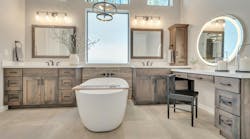
Among homeowners adding or replacing a bathtub, 57% choose freestanding flat-bottom tubs, an increase of 12 percentage points year over year. Alcove tubs declined 18 percentage points to 22%, while deck-mounted tubs increased 7 points to 13%, nearly doubling their share.
Freestanding claw-foot tubs account for 5% of choices, while corner-style tubs represent 1%.
Soaking tubs are also gaining ground, selected in 72% of renovated bathrooms with a new or upgraded tub, up 10 percentage points year over year. Standard tubs fell 10 percentage points to 19%, while walk-in tubs remain uncommon at 2%.
Acrylic continues to lead bathtub materials at 54%, followed by fiberglass at 12%. Enameled cast iron and cast polymer each account for 9%, with ceramic close behind at 8%.
Specialty Tub Features Decline as Homeowners Prioritize Nonslip Flooring
Fewer than half of renovating homeowners (46%) include specialty features in a new or upgraded bathtub, a decline of 9 percentage points.
Nonslip flooring is the most common feature, included by 23% of homeowners. Grab bars account for 14%, down 8 percentage points, while 13% choose tubs with space for two.
Whirlpool or jet features appear in 9% of new or upgraded tubs. A seat, built-in lighting and a heated backrest each account for 5%.
For more shower and bathtub statistics, along with data on vanities, colors, lighting and sustainability, check out the complete 2026 US Houzz Bathroom Trends Study at www.houzz.com/magazine/2026-u-s-houzz-bathroom-trends-study-stsetivw-vs~185833793.