Leak Detection in Extreme Heat: What Riyadh's Water Systems Teach About Plumbing Failure
Key Highlights
- Heat cycles, pressure spikes, and shifting soil can weaken joints and crack underground pipes
- In hot, dry climates, leaks may evaporate or drain away before leaving visible signs
- A meter spin test and zone-by-zone pressure testing help narrow down the source
- Nighttime acoustic surveys can reveal leaks masked by daytime noise
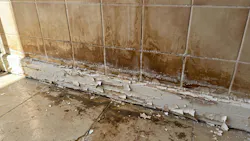
A villa owner in north Riyadh called us last July with a problem that sounded simple. His water bill had tripled in two months, but there was no damp patch on any wall, no puddle anywhere, and the garden was bone dry. Somewhere between the street meter and his taps, several cubic meters of water were vanishing every day.
We found it under the driveway, a cracked PPR elbow joint feeding the villa's main line. It had been leaking for weeks, maybe months. The soil drank it before it ever reached the surface.
That call is routine for us in summer. And it taught me something I think every plumbing contractor working in hot climates should know: extreme heat does not just make leaks more likely. It changes how leaks behave, where they hide, and how you have to hunt them.
Heat is a Slow-Motion Wrecking Crew
In Riyadh, summer air sits above 45 degrees C for weeks, and pipe surface temperatures in sun-exposed runs can push past 60 degrees C. Nothing in a water system was designed to cycle like that, day after day, year after year.
The damage follows a few predictable patterns.
First, thermal expansion cycling. PPR and PEX runs in an attic or a roof void lengthen noticeably at midday and contract at night. Do that math over a thousand cycles and the joints, especially elbows and tee fittings, start to work loose. The failures we see most are not burst pipes. They are joints that gave up slowly, weeping at 2:00 AM when nobody is watching.
Second, pressure spikes. Rooftop storage tanks are standard on Riyadh villas, and a tank baking in direct sun heats its water far beyond what the system expects. Water expands, pressure climbs, and the weakest joint in the house takes the punishment. We have pulled failed angle valves off lines that were seeing pressure 30 percent above the design rating, with no expansion tank or pressure-reducing valve anywhere in the system.
Third, soil movement. Dry, sandy soil shifts. Underground runs that were bedded fine at installation get point-loaded when the ground settles around them, and a rigid copper or PVC run under a driveway cracks instead of flexing. The leak in that north Riyadh villa was exactly this: a rigid joint, a settled trench, and months of silent loss.
Why Leaks Hide Better in Hot Climates
Here is the part that matters for the American contractor reading this in Phoenix or Las Vegas or South Texas. In a cool climate, a leak announces itself. Water pools, soil turns to mud, a wall stains.
In extreme heat, the ground is a sponge. A leak of several liters an hour can evaporate or percolate away before it ever surfaces. We have traced leaks where the only surface evidence was a faint salt crust on a patch of paving, minerals left behind after the water evaporated. The villa owner pays for water he never uses, the structure sits on increasingly unstable soil, and nothing looks wrong.
So the first skill a hot-climate plumber needs is not better repair technique. It is better hunting technique.
Our Detection Routine, Step by Step
When a Riyadh customer reports an unexplained bill or a suspected leak, we work a sequence that has proven itself across hundreds of jobs. Contractors in any hot market can run the same routine.
1. The meter spin test
Turn off every tap, appliance, and irrigation valve in the building, then watch the meter for fifteen minutes. If the dial creeps, water is going somewhere. This takes no equipment and we still catch about a third of our cases this way. It also tells the customer, on the spot, that the problem is real.
2. Zone isolation with pressure
We break the system into zones (upstairs, downstairs, irrigation, rooftop tank feed) and pressure-test each at roughly 10 bar, holding for thirty minutes. A zone that will not hold pressure is the zone with the leak. This narrows the search from a whole property to one run, before anyone touches a listening device.
3. Acoustic listening, at night
This is the step most contractors skip, and it is the one that changed our business. Ground microphones and listening sticks pick up the hiss of pressurized water escaping a pipe, but only if the ambient noise is low. In a Riyadh villa at 2:00 PM, with two AC condensers running and traffic outside, you hear nothing. At 2:00 AM, a pinhole leak in a copper run under a slab sounds like a kettle through the headphones. We schedule our acoustic surveys for late night or early morning as a matter of policy now. The difference in hit rate is not subtle.
4. Thermal imaging for hot lines
On hot-water runs, an infrared camera shows the leak as a warm bloom spreading through a slab or wall. Cold-water leaks do not give you this trick, which is why the acoustic step comes first in our order of operations.
5. Tracer gas for the stubborn ones
For the small percentage of leaks that defeat acoustics (deep runs, plastic pipe which transmits sound poorly), we drain the line, pressurize it with a nitrogen-hydrogen mix, and sweep the surface with a gas detector. Hydrogen is the smallest molecule there is; it finds the exit the water was using. This catches what gauges and ears miss.
What Prevention Actually Looks Like
Detection is the ambulance. Prevention is the part I wish more building owners took seriously, because every item on this list is cheaper than one flooded villa.
Install a pressure-reducing valve and an expansion tank on every system with a rooftop tank or a long sun-exposed run. We treat this as non-negotiable on new work now.
Pressure-test annually, before summer. A thirty-minute hold test each spring catches joints that are starting to weep, months before they become emergencies. We sell this as a maintenance visit, and customers who take it almost never call us with a flood.
Teach the meter test. We leave a one-page card with every customer showing how to run the fifteen-minute meter check. It costs us nothing, and it has brought us more repeat business than any advertisement, because the customer who catches a leak early remembers who taught him how.
Bed and backfill properly. Most of the underground failures we excavate trace back to installation shortcuts: no sand bedding, sharp backfill, rigid joints where the design called for flex. In shifting, heat-baked soil, the installation detail is the failure, years later.
What This Means for Hot US Markets
The American Southwest is catching up to Gulf conditions faster than most people admit. Longer heat seasons, hotter nights, and more pressure on aging water infrastructure mean the failure patterns we see in Riyadh are a preview, not an exception.
The contractors who will win in that environment are the ones who stop treating leak detection as a guess-and-dig exercise. A meter test, a pressure gauge, a ground microphone, and the discipline to listen at 2:00 AM will find leaks that excavation crews walk past for months. We know, because we have walked past them too, and then we changed the routine.
The leak under that north Riyadh driveway never surfaced. The soil drank it for months while the bill climbed. The only reason we found it is that we stopped looking for water and started listening for it.
About the Author
Umar Salman
Umar Salman is the founder of SheelTalab (sheeltalab.com), an AC repair and home-services company in Riyadh, Saudi Arabia. His plumbing crews handle acoustic leak detection, drain de-clogging, sanitary valve replacement, and pressure booster pump repair across the city, running hundreds of leak-detection jobs a year in 45 degree C-plus summer conditions.
Related
 Dreamstime M 123696897
 dreamstime_m_141822218